





A New Era of Public Interest in Space Exploration
Humanity's fascination with space has always been driven by curiosity, ambition, and the desire to understand what lies beyond our planet. From the historic Apollo Moon landings to the International Space Station, every major milestone has inspired generations of scientists, engineers, students, and dreamers. In 2026, that excitement has reached a new level as NASA's Artemis II mission continues to capture worldwide attention.
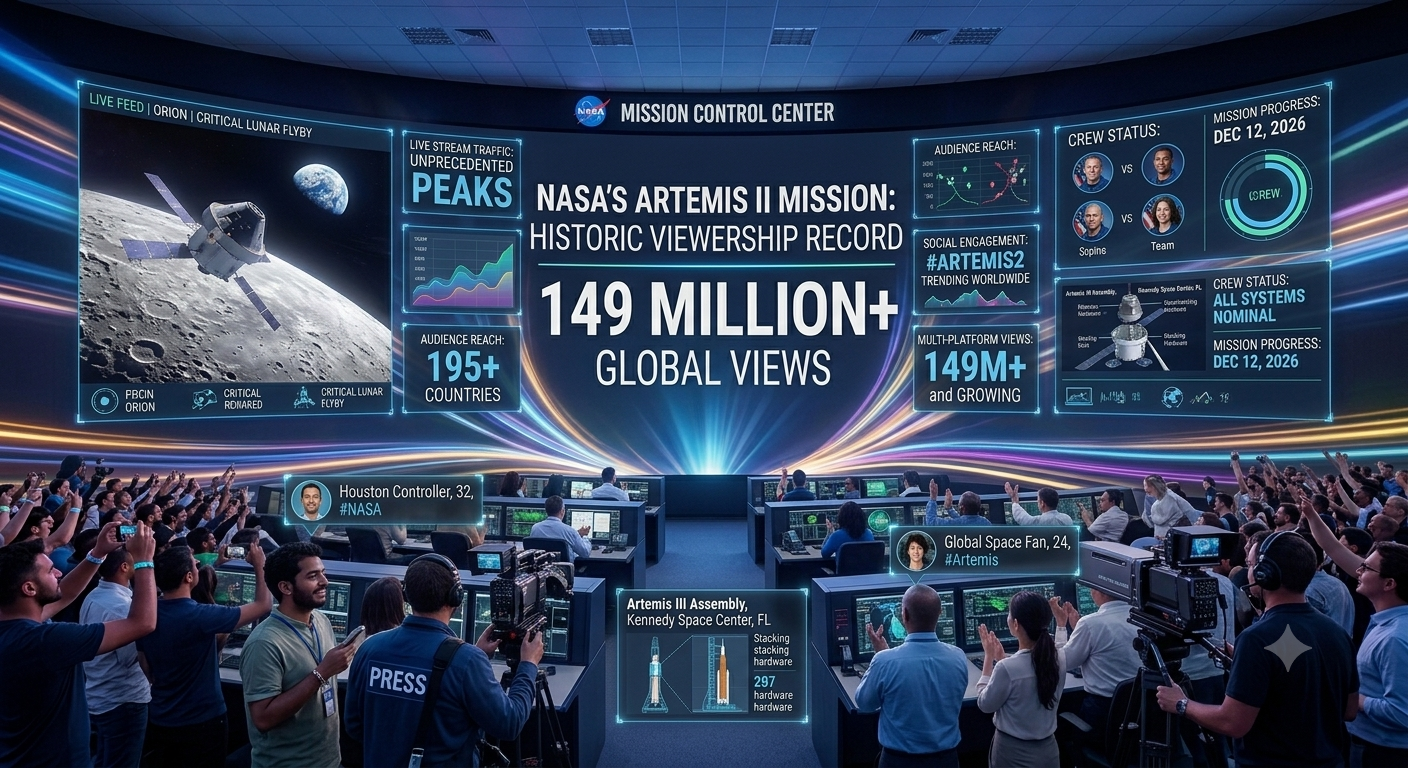
NASA recently announced that the official live coverage of Artemis II has achieved an extraordinary milestone, attracting approximately 149 million viewers worldwide across multiple digital platforms. This remarkable achievement has made the mission the most-watched live broadcast in the agency's history, surpassing previous records set by Mars rover landings, commercial crew launches, and other landmark space events.
The record-breaking audience demonstrates that public interest in human space exploration is stronger than ever. Millions of people from different countries, cultures, and age groups have followed the mission in real time, watching astronauts travel farther from Earth than any crew in more than five decades. Unlike previous generations that relied primarily on television broadcasts, today's audiences can experience every major mission event instantly through smartphones, tablets, computers, streaming services, and social media platforms.
This unprecedented engagement highlights how modern communication technology has transformed space exploration into a truly global experience. Whether someone is watching from New York, Tokyo, London, Islamabad, Sydney, or São Paulo, they can witness historic moments simultaneously and become part of a worldwide audience sharing the same excitement.
The Artemis Program and Humanity's Return to Deep Space
The Artemis program represents one of the most ambitious space initiatives ever undertaken. Developed by NASA in collaboration with numerous international partners and private aerospace companies, the program aims to establish a sustainable human presence on and around the Moon while preparing for future missions to Mars.
Unlike the Apollo missions of the twentieth century, which focused primarily on landing astronauts on the lunar surface, Artemis has a much broader vision. It seeks to create long-term infrastructure that will support continuous scientific research, technological innovation, and deep-space exploration for decades to come.
Artemis II is a particularly significant milestone because it is the first crewed mission of the program. While Artemis I successfully demonstrated the capabilities of the Orion spacecraft during an uncrewed lunar journey, Artemis II places human astronauts aboard the spacecraft for the first time, testing every critical system under real operational conditions.
The mission serves as a bridge between experimental testing and future lunar landings. Every maneuver, communication system, navigation procedure, environmental control system, and emergency protocol is being evaluated to ensure that future crews can safely travel to and from the Moon.
Because of this importance, millions of viewers around the world have followed every stage of the mission, understanding that they are witnessing history in the making.
Breaking Every Previous Streaming Record
NASA's official announcement that Artemis II generated approximately 149 million global views represents more than just an impressive statistic. It reflects a major transformation in how people consume scientific events and engage with space exploration.
Previous landmark missions, including Perseverance's landing on Mars and the first commercial crew launches to the International Space Station, attracted enormous audiences. However, Artemis II has surpassed them by an impressive margin.
Several factors contributed to this achievement.
First, the mission involves human astronauts rather than robotic spacecraft. Human stories naturally create stronger emotional connections. Viewers are not simply observing a machine traveling through space—they are following real people undertaking one of the most dangerous and inspiring journeys imaginable.
Second, NASA has dramatically expanded its digital media strategy. Instead of relying primarily on traditional television networks, the agency now broadcasts simultaneously through YouTube, X (formerly Twitter), Facebook, NASA+, educational websites, mobile applications, and numerous international media partners.
This multi-platform approach allows audiences to watch using whichever service they prefer, dramatically increasing accessibility.
Third, improvements in internet infrastructure and streaming technology have enabled millions of viewers to watch high-definition broadcasts without interruption, even in regions where live space coverage was previously difficult to access.
The combination of these factors has transformed Artemis II from a scientific mission into a truly global media event.
How Digital Technology Changed Space Broadcasting
The way space missions are presented to the public has changed dramatically over the past several decades.
During the Apollo era, television broadcasts were limited by the technology available at the time. Images were grainy, communication delays were common, and only a handful of television channels could provide live coverage.
Today's audiences enjoy a completely different experience.
NASA now utilizes ultra-high-definition cameras, sophisticated onboard communication systems, cloud-based streaming infrastructure, and real-time broadcasting technology capable of delivering stunning visuals from deep space.
The Orion spacecraft carries multiple internal and external cameras that provide viewers with breathtaking perspectives throughout the mission.
Inside the spacecraft, audiences can observe astronauts performing scientific experiments, conducting system checks, communicating with mission control, exercising to maintain physical health, and sharing personal reflections about life in deep space.
Outside the spacecraft, viewers witness spectacular images of Earth shrinking into the distance, the Moon growing larger during approach, and the incredible darkness of space stretching beyond human imagination.
These immersive visuals help audiences feel connected to the mission in ways that were impossible only a generation ago.