




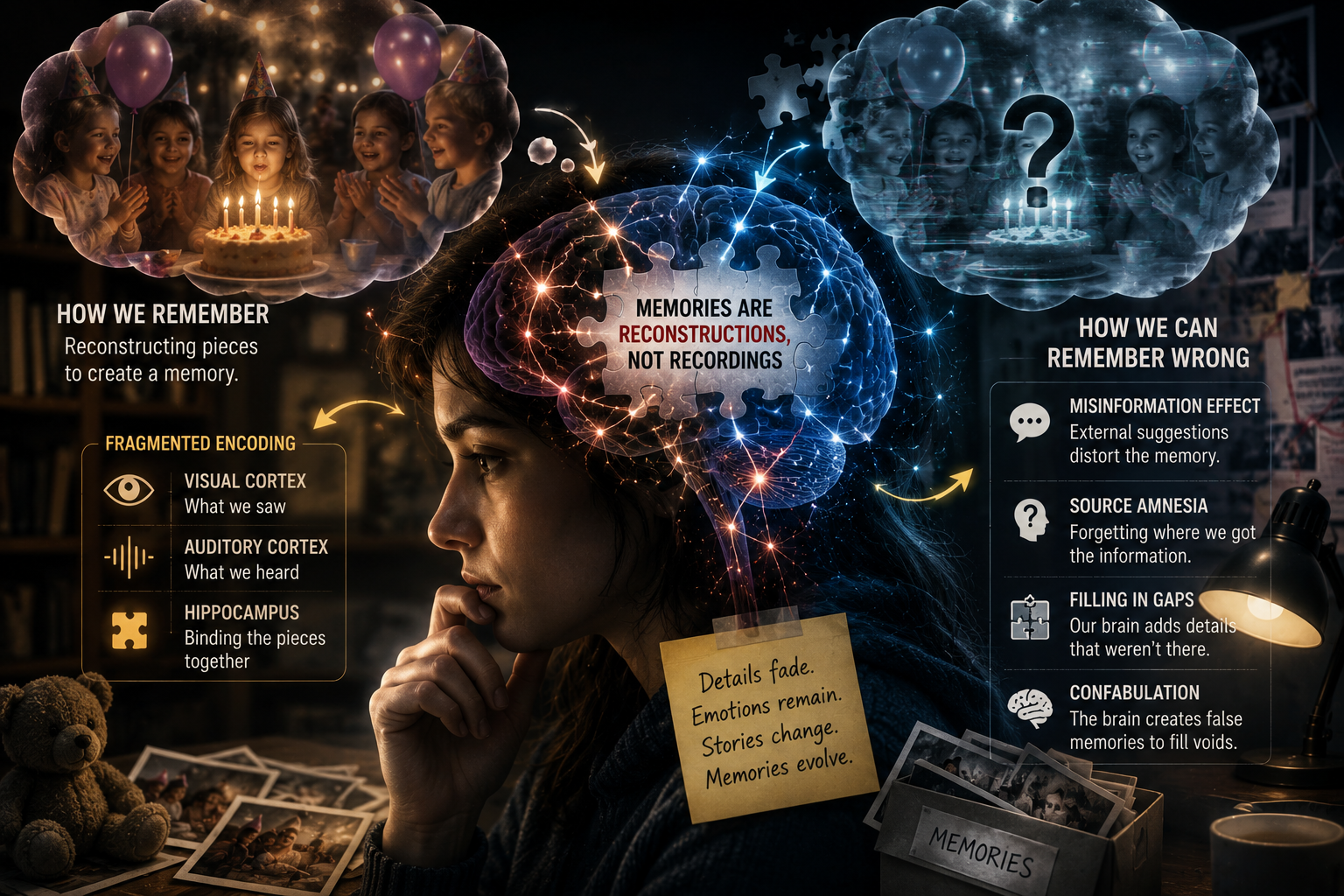
Close your eyes and think back to your fifth birthday party. Can you see the cake? Can you hear the laughter? Can you remember who was there? Now, hold onto that image. Is it possible... just possible... that it didn’t happen exactly the way you remember it?
For decades, we viewed human memory like a video recorder. We assumed our brains captured life events, stored them on a hard drive, and played them back perfectly upon request. But modern neuroscience has shattered that illusion. Our memories are not recordings; they are reconstructions. And in the process of reconstruction, your brain is remarkably prone to making things up. This article explores why your brain creates false memories—and why it might actually be a helpful feature, not a bug.
1. Memory Is Reconstructive, Not Reproductive
To understand false memories, you must first understand how memory works. When you form a memory of an event, you don’t store a single, unified snapshot. Instead, different parts of the event are stored in different areas of the cerebral cortex:
- The visual cortex stores what you saw.
- The auditory cortex stores what you heard.
- The hippocampus binds these fragments together into a single "file."
When you remember that fifth birthday party years later, your brain isn't just hitting "play." It is actively reassembling those fragmented pieces in the present moment. During this reassembly, the brain may accidentally fill in gaps with information learned *after* the event, or logically deduce what *should* have happened. This is where errors creep in.
2. The Power of Suggestion: The Misinformation Effect
False memories are surprisingly easy to plant. This is largely due to the misinformation effect, a concept famously studied by psychologist Elizabeth Loftus. The effect demonstrates that exposure to incorrect information *after* an event can contaminate our memory of that event.
Imagine you witness a car accident at an intersection. Later, a police officer asks, "How fast was the blue sedan going when it smashed into the red truck?" Even if the truck was actually gray, the simple suggestion of "smashed" can implant the false memory of a more violent impact than you actually witnessed. Your brain incorporates the suggestion into its reconstruction of the event.
3. Source Amnesia and Internal Confusion
Another major contributor to false memories is source amnesia. This occurs when you remember a piece of information but cannot correctly recall *where* you learned it.
For example, you might have a vivid memory of riding a rollercoaster as a child. You feel the wind; you remember the fear. Years later, your mother mentions that you never actually rode that rollercoaster; you were too short. You just saw it in a movie dozens of times. Your brain retained the emotional experience and the imagery but misattributed the source of the memory from "a film I saw" to "an event I lived."
4. Filling in the Blanks: Schemas and Priming
Our brains love coherence. We hate incomplete stories or confusing gaps in our timeline. To maintain a consistent sense of self and history, the brain uses schemas—mental frameworks for how the world works.
If you are asked to recall waiting in a dentist's office ten years ago, your brain might "remember" a stack of magazines on the table, even if there weren't any. Why? Because your brain accesses its "dentist office schema" and assumes there were magazines. This is an adaptive function; it allows us to navigate the world quickly. But it comes at the cost of strict memory accuracy.
5. The "Fringe" of False Memories: Confabulation
While most people experience minor memory distortions, severe cases occur in certain neurological conditions. Confabulation is the creation of fabricated, distorted, or misinterpreted memories about oneself or the world, without the conscious intention to deceive.
This is often seen in individuals with Korsakoff syndrome (caused by severe alcoholism) or damage to the frontal lobes of the brain. When asked what they did yesterday, these individuals may invent elaborate, impossible stories. Their brains are trying desperately to fill massive gaps in their actual memory, leading to wild—yet deeply believed—fabrications.
Conclusion: A Feature, Not a Bug?
Learning that our memories are fallible can be unsettling. Eyewitness testimony—the cornerstone of the legal system—is far less reliable than we once thought. However, the reconstructive nature of memory is not necessarily a defect.
A perfect, photographic memory would be overwhelmed with useless data. Our brains are built to extract the *gist* of an experience to help us learn and survive. The ability to generalize, fill in blanks, and adapt past information to new situations is crucial for creativity and problem-solving. False memories are the unintended tax we pay for a highly creative, flexible, and efficient mind. So the next time you and an old friend argue over what *really* happened in high school, remember: both of your brains are telling slightly different stories, and neither is entirely true.