



For the past few years, the artificial intelligence revolution has felt distant, massive, and entirely dependent on colossal data centers. Whenever we asked a chatbot a complex question, generated a digital image, or summarized a lengthy document, invisible server farms burning through megawatts of electricity in remote deserts did the heavy lifting. Your phone functioned merely as a remote control—a fragile glass window peering into a distant digital brain.
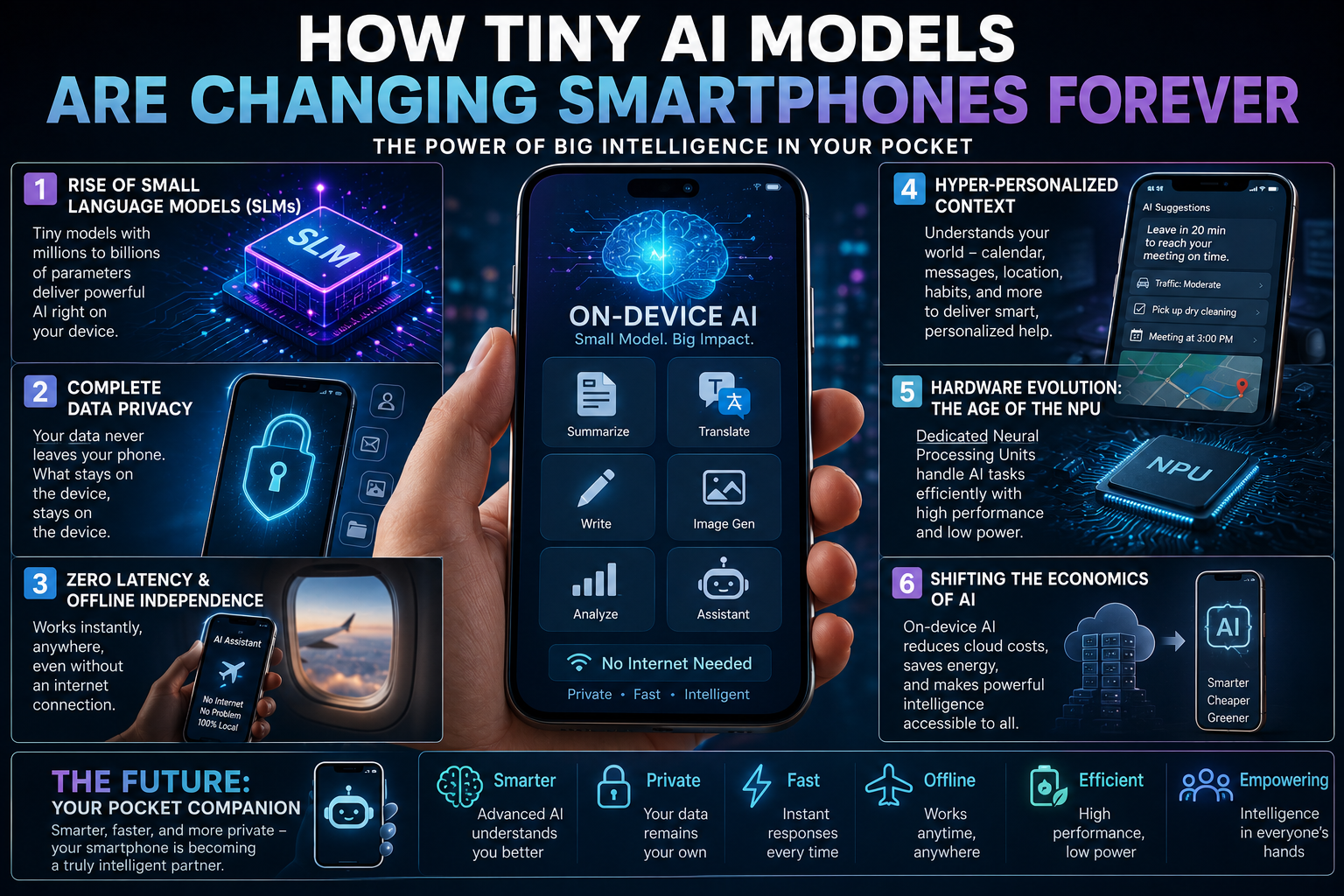
That paradigm is experiencing a seismic shift. A quiet, lightning-fast revolution is unfolding directly inside our pockets. Fueled by the rapid maturation of Small Language Models (SLMs) and specialized neural processing units (NPUs) built into modern mobile chips, smartphones are no longer just connected windows to the cloud. They are becoming genuinely autonomous, intelligent local entities. Here is how tiny AI models are changing smartphones forever.
1. The Rise of Small Language Models (SLMs): Punching Above Their Weight
For a long time, conventional wisdom in tech assumed that bigger was always better. Massive Large Language Models (LLMs) featuring hundreds of billions of parameters demanded server racks filled with high-end graphics cards to operate. However, the tech industry has pivoted sharply toward optimization, quantization, and distillation.
Enter Small Language Models—compact neural networks ranging from a few hundred million to a few billion parameters. Families of models like Google’s Gemini Nano, Gemma variants, and LLaMA edge editions prove that you do not need a trillion parameters to achieve exceptional utility. Through clever architectural choices like grouped-query attention and weight quantization, these tiny models pack astonishing reasoning, summarization, and contextual comprehension skills into packages light enough to live entirely within a mobile operating system.
2. Complete Data Privacy: What Stays on the Device, Stays on the Device
One of the most profound consumer anxieties surrounding the initial wave of cloud-based generative AI was data privacy. Handing over personal emails, confidential business notes, medical questions, and private photos to third-party servers raised major security red flags.
On-device tiny AI models completely eliminate this vulnerability. Because inference—the process where an AI model generates responses or analyzes data—happens entirely locally on your phone’s silicon chip, your personal information never leaves your device. Whether you are drafting a sensitive message, analyzing private financial records, or organizing personal journal entries, local SLMs ensure absolute confidentiality. Your data remains yours, shielded behind your phone's hardware-level security vault.
3. Zero Latency and Total Offline Independence
We have all experienced the deep frustration of watching a spinning loading wheel or receiving a "network error" notification while trying to use cloud apps in a crowded subway station, deep inside an airplane, or out in rural areas with poor cellular coverage.
Cloud-dependent AI is fundamentally tethered to internet connectivity and server queue loads. In contrast, tiny models running directly on mobile hardware operate with virtually zero latency. Because there are no round-trip data packets traveling back and forth across cellular towers to a remote server farm, responses happen in milliseconds. Furthermore, your phone's AI intelligence functions seamlessly anywhere on Earth—even in airplane mode at 35,000 feet.
4. Hyper-Personalized Context and Predictive Intelligence
True intelligence requires deep context. Cloud AI assistants often struggle to understand your unique daily rhythm because they lack immediate access to your hyper-local device state due to privacy boundaries.
With local SLMs integrated natively into mobile operating systems, the AI has real-time access to your contextual ecosystem: your calendar appointments, recent location history, text message threads, photo galleries, and app usage patterns. Instead of offering generic web answers, a localized assistant can answer complex multi-layered prompts like: "How early do I need to leave for my afternoon meeting, considering my current location, local traffic delays, and the fact that I need to pick up dry cleaning first?" The model synthesizes this information locally, instantly, and accurately.
5. Hardware Evolution: The Age of the NPU
This software revolution would be impossible without a corresponding leap in mobile hardware architecture. Modern smartphone system-on-chips (SoCs)—such as advanced Snapdragon, Apple Silicon, and MediaTek processors—now come equipped with dedicated Neural Processing Units (NPUs).
These specialized hardware cores are custom-built to handle parallel matrix math equations required by neural networks with exceptional energy efficiency. While running heavy AI tasks used to drain a phone battery within an hour a few years ago, modern NPUs execute billions of operations per second (TOPS) while sipping minimal power. This ensures that continuous background AI processing doesn't sacrifice everyday battery longevity.
6. Shifting the Economics of Artificial Intelligence
Beyond consumer convenience, the shift toward tiny on-device models fundamentally alters the macroeconomic landscape of the tech industry. Running massive cloud data centers for millions of daily user queries carries staggering capital costs, infrastructure demands, and energy consumption footprints.
By pushing routine inference tasks down to billions of consumer handsets, tech companies offload computation onto hardware that consumers have already purchased and powered. This distributed computing model makes scaling generative AI economically sustainable, lowering operating costs for software developers while delivering faster, more reliable service to end-users.
Conclusion: The Intelligent Pocket Companion
Smartphones spent the last decade connecting us to the wider world via static apps and web browsers. Now, driven by the quiet triumph of tiny artificial intelligence models, they are transforming into deeply intuitive, private, and lightning-fast cognitive partners.
As these models continue to shrink in physical size while expanding in computational capability, the boundary between human thought and digital action will continue to blur. The smartphone in your pocket is no longer just a clever tool; thanks to edge AI, it is truly coming alive.