





Samsung Formally Announces Galaxy Unpacked July 2026: AI Foldables to Take Center Stage in London

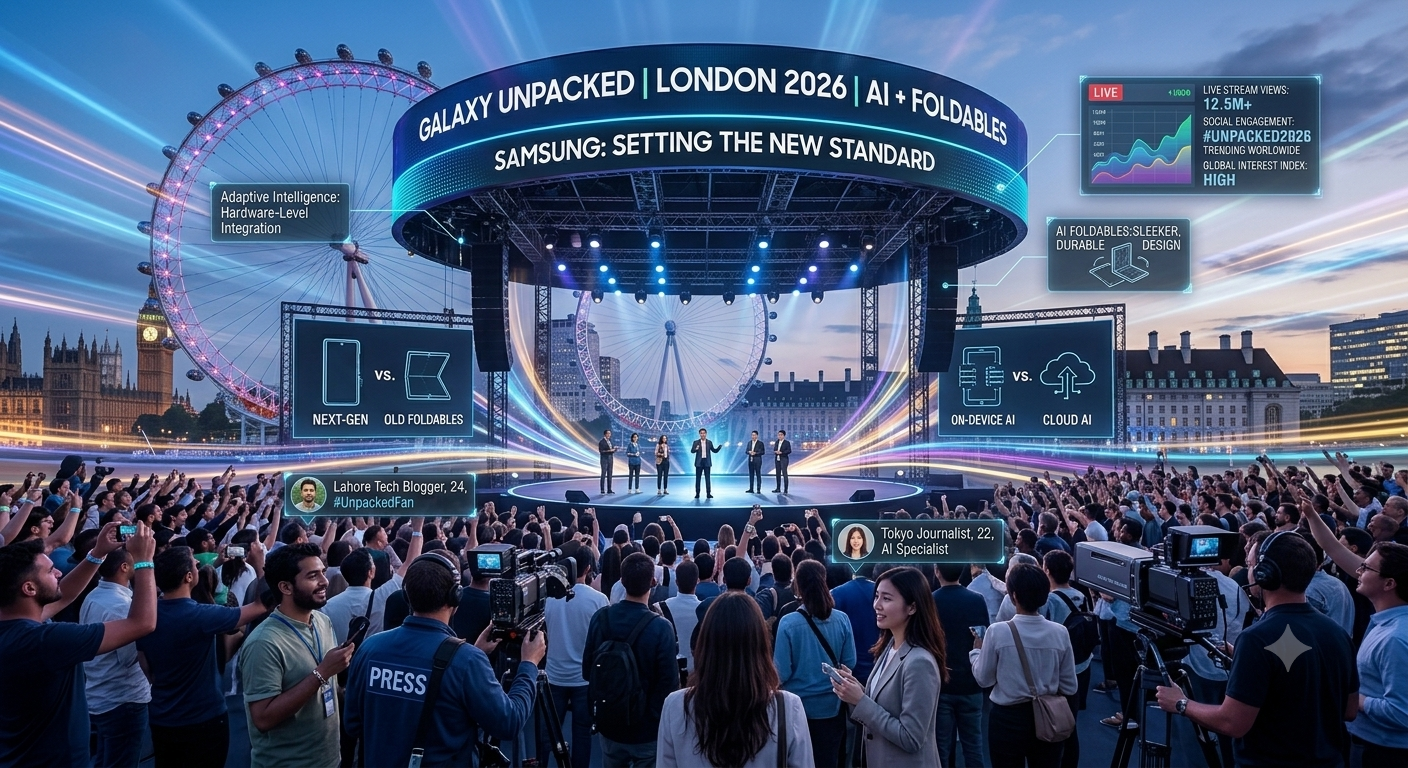
Samsung Electronics has officially confirmed its next Galaxy Unpacked event for July 22, 2026, in London, promising to set a new standard for mobile AI and next-generation foldables.

Samsung Formally Announces Galaxy Unpacked July 2026: AI Foldables to Take Center Stage in London

The Next Chapter of Foldables

The smartphone industry is entering another major phase of innovation as Samsung Electronics prepares to unveil its next generation of Galaxy devices during the highly anticipated Galaxy Unpacked 2026 event on July 22, 2026. This year's launch carries extra significance as Samsung shifts the event to London, United Kingdom, a city recognized for influencing global technology, fashion, and lifestyle trends. Rather than simply introducing new smartphones, Samsung is expected to present its broader vision for the future of mobile computing, where foldable hardware and artificial intelligence work together to create more intuitive, productive, and personalized digital experiences.

Over the past several years, Samsung has established itself as the market leader in foldable smartphones. With every generation, the company has refined display durability, hinge engineering, software optimization, and multitasking capabilities. The upcoming Galaxy Unpacked event is expected to continue that momentum by introducing slimmer designs, lighter materials, stronger folding mechanisms, and smarter software integration. Industry analysts believe these improvements could further strengthen Samsung's position as the dominant force in the premium foldable smartphone market while encouraging wider consumer adoption across the globe.

The Evolution of Foldable Technology

Foldable smartphones have evolved from experimental concepts into practical flagship devices. Samsung's latest generation is expected to focus on improving nearly every aspect of the user experience while making foldables more reliable for everyday use.

One of the biggest anticipated upgrades is a redesigned hinge mechanism that allows the device to fold more smoothly while reducing the visible crease across the display. Engineers are also expected to introduce stronger ultra-thin glass combined with improved protective layers, making the screens more resistant to scratches and accidental damage.

Battery efficiency is also likely to receive significant attention. New processors built using advanced manufacturing technologies are expected to deliver higher performance while consuming less power, allowing users to enjoy longer battery life despite increasingly powerful hardware.

Camera systems may also receive flagship-level improvements through upgraded image sensors, advanced computational photography, and AI-powered image processing that automatically adjusts lighting, color balance, and detail for professional-quality photos and videos.

Artificial Intelligence Takes Center Stage

The defining theme of Galaxy Unpacked 2026 is expected to be Galaxy AI. Rather than treating artificial intelligence as an optional software feature, Samsung appears to be integrating AI directly into the core operating experience.

The upcoming devices are expected to feature powerful on-device AI models capable of performing complex tasks without relying entirely on cloud servers. This approach improves speed, enhances privacy, and allows many intelligent features to work even without an internet connection.

Some of the anticipated AI capabilities include:

  • Adaptive User Experience: The device may automatically adjust its interface depending on whether it is folded, unfolded, or placed in Flex Mode, ensuring the most efficient layout for every situation.
  • Smarter Productivity Tools: AI is expected to assist with multitasking by predicting frequently used applications, organizing split-screen layouts, summarizing documents, and simplifying workflow management.
  • Real-Time Communication: Advanced translation, live transcription, AI-assisted writing, and conversation summarization could become even faster and more accurate through dedicated AI processors.
  • Creative Assistance: Built-in AI image editing, object removal, background enhancement, and intelligent video editing tools may allow users to create professional-quality content directly from their smartphones.

Samsung's long-term strategy appears focused on making AI an invisible assistant that works quietly in the background to improve every interaction without requiring constant user input.

Designed for Productivity and Everyday Use

Samsung's foldable lineup has always targeted users who demand more than traditional smartphones can offer. The larger internal displays provide tablet-like productivity while maintaining pocket-sized portability.

With improved multitasking software, users are expected to run multiple applications simultaneously, drag and drop content between windows, edit documents while participating in video meetings, and browse the web without constantly switching between apps.

Business professionals may particularly benefit from enhanced integration with Samsung DeX, allowing foldable devices to function as desktop workstations when connected to external displays. Combined with AI-powered workflow optimization, these features could further position foldables as powerful productivity tools for both enterprise users and content creators.

Expanding the Galaxy Ecosystem

Galaxy Unpacked is expected to showcase more than smartphones. Samsung continues building a connected ecosystem where phones, tablets, laptops, smartwatches, earbuds, smart TVs, and home appliances communicate seamlessly with one another.

Improved synchronization between Galaxy devices may allow users to transfer files instantly, continue tasks across multiple screens, receive intelligent device recommendations, and manage smart home products through a unified AI-powered interface.

Health tracking is also expected to become more intelligent, with Galaxy wearables providing deeper wellness insights that integrate directly with smartphones to deliver personalized fitness, sleep, and health recommendations.

Global Launch and Availability

Samsung will livestream Galaxy Unpacked worldwide from London on July 22, 2026. Viewers across the globe will be able to watch the announcements live through Samsung's official website, Samsung Newsroom, and the company's YouTube channel.

Following the presentation, pre-orders are expected to open shortly after the event, with global availability beginning in major markets over the following weeks. Industry analysts anticipate strong demand, particularly for Samsung's latest foldable flagship models and AI-powered Galaxy ecosystem products.

Looking Ahead

Galaxy Unpacked 2026 represents more than another annual smartphone launch—it reflects Samsung's vision for the future of personal technology. By combining increasingly refined foldable hardware with powerful on-device artificial intelligence, the company aims to redefine how people work, communicate, create content, and interact with their devices throughout the day.

As competition in the smartphone industry continues to intensify, Samsung's focus on flexible displays, intelligent software, and ecosystem integration positions the company to remain at the forefront of mobile innovation. If expectations are met, this year's Galaxy Unpacked event could become one of the most influential technology launches of 2026, setting new standards for what consumers expect from the next generation of smart devices.
Quick Summary

Samsung Electronics has officially confirmed its next Galaxy Unpacked event for July 22, 2026, in London, promising to set a new standard for mobile AI and next-generation foldables.

Key Takeaways

  • Adaptive User Experience: The device may automatically adjust its interface depending on whether it is folded, unfolded, or placed in Flex Mode, ensuring the most efficient layout for every situation.
  • Smarter Productivity Tools: AI is expected to assist with multitasking by predicting frequently used applications, organizing split-screen layouts, summarizing documents, and simplifying workflow management.
  • Real-Time Communication: Advanced translation, live transcription, AI-assisted writing, and conversation summarization could become even faster and more accurate through dedicated AI processors.
  • Creative Assistance: Built-in AI image editing, object removal, background enhancement, and intelligent video editing tools may allow users to create professional-quality content directly from their smartphones.

Quick Facts

Category: Technology
Published: July 13, 2026
Updated: October 7, 2026
Reading time: 5 min
1,374 views
Updated Oct 7, 2026 5 min read

Related Articles

View all
The 2026 Smartphone Divide: iPhone vs. Android Technology
News Technology

The 2026 Smartphone Divide: iPhone vs. Android

As we move through 2026, the long-standing rivalry between iOS and Android has evolved. While both platforms are more capable and secure than ever, they serve fundamentally different philosophies: Apple’s curated ecosystem versus Android’s open-source flexibility.

Orwell, George 9 min 293

Popular

View all

Mixed Content

Technology
News Technology

The Post-Automation Economy: Architecting Human Skill Premiums in the Age of Autonomy

The rapid proliferation of agentic workflows and large action models is structurally inverting the traditional corporate skill pyramid. While routine analytical processes and information retrieval tasks are being automated into low-cost utility, uncommoditizable human traits—emotional intelligence, strategic ambiguity management, and ethical governance—are commanding an unprecedented value premium. Succeeding in the post-automation enterprise requires re-engineering workforce development to focu

Mutwassim 3 min 72
The Decline of Friction: Inside the FinTech Revolution in Cross-Border Settlement and Digital Identity Technology
News Technology

The Decline of Friction: Inside the FinTech Revolution in Cross-Border Settlement and Digital Identity

The traditional plumbing of global finance—characterized by multi-day delays, hidden fees, and fragmented identity silo—is undergoing a profound transformation. A new generation of FinTech architectures, combining distributed ledger technology (DLT), synchronized liquidity pools, and decentralized digital passports, is enabling cross-border instant payments with near-zero friction.

Mutwassim 1 min 44
The City as a Switch: Architecting IoT Logistics for the Post-Congestion Urban Era Technology
News Technology

The City as a Switch: Architecting IoT Logistics for the Post-Congestion Urban Era

The traditional model of urban delivery—reliant on high-emission diesel vans navigating static street grids—is creating unsustainable levels of congestion and pollution in global metros. To reclaim urban space, cities are transitioning to IoT-orchestrated logistics. This data-driven framework utilizes autonomous delivery swarms, automated micro-fulfillment centers, and dynamic digital kerb-side management to route goods with the efficiency of internet packets, transforming static streets into fl

Mutwassim 4 min 71
Beyond the Coffee Shop: How Cross-Border Employment and Sovereign Visas Are Institutionalizing Remote Work Technology
News Technology

Beyond the Coffee Shop: How Cross-Border Employment and Sovereign Visas Are Institutionalizing Remote Work

Remote work is transitioning from an informal perk into an institutionalized pillar of international commerce. Over 60 nations have launched dedicated digital nomad visa regimes, while multi-jurisdictional compliance platforms and Employer of Record (EOR) frameworks dismantle traditional geographic barriers. As knowledge workers disperse globally, enterprises and municipal governments are formalizing policies around tax residency, permanent establishment risk, and asynchronous operational workfl

Mutwassim 3 min 71
The Death of Syntax: Inside the Shift to Intent-Driven Software Engineering Technology
News Technology

The Death of Syntax: Inside the Shift to Intent-Driven Software Engineering

The day-to-day discipline of software engineering is undergoing its most radical abstraction leap since the transition from assembly language to high-level compilers. Generative code synthesis and deterministic reasoning engines are automating boilerplate syntax, turning software developers into systems architects. Survival in this new paradigm demands mastering intent formalization, specification design, and continuous verification.

Mutwassim 3 min 71
The Post-Visual Threat: Architecting Zero-Trust Defense Against Weaponized Deepfakes Technology
News Technology

The Post-Visual Threat: Architecting Zero-Trust Defense Against Weaponized Deepfakes

The rapid weaponization of real-time voice cloning and synthetic video generation has transformed social engineering from opportunistic phishing into targeted executive identity emulation. High-profile incidents involving multi-million-dollar wire transfers authorized via synthetic video calls prove that sight and sound can no longer authenticate authorization. Securing modern enterprises requires an uncompromising zero-trust identity layer capable of neutralizing synthetic deception.

Mutwassim 3 min 140
Beyond the Battery: How Electric Mobility Is Forcing a Overhaul of the Global Power Grid Technology
News Technology

Beyond the Battery: How Electric Mobility Is Forcing a Overhaul of the Global Power Grid

The global transition toward electric vehicles is no longer constrained primarily by battery chemistry or vehicle range. Instead, the real bottleneck has shifted directly to the electrical grid. As commercial fleets and passenger cars electrify at scale, utilities and city planners are racing to deploy vehicle-to-grid (V2G) bidirectional systems, AI-driven dynamic load balancers, and decentralized microgrid storage to avoid grid failure.

Mutwassim 3 min 58
Cloud 3.0: The Shift Toward Sovereign Data Architectures and Edge Computing Technology
News Technology

Cloud 3.0: The Shift Toward Sovereign Data Architectures and Edge Computing

The architectural assumption that enterprise compute and storage should reside in a handful of centralized hyperscaler data centers is fracturing. Driven by strict cross-border data sovereignty regulations and the demand for millisecond-latency AI inference, global IT leaders are pivoting to Cloud 3.0—a model centered on distributed, locally governed, and hybrid sovereign architectures.

Mutwassim 3 min 62