





Beyond the Battery: How Electric Mobility Is Forcing a Overhaul of the Global Power Grid

Mass EV adoption and heavy commercial fleet electrification are transforming power distribution from a static utility model to a bidirectional digital smart grid.

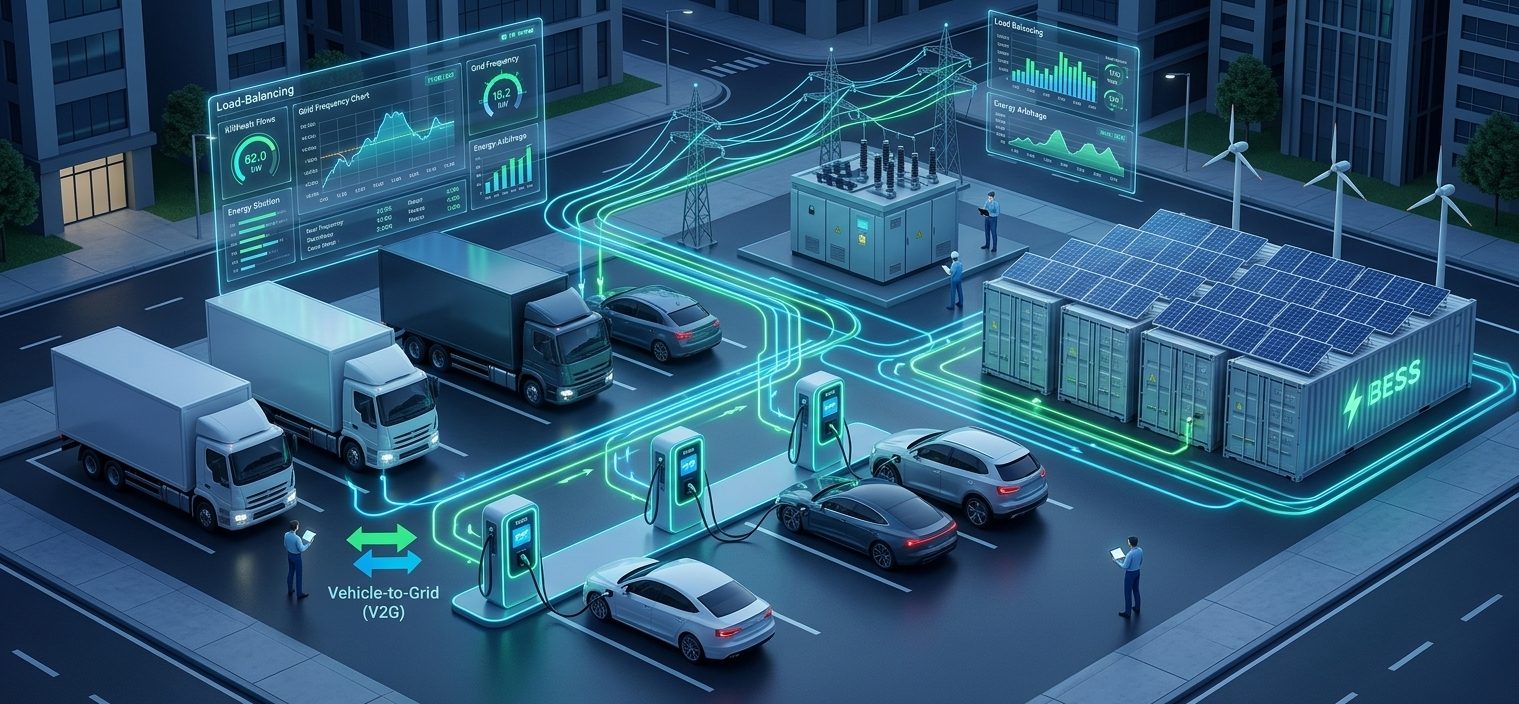
Isometric view of commercial electric vehicles plugged into smart bidirectional charging stations powered by solar and battery storage.
A modern electric fleet charging depot integrating solar arrays, local battery storage, and dynamic vehicle-to-grid energy routing. CleanTech Global / Mobility Archive

Over the past decade, the global conversation surrounding electric mobility focused on a few core consumer concerns: driving range, public charging station density, and battery cell chemistry. As lithium-iron-phosphate (LFP) and solid-state battery innovations push range envelopes past acceptable thresholds and fast-charging rates drop below twenty minutes, the primary friction point has migrated downstream.

The defining bottleneck of modern electrification is no longer the vehicle itself—it is the municipal power grid.

The legacy electrical grid was engineered around predictable, unidirectional generation: power was produced at centralized coal, gas, or nuclear facilities, stepped down through substations, and delivered as passive current to homes and commercial facilities. The mass influx of multi-megawatt heavy-duty fleet depots and residential fast chargers is breaking this static architecture, driving an urgent transition toward next-generation smart grid infrastructure.

The Concurrency Crisis: Managing Megawatt Demand Spikes

Charging a single commercial electric truck can pull up to 1 megawatt of instantaneous power—equivalent to the peak electrical demand of a small town. When hundreds of passenger EVs plug in simultaneously during post-work hours or an entire distribution fleet charges overnight, local substations face extreme phase imbalances and thermal overload.

Expanding the physical grid with thicker copper lines and bigger transformers alone is cost-prohibitive and structurally slow; permitting and constructing new high-voltage transmission lines regularly spans 5 to 10 years.

To bridge this infrastructure lag, utilities are deploying intelligent software and edge hardware solutions:

  • Dynamic Time-of-Use and Automated Load Shedding: Modern charging software interfaces directly with utility pricing signals, automatically throttling or staggering charging speeds to match renewable generation peaks and avoid evening demand spikes.

  • Co-Located Battery Energy Storage Systems (BESS): Charging hubs increasingly integrate on-site stationary battery packs. These units slowly accumulate power from the grid during off-peak hours and discharge rapidly to support high-speed vehicle charging without pulling directly from strained local substations.

  • Behind-the-Meter Solar Microgrids: Industrial logistics parks are pairing rooftop photovoltaic arrays with localized DC microgrids, allowing commercial fleets to generate and consume green energy on-site with minimal grid interaction.

Vehicle-to-Grid (V2G): Transforming Fleets into Distributed Power Plants

The most transformative aspect of Cloud and grid modernization in clean mobility is bidirectional power flow, widely known as Vehicle-to-Grid (V2G).

Historically, parked vehicles represented idle capital. Under a bidirectional paradigm, an EV connected to a smart charger functions as a decentralized battery asset. During periods of extreme heatwaves or winter peak loads, thousands of parked EVs can feed kilowatt-hours back into regional distribution lines to stabilize frequency and prevent rolling blackouts.

In return, fleet operators and vehicle owners are financially compensated through automated energy arbitrage—purchasing cheap power when renewable generation is high and selling it back at a premium during supply crunches.

The Data Backbone of Modern Energy Orchestration

Synchronizing millions of mobile, high-voltage batteries with fluctuating solar and wind supplies demands massive telemetry ingestion:

  • Predictive AI Dispatch: Machine learning models forecast localized vehicle departure times, historical travel routes, and driver habits to ensure every vehicle is fully charged by shift departure while maximizing grid support windows.

  • Standardized Communication Protocols: Adoption of universal standards like ISO 15118 enables automated "Plug & Charge" authentication, bidirectional cryptographic handshakes, and frictionless micro-billing between vehicles and charging networks.

The future of electric transportation is inseparable from the modernization of energy distribution. The automotive revolution and the clean energy transition are converging into a single, software-orchestrated ecosystem—one where the vehicles on our roads serve as the distributed energy storage network of tomorrow.

Quick Summary

The global transition toward electric vehicles is no longer constrained primarily by battery chemistry or vehicle range. Instead, the real bottleneck has shifted directly to the electrical grid. As commercial fleets and passenger cars electrify at scale, utilities and city planners are racing to deploy vehicle-to-grid (V2G) bidirectional systems, AI-driven dynamic load balancers, and decentralized microgrid storage t...

Key Takeaways

  • Dynamic Time-of-Use and Automated Load Shedding: Modern charging software interfaces directly with utility pricing signals, automatically throttling or staggering charging speeds to match renewable generation peaks and avoid evening demand spikes.
  • Co-Located Battery Energy Storage Systems (BESS): Charging hubs increasingly integrate on-site stationary battery packs. These units slowly accumulate power from the grid during off-peak hours and discharge rapidly to support high-speed vehicle charging without pulling directly from strained local substations.
  • Behind-the-Meter Solar Microgrids: Industrial logistics parks are pairing rooftop photovoltaic arrays with localized DC microgrids, allowing commercial fleets to generate and consume green energy on-site with minimal grid interaction.
  • Predictive AI Dispatch: Machine learning models forecast localized vehicle departure times, historical travel routes, and driver habits to ensure every vehicle is fully charged by shift departure while maximizing grid support windows.
  • Standardized Communication Protocols: Adoption of universal standards like ISO 15118 enables automated "Plug & Charge" authentication, bidirectional cryptographic handshakes, and frictionless micro-billing between vehicles and charging networks.

Quick Facts

Category: Technology
Published: September 4, 2026
Updated: September 4, 2026
Reading time: 3 min
Updated Sep 4, 2026 3 min read

Related Articles

View all
The 2026 Smartphone Divide: iPhone vs. Android Technology
Article Technology

The 2026 Smartphone Divide: iPhone vs. Android

As we move through 2026, the long-standing rivalry between iOS and Android has evolved. While both platforms are more capable and secure than ever, they serve fundamentally different philosophies: Apple’s curated ecosystem versus Android’s open-source flexibility.

Orwell, George 9 min 258

Mixed Content

The Post-Visual Threat: Architecting Zero-Trust Defense Against Weaponized Deepfakes Technology
Article Technology

The Post-Visual Threat: Architecting Zero-Trust Defense Against Weaponized Deepfakes

The rapid weaponization of real-time voice cloning and synthetic video generation has transformed social engineering from opportunistic phishing into targeted executive identity emulation. High-profile incidents involving multi-million-dollar wire transfers authorized via synthetic video calls prove that sight and sound can no longer authenticate authorization. Securing modern enterprises requires an uncompromising zero-trust identity layer capable of neutralizing synthetic deception.

Mutwassim 3 min 0
Cloud 3.0: The Shift Toward Sovereign Data Architectures and Edge Computing Technology
Article Technology

Cloud 3.0: The Shift Toward Sovereign Data Architectures and Edge Computing

The architectural assumption that enterprise compute and storage should reside in a handful of centralized hyperscaler data centers is fracturing. Driven by strict cross-border data sovereignty regulations and the demand for millisecond-latency AI inference, global IT leaders are pivoting to Cloud 3.0—a model centered on distributed, locally governed, and hybrid sovereign architectures.

Mutwassim 3 min 0
Beyond Offshoring: The Strategic Pivot to Multi-Hub Sourcing and Nearshore Resilience Technology
Article Technology

Beyond Offshoring: The Strategic Pivot to Multi-Hub Sourcing and Nearshore Resilience

The era of hyper-optimized, single-country manufacturing has come to an end. Faced with regulatory friction, geopolitical realignment, and maritime chokepoint vulnerabilities, global corporations are trading the narrow margins of ultra-lean offshoring for redundant, regionalized production networks. This strategic decoupling is fundamentally rewriting global trade routes and capital expenditure priorities.

Mutwassim 3 min 0
The Rise of Autonomous Agentic Workflows: How Multi-Agent Systems Are Redefining Enterprise Operations Technology
Article Technology

The Rise of Autonomous Agentic Workflows: How Multi-Agent Systems Are Redefining Enterprise Operations

The generative AI paradigm is shifting from conversational assistants to goal-driven multi-agent architectures. Rather than waiting for manual inputs at every stage, autonomous agentic workflows now orchestrate complex reasoning, call external APIs, self-correct errors, and execute end-to-end tasks across distributed software ecosystems.

Mutwassim 3 min 0
Technology
Article Technology

The Edge Energy Revolution: How Silicon-Level Power Optimization and Next-Gen Battery Chemistries Are Redefining Modern Mobility and Connected Devices

Compute power has scaled dramatically over the last decade, but battery capacity and thermal limits have struggled to keep up. Now, a combined wave of high-density solid-state batteries, intelligent silicon power management, and local edge efficiency is closing the gap for electric vehicles, smartphones, and industrial sensors.

Mutwassim 9 min 15
The Quantum Infiltration Defense: Why Post-Quantum Cryptography (PQC) and Cryptographic Agility Are the Defining Cyber Battleground Technology
Article Technology

The Quantum Infiltration Defense: Why Post-Quantum Cryptography (PQC) and Cryptographic Agility Are the Defining Cyber Battleground

Public-key infrastructure is undergoing its most significant structural replacement in modern computing history. With NIST post-quantum standards finalized and adversaries executing large-scale data harvesting campaigns, global enterprises are transitioning from theoretical quantum awareness to full-scale post-quantum cryptographic migrations.

Mutwassim 9 min 16
One Piece Film God Valley: 2027 Movie, BAAD & What We Know Technology
Article Technology

One Piece Film God Valley: 2027 Movie, BAAD & What We Know

One Piece is getting two new theatrical movies. ONE PIECE FILM GOD VALLEY is scheduled for summer 2027, while ONE PIECE FILM BAAD is set for 2029. FindEdition breaks down the announcement, God Valley’s importance, the 2027 release window, what is known about BAAD, and what fans should expect next.

Agatha Christie 11 min 31