





Over the past decade, the global conversation surrounding electric mobility focused on a few core consumer concerns: driving range, public charging station density, and battery cell chemistry. As lithium-iron-phosphate (LFP) and solid-state battery innovations push range envelopes past acceptable thresholds and fast-charging rates drop below twenty minutes, the primary friction point has migrated downstream.
The defining bottleneck of modern electrification is no longer the vehicle itself—it is the municipal power grid.
The legacy electrical grid was engineered around predictable, unidirectional generation: power was produced at centralized coal, gas, or nuclear facilities, stepped down through substations, and delivered as passive current to homes and commercial facilities. The mass influx of multi-megawatt heavy-duty fleet depots and residential fast chargers is breaking this static architecture, driving an urgent transition toward next-generation smart grid infrastructure.
The Concurrency Crisis: Managing Megawatt Demand Spikes
Charging a single commercial electric truck can pull up to 1 megawatt of instantaneous power—equivalent to the peak electrical demand of a small town. When hundreds of passenger EVs plug in simultaneously during post-work hours or an entire distribution fleet charges overnight, local substations face extreme phase imbalances and thermal overload.
Expanding the physical grid with thicker copper lines and bigger transformers alone is cost-prohibitive and structurally slow; permitting and constructing new high-voltage transmission lines regularly spans 5 to 10 years.
To bridge this infrastructure lag, utilities are deploying intelligent software and edge hardware solutions:
Dynamic Time-of-Use and Automated Load Shedding: Modern charging software interfaces directly with utility pricing signals, automatically throttling or staggering charging speeds to match renewable generation peaks and avoid evening demand spikes.
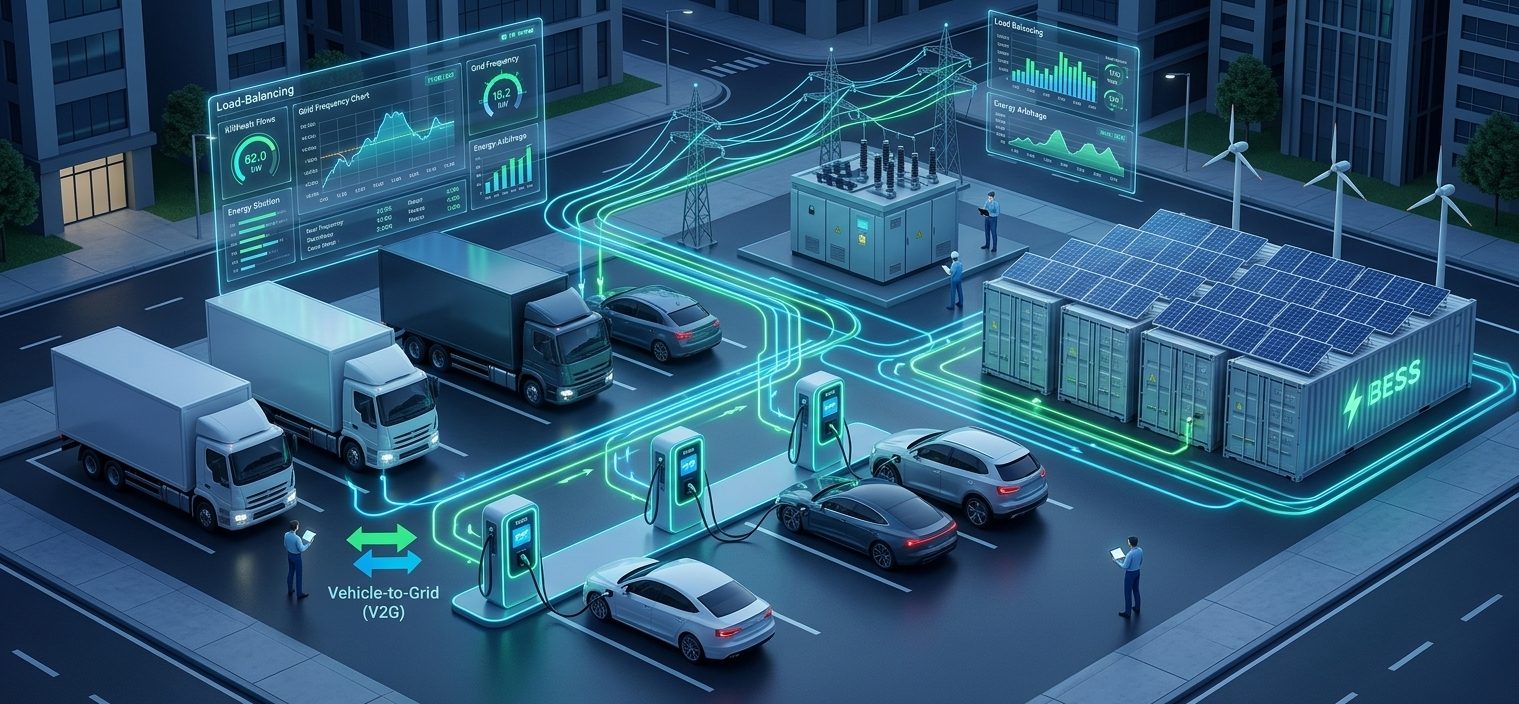
Co-Located Battery Energy Storage Systems (BESS): Charging hubs increasingly integrate on-site stationary battery packs. These units slowly accumulate power from the grid during off-peak hours and discharge rapidly to support high-speed vehicle charging without pulling directly from strained local substations.
Behind-the-Meter Solar Microgrids: Industrial logistics parks are pairing rooftop photovoltaic arrays with localized DC microgrids, allowing commercial fleets to generate and consume green energy on-site with minimal grid interaction.
Vehicle-to-Grid (V2G): Transforming Fleets into Distributed Power Plants
The most transformative aspect of Cloud and grid modernization in clean mobility is bidirectional power flow, widely known as Vehicle-to-Grid (V2G).
Historically, parked vehicles represented idle capital. Under a bidirectional paradigm, an EV connected to a smart charger functions as a decentralized battery asset. During periods of extreme heatwaves or winter peak loads, thousands of parked EVs can feed kilowatt-hours back into regional distribution lines to stabilize frequency and prevent rolling blackouts.
In return, fleet operators and vehicle owners are financially compensated through automated energy arbitrage—purchasing cheap power when renewable generation is high and selling it back at a premium during supply crunches.
The Data Backbone of Modern Energy Orchestration
Synchronizing millions of mobile, high-voltage batteries with fluctuating solar and wind supplies demands massive telemetry ingestion:
Predictive AI Dispatch: Machine learning models forecast localized vehicle departure times, historical travel routes, and driver habits to ensure every vehicle is fully charged by shift departure while maximizing grid support windows.
Standardized Communication Protocols: Adoption of universal standards like ISO 15118 enables automated "Plug & Charge" authentication, bidirectional cryptographic handshakes, and frictionless micro-billing between vehicles and charging networks.
The future of electric transportation is inseparable from the modernization of energy distribution. The automotive revolution and the clean energy transition are converging into a single, software-orchestrated ecosystem—one where the vehicles on our roads serve as the distributed energy storage network of tomorrow.