





Quick Summary
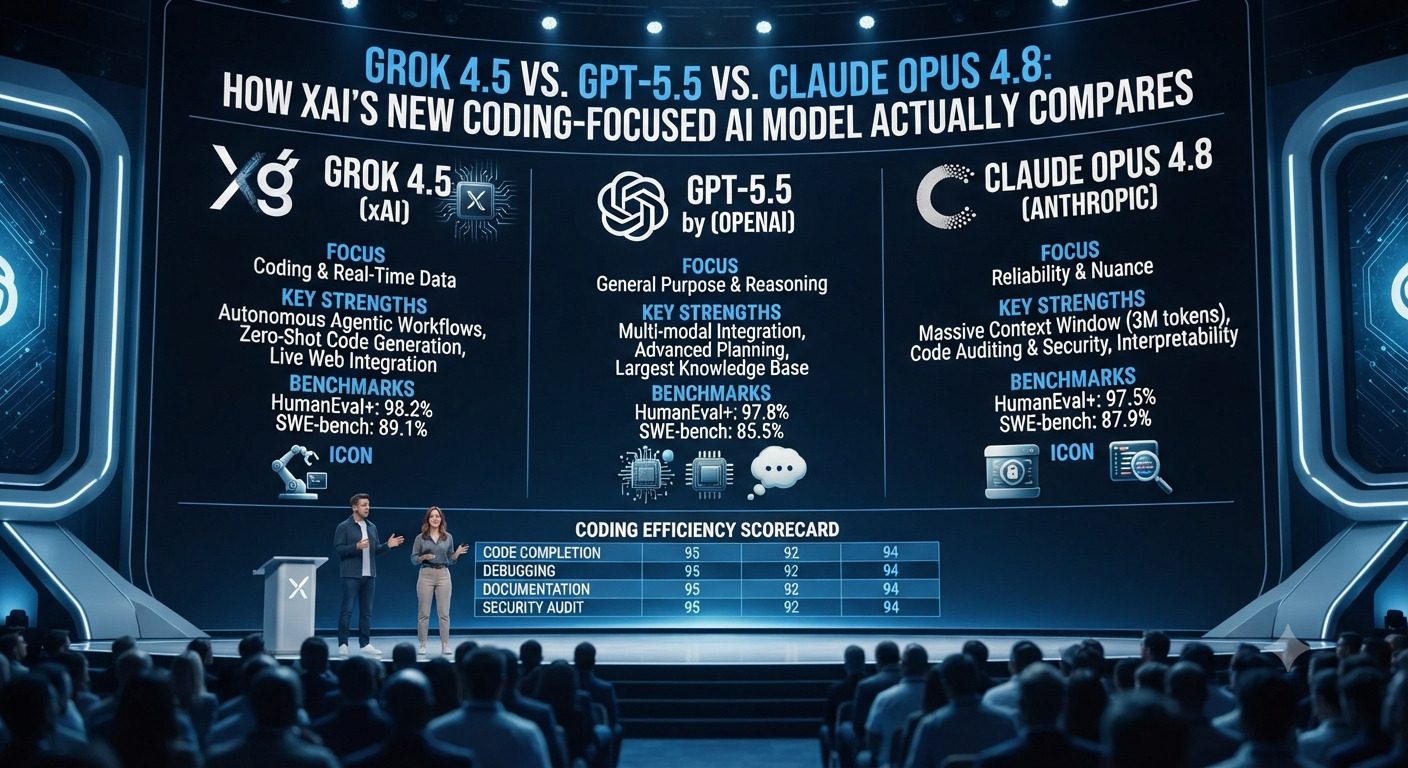
xAI released Grok 4.5 on July 8, 2026, positioning it as a coding- and agent-focused model trained partly on real developer session data from Cursor. Early benchmarks place it fourth on the Artificial Analysis Intelligence Index, ahead of every Gemini and open-weight model, while pricing it more than 60% below Claude Opus 4.8 and GPT-5.5 — a combination that has made it one of the most closely watched AI releases of the summer among developers deciding which model to build with.
Key Takeaways
- Grok 4.5 launched July 8, 2026, built on a 1.5-trillion-parameter foundation model
- It ranks fourth on the Artificial Analysis Intelligence Index, ahead of all Gemini and open-weight models
- Pricing is $2 per million input tokens and $6 per million output tokens — over 60% cheaper than Opus 4.8 or GPT-5.5
- It is notably more token-efficient, using a fraction of the output tokens Opus 4.8 needs for comparable tasks
A Model Built Specifically for Developers
Grok started out as a conversational chatbot built around real-time access to X. Grok 4.5 marks a clear pivot away from that framing. xAI trained it using real developer session data supplied through its partnership with Cursor, the AI code editor, and designed its benchmarks around what a model can actually accomplish inside a real, long-running codebase rather than isolated coding puzzles. That's a meaningfully different design goal than a general-purpose assistant, and it shows in how the model is being marketed — not as a smarter chatbot, but as infrastructure for coding tools and agent workflows.
What Elon Musk Actually Claimed
In his launch posts, Musk described Grok 4.5 as "roughly comparable to Opus 4.7, but much faster," and separately called it "more token-efficient and lower cost" — framing it as a direct alternative to Anthropic's Claude models for teams building AI-powered products. It's worth noting these were self-reported comparisons at launch, later supported by independent third-party benchmarking from Artificial Analysis, which placed Grok 4.5 fourth on its Intelligence Index — a meaningful, though not top-tier, result.
The Benchmarks in Context
According to Artificial Analysis's testing, Grok 4.5 scored ahead of every Gemini model and every open-weight model currently available, though it did not surpass the very top frontier models on the index. For coding-specific benchmarks, independent testing put it roughly on par with GPT-5.5 in Codex-style evaluations — at approximately half the per-task cost.
Also Read: Agentic AI, Explained: What It Actually Does Differently From ChatGPT and Older AI Assistants
Token efficiency is where the gap becomes most visible. Grok 4.5 reportedly uses around 14,000 output tokens to complete a typical Intelligence Index task, compared to roughly 67,020 tokens for Claude Opus 4.8 on the same class of task — a difference that directly affects both response speed and the real-world cost of running the model at scale.
Pricing Breakdown
Grok 4.5 is priced at $2 per million input tokens and $6 per million output tokens through its API — positioning it as a notably cheaper option than both Claude Opus 4.8 and GPT-5.5, which xAI states are priced more than 60% higher for comparable usage. For teams running high-volume coding agents or automated workflows, that pricing gap compounds quickly across millions of tokens processed daily.
Where This Fits in a Fast-Moving Market
Grok 4.5's launch landed in an unusually crowded week for frontier AI releases — the same period saw OpenAI pushing GPT-5.6 toward general availability and Anthropic dealing with an unrelated trademark dispute, underscoring just how quickly competing labs are now shipping updates. It's also worth noting that Grok 4.5 arrived through a joint effort with Cursor, which itself was acquired by SpaceX for a reported $60 billion just weeks later — tying the model, the compute powering it, and one of the most widely used AI coding tools under increasingly related ownership.
Should Developers Actually Switch?
For teams currently using Claude or GPT for coding tasks, Grok 4.5 is worth testing primarily on cost-sensitive, high-volume workloads — background agents, automated code review, or large-scale refactoring tasks where token efficiency directly affects your bill. For tasks requiring the highest achievable reasoning quality regardless of cost, the top-ranked frontier models still hold an edge based on current independent benchmarks. The most practical approach many developers are taking is running Grok 4.5 alongside their existing model rather than replacing it outright, given how quickly rankings in this space continue to shift.
FAQ
Q: When was Grok 4.5 released?
xAI released Grok 4.5 to the public on July 8, 2026.
Q: How much does Grok 4.5 cost compared to Claude Opus 4.8?
Grok 4.5 is priced at $2/$6 per million input/output tokens, reportedly more than 60% cheaper than Claude Opus 4.8 for comparable usage.
Q: Is Grok 4.5 better than GPT-5.5 for coding?
Independent benchmarks put Grok 4.5 roughly on par with GPT-5.5 on Codex-style coding evaluations, at approximately half the per-task cost.
Q: What data was Grok 4.5 trained on?
Grok 4.5 was built on xAI's 1.5-trillion-parameter V9 foundation model, with supplemental training on real developer session data provided through its partnership with Cursor.