





The mid-range smartphone category has long been the battleground where manufacturers fight hardest for consumer loyalty. In 2026, this tier has blurred the lines with true flagships, offering premium features like high-refresh-rate AMOLED displays, sophisticated multi-lens camera arrays, and robust processing power without commanding a thousand-dollar price tag. Two formidable contenders standing at the forefront of this category are the Oppo Reno 15 Pro and the Samsung Galaxy A58. Both devices cater to everyday users, mobile enthusiasts, and photography lovers, yet they approach mobile engineering from entirely different perspectives.
Oppo’s Reno series has consistently championed striking visual aesthetics, rapid charging speeds, and advanced portrait photography. Meanwhile, Samsung’s Galaxy A-series represents the benchmark for mainstream reliability, long-term software support, and widely recognized ecosystem integration. In this comprehensive 1500-word analysis, we will contrast every critical aspect of the Oppo Reno 15 Pro and the Samsung Galaxy A58 to help you determine which device aligns best with your daily routine.
1. Design Philosophy and Build Craftsmanship
When you pull a phone out of your pocket multiple times a day, tactile feel and physical presence matter immensely. Both brands have taken distinct paths in shaping their mid-range contenders.
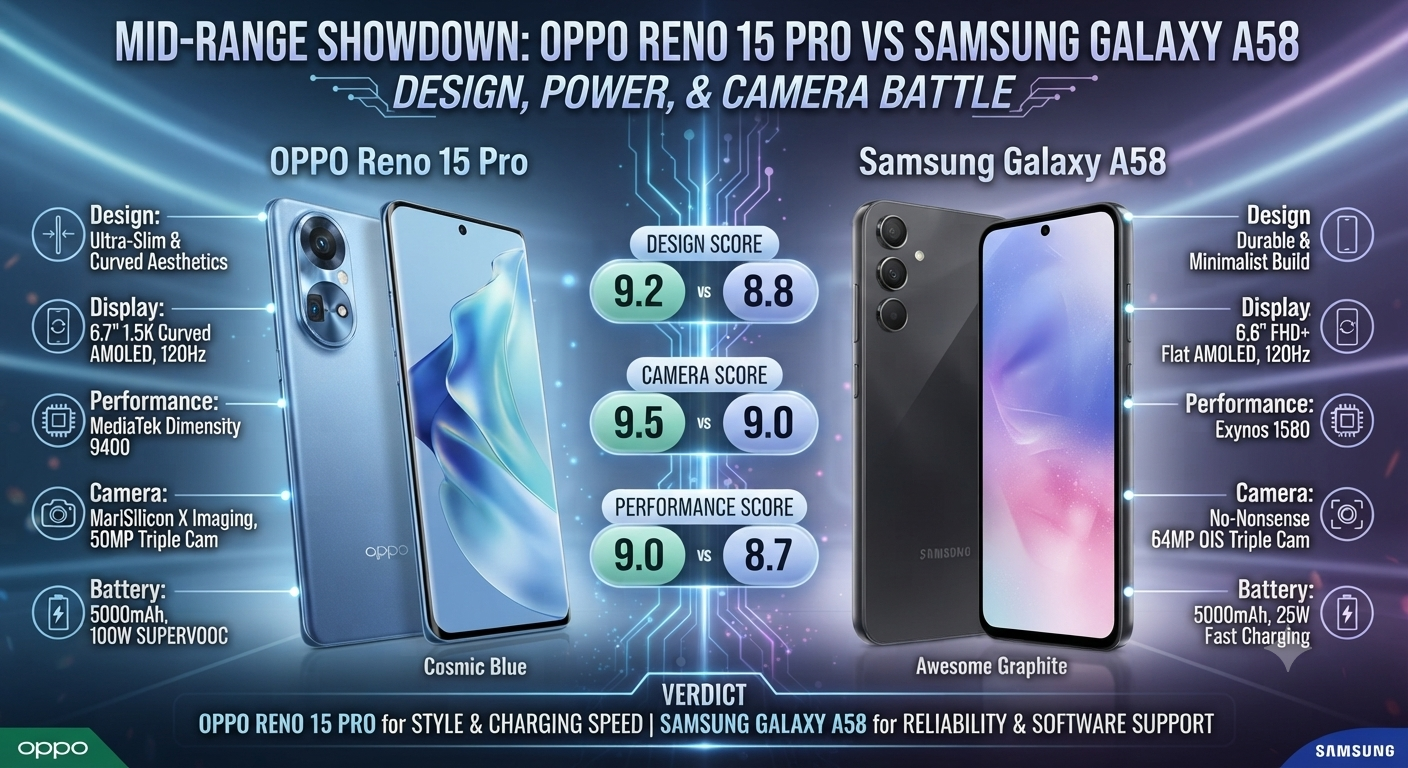
The Oppo Reno 15 Pro leans heavily into high-fashion aesthetics and ultra-slim ergonomics. Featuring delicately curved glass edges that melt smoothly into a polished frame, it feels featherlight and luxurious in the hand. The rear camera island features a streamlined, sophisticated housing that minimizes wobble when laid flat on a desk. Oppo also introduces mesmerizing color finishes that catch light dynamically, appealing directly to users who view their phone as an extension of their personal style.
Conversely, the Samsung Galaxy A58 champions a clean, minimalist design language that mirrors Samsung’s ultra-premium flagship Galaxy S lineup. It features a flat display and a matte-finished rear panel framed by clean, clean-cut edges. The individual camera lenses sit flush without an overarching bulky module, maintaining a neat, utilitarian elegance. Samsung places a strong emphasis on robust everyday durability, incorporating high-grade dust and water resistance ratings that give users peace of mind in unpredictable weather conditions.
2. Display Technologies and Visual Experience
Your interaction with a smartphone happens primarily through its screen, making display quality paramount. Both devices feature state-of-the-art AMOLED panels, but their tactile visual execution differs.
The Oppo Reno 15 Pro equips a gorgeous 6.7-inch curved 1.5K AMOLED panel supporting a smooth 120Hz refresh rate. The curvature at the edges creates an immersive, borderless effect when watching cinematic videos or swiping through system menus. High peak brightness levels ensure that content remains vividly legible even under harsh midday sunlight. Color calibration leans toward punchy, vibrant saturation out of the box, making photos and media look instantly striking.
The Samsung Galaxy A58 counters with a 6.6-inch FHD+ flat AMOLED display, also boasting a responsive 120Hz refresh rate. While it lacks the dramatic curved edges of the Oppo, many users prefer a flat panel to eliminate accidental palm touches and simplify screen protector installation. Samsung’s display tuning is legendary for its color accuracy, offering natural tones, deep contrast blacks, and excellent HDR performance. If you edit photos or prefer true-to-life color reproduction, Samsung's screen tuning is exceptionally satisfying.
3. Processing Hardware and Everyday Performance
Underneath the exterior glass, performance dictates how smoothly applications open, how fast multitasking feels, and how well heavy tasks are handled over extended periods.
The Oppo Reno 15 Pro is powered by a high-performance MediaTek Dimensity processor paired with ample LPDDR5X RAM. This silicon architecture is optimized for high-efficiency multitasking and smooth graphical rendering. Whether you are jumping between heavy social media applications, editing 4K video clips, or gaming on high settings, the Reno 15 Pro maintains a snappy, fluid response rate with minimal thermal buildup, thanks to an integrated vapor chamber cooling system.
The Samsung Galaxy A58 runs on an in-house Exynos processing platform fine-tuned for stable, sustained power efficiency and seamless ecosystem synergy. While raw synthetic benchmark scores might favor the MediaTek chip in intense bursts, Samsung’s software-hardware optimization ensures that daily interactions—such as opening apps, scrolling web feeds, and managing split-screen tasks—are silky smooth. The phone prioritizes thermal stability and battery preservation over short bursts of extreme peak performance, making it an exceptionally reliable daily workhorse.
4. Software Ecosystems and User Interface
Software dictates your daily interaction flow, feature accessibility, and long-term device security.
The Oppo Reno 15 Pro runs ColorOS, an interface known for its deep visual customizability, smooth animations, and handy productivity tools like floating windows, sidebar shortcuts, and expansive theme options. ColorOS gives you granular control over notifications, privacy toggles, and system behaviors, though it may require a brief cleanup of pre-installed promotional applications upon first boot.
The Samsung Galaxy A58 features One UI running on top of Android, widely regarded as one of the most polished, feature-rich, and stable operating systems available. One UI offers seamless integration with Samsung’s ecosystem of tablets, smartwatches, and smart home appliances. Furthermore, Samsung's industry-leading software support commitment guarantees multiple generations of major Android OS upgrades and years of security patches, making the Galaxy A58 a safer long-term investment for users who keep their phones for many years.
5. Camera Systems and Imaging Science
Mid-range phones are heavily judged by their photography capabilities, and both devices bring robust multi-lens configurations to the table.
The Oppo Reno 15 Pro shines brightly in portrait photography and creative styling. Equipped with high-resolution sensors and Oppo's proprietary imaging chips, it excels at capturing sharp facial details, natural background separation in portrait mode, and brilliant low-light selfies. AI-driven enhancements optimize skin tones and lighting conditions dynamically, ensuring social-media-ready shots straight from the gallery.
The Samsung Galaxy A58 focuses on consistency, reliable optical image stabilization (OIS), and faithful color reproduction. Its main camera handles difficult lighting environments with grace, minimizing noise and preserving shadow details without over-processing. Video stabilization is exceptionally steady, making the Galaxy A58 a dependable tool for recording family events, casual vlogs, and motion-heavy clips.
6. Battery Life and Charging Speeds
Keeping your device powered throughout a demanding schedule is essential, and these two phones handle energy replenishment quite differently.
The Oppo Reno 15 Pro features a robust 5000mAh battery coupled with ultra-fast proprietary charging technology. It can replenish from zero to full capacity in record time using the bundled high-wattage charger, making battery anxiety virtually non-existent even for heavy users who forget to plug in overnight.
The Samsung Galaxy A58 houses a matching 5000mAh battery that easily stretches through a full day—and often well into a second day—of moderate usage, aided by power-efficient processor tuning. While its wired charging speed is more conservative by comparison, it prioritizes long-term battery health preservation over raw charging velocity.
Final Verdict
Choosing between the Oppo Reno 15 Pro and the Samsung Galaxy A58 depends entirely on what you value most in a smartphone experience.
- Choose the Oppo Reno 15 Pro if you prioritize ultra-slim curved design aesthetics, lightning-fast charging speeds, and specialized portrait photography capabilities.
- Choose the Samsung Galaxy A58 if you value long-term software update support, a clean flat display, reliable day-to-day ecosystem integration, and rugged build durability.
Which of these mid-range contenders fits your workflow better? Let us know your thoughts in the comments below!