



For centuries, the architecture of education has rested on a rigid logistical compromise: the one-to-many classroom model. A single human educator, tasked with managing twenty to forty distinct minds, stands at the front of a room and delivers a generalized lecture meant to serve an average of those students. In reality, that "average student" is a pedagogical myth. Some children grasp complex algebraic concepts in minutes while others struggle, some drift into boredom, and others battle quiet anxiety, unable to keep up with the collective pace.
Today, that compromise is shattering. We are living through a profound technological shift driven by generative artificial intelligence and advanced adaptive learning systems. With round-the-clock intelligent tutors capable of holding natural Socratic dialogues, explaining difficult physics formulas at midnight, and instantly adapting to a student's unique cognitive pace, a provocative question echoes across educational circles: Are AI tutors about to replace human teachers? To answer that, we must look honestly at what algorithms do exceptionally well, where they inevitably stumble, and why the future of learning points toward a powerful hybrid model rather than a zero-sum war.
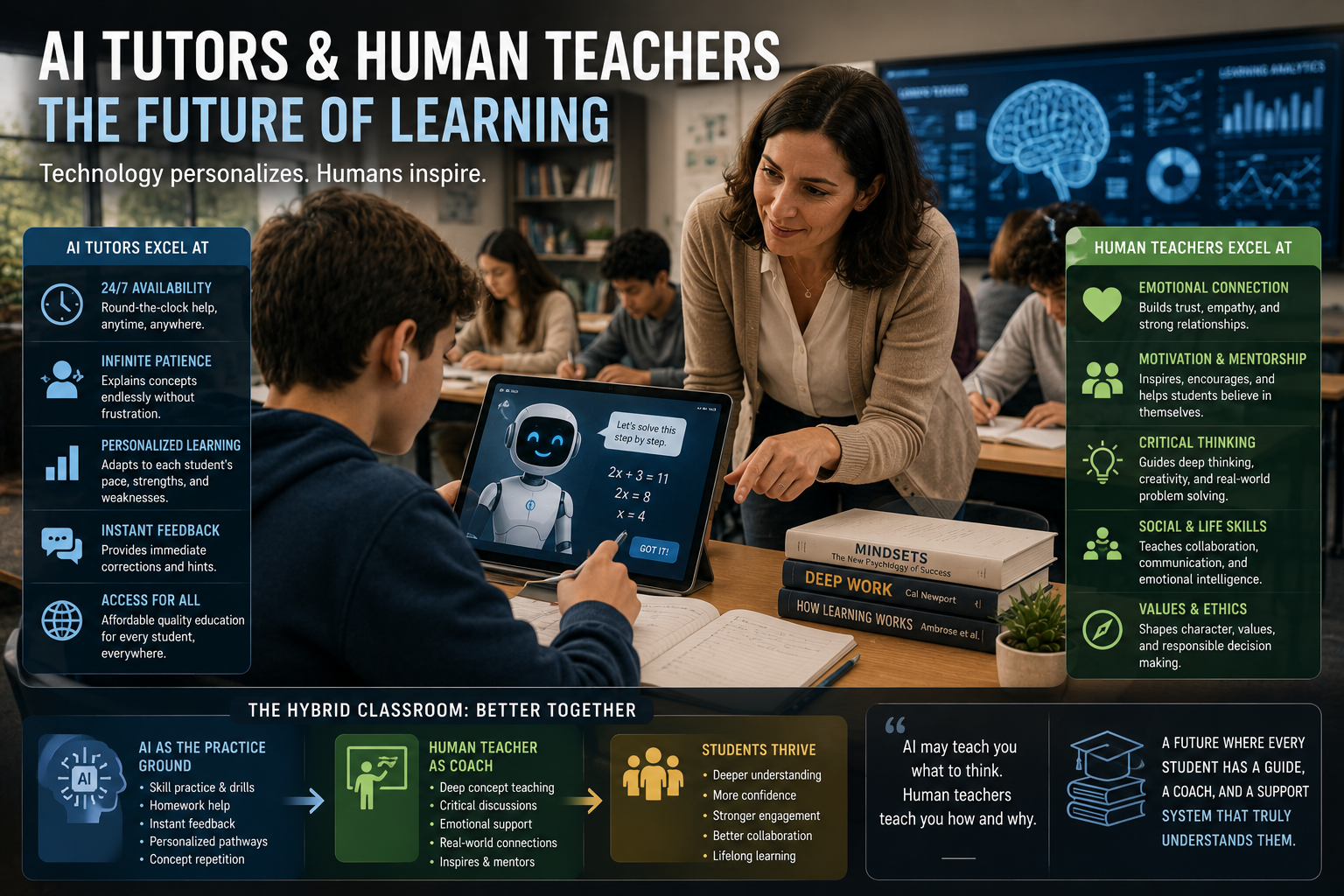
1. What AI Tutors Do Brilliantly: The Power of Scale and Patience
To understand the disruption, we must acknowledge how far intelligent tutoring systems have evolved. They are no longer clunky, rule-based software programs of the past; they are fluent, empathetic-sounding conversational agents capable of delivering hyper-personalized instruction at scale.
- Infinite Patience: A human teacher, no matter how dedicated, will eventually display signs of fatigue or frustration when a student asks the exact same question for the fifth time. An AI tutor never grows tired, irritable, or distracted. It will re-explain a complex fraction or a coding loop twenty different ways without a trace of judgment.
- Radical Affordability and Availability: Private one-on-one human tutoring has historically been a luxury accessible only to affluent families. Advanced AI tutoring apps now provide continuous, round-the-clock support for a fraction of the cost, democratizing access for students in remote or underserved areas.
- Judgment-Free Safe Space: Psychological research consistently shows that many students—especially adolescents navigating severe performance anxiety—experience intense shame around academic struggle. They will readily ask an AI a "basic" question or confess a misunderstanding that they would hide from their peers and teachers out of embarrassment.
- Granular Dynamic Scaffolding: Rather than simply handing over the correct answer, modern AI systems use Socratic questioning to guide a student through a problem step-by-step, adjusting difficulty levels based on real-time typing speed, hesitation pauses, and error patterns.
2. Where AI Tutors Fall Short: The Irreplaceable Human Element
Despite these staggering technical capabilities, pitting AI against human educators reveals distinct boundaries that silicon chips and large language models simply cannot cross.
A. Motivation, Accountability, and Emotional Resonance
Learning is rarely just an intellectual exercise; it is an emotional and psychological journey. A student who understands *how* to solve a math problem may still lack the internal drive to sit down and do it.
Human teachers provide mentorship, inspiration, accountability, and emotional intelligence. They notice when a student is quiet not because they are tired of chemistry, but because they are dealing with social bullying, family stress, or a loss of self-confidence. A human educator offers empathy, serves as a role model, and builds a trusting relational environment that sparks genuine resilience and a lifelong love of learning. An algorithm can simulate encouragement, but it cannot genuinely care.
B. Diagnosing Deep Conceptual Misconceptions
When a student struggles, the issue is often not a superficial gap in facts, but a deeply ingrained, faulty mental model. Diagnosing why a student holds a wrong assumption requires subtle probing dialogue, reading micro-expressions, interpreting body language, and asking open-ended questions that uncover emotional or psychological blocks. Skilled human teachers excel at reading between the lines in ways automated systems still handle inconsistently.
C. Ethical Guidance, Critical Thinking, and Socialization
The classroom is society in miniature. It is where young people learn how to collaborate in groups, resolve interpersonal conflicts face-to-face, navigate ethical dilemmas, and develop civic responsibility. Over-reliance on isolated AI interactions risks reducing human socialization, which is vital for holistic emotional and psychological development.
3. Reclaiming the Educator: Slaying the Administrative Monster
For decades, the teaching profession has faced an unprecedented burnout crisis. The primary driver of this exhaustion has rarely been the actual act of teaching children; it has been the crushing mountain of "shadow work"—grading hundreds of repetitive assignments, formatting lesson plans, filling out compliance spreadsheets, and managing administrative reporting.
This is where AI is already creating a quiet revolution, acting not as a replacement for teachers, but as an indispensable force multiplier. In forward-thinking schools, AI handles the mechanical friction of education: instantly grading essays with rubric feedback, drafting adaptive lesson plans, and summarizing individual student performance data into actionable dashboards. By slashing administrative burdens by up to 70%, AI allows educators to step away from the desk and return to what they do best: mentoring, direct instruction, and human connection.
4. The Hybrid Model: The Future of the Modern Classroom
The narrative framing education as a battleground between human teachers and AI tutors is fundamentally flawed. The future belongs neither to cold algorithms nor to overburdened, traditional classrooms, but to a powerful hybrid model.
In this emerging ecosystem, the roles are clearly distributed:
- AI as the Practice Ground: Between structured lessons, students use intelligent AI tutors for daily skill drills, low-stakes vocabulary practice, immediate feedback loops on homework, and round-the-clock conceptual troubleshooting.
- The Human Teacher as Coach and Strategist: Armed with performance analytics generated by AI diagnostic tools, human teachers act as high-level mentors. They review what students practiced with the AI, correct underlying conceptual misinterpretations, facilitate rich classroom debates, and provide the essential emotional support required to keep students motivated.
Conclusion: The Evolution of Knowledge
Technology has always transformed education—from the invention of the printing press and the pocket calculator to the rollout of the internet. Each time, skeptics feared the death of human instruction; each time, education evolved to become more expansive.
AI tutors are not here to replace human teachers. They are here to eliminate the one-size-fits-all bottleneck of mass education, offering every student a personalized pathway to understanding. By freeing teachers from administrative overload and amplifying their ability to reach individual learners, AI and human teachers together are forging a future where learning is deeper, more accessible, and profoundly more human than ever before.