



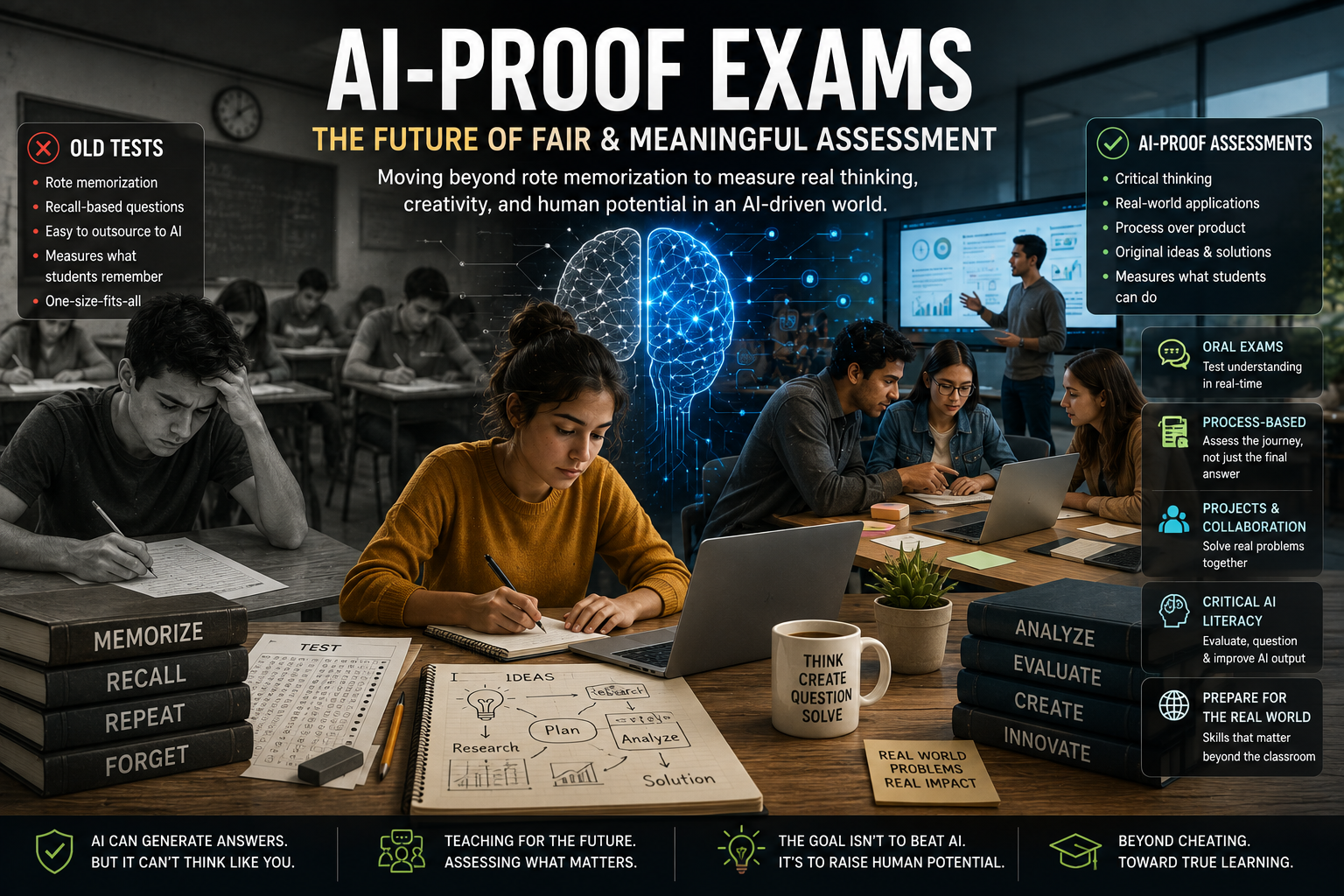
For over a century, the gold standard of academic evaluation has remained stubbornly consistent: the timed, proctored, sit-down examination. Students armed with nothing but recall, anxiety, and a #2 pencil would fill in bubbles or write furiously in blue books to prove mastery of a subject. This system, designed for the Industrial Age to certify standardized knowledge retention, has finally met its disruptive match.
The public release of hyper-capable generative AI models has rendered the traditional essay, the take-home assignment, and even many introductory coding tests functionally obsolete as reliable metrics of human learning. If a sophisticated AI can compose a passing thesis on 19th-century literature or debug a complex Python script in under ten seconds, what are we actually measuring when we ask a student to do the same? This crisis of integrity has forced an urgent, overdue revolution in pedagogy. The future of exams is not about finding better ways to police students; it is about fundamentally redesigning how we assess their thinking. Welcome to the era of the "AI-proof" assessment.
The Obsolescence of Recall: Why Old Tests Fail
The fundamental vulnerability of the traditional exam lies in its reliance on cognitive recall and procedural execution. For decades, schools have operated on a "banking model" of education: deposit facts into the student’s brain, and withdraw them during the exam to prove they were learned. Bloom’s Taxonomy, the widely accepted framework for educational goals, places "Remembering" and "Understanding" as the foundational base.
Generative AI excels precisely at this base level. It is an infinite repository of human understanding that can regurgitate facts instantly. Traditional assessments that reward the ability to define terms, summarize plots, or perform standard calculations are now measuring a student’s ability to access technology, not their internal cognitive development. When the barrier to entry for high-level cheating is lowered to simply copying a prompt into a chatbot, the assessment itself loses all validity.
The panic over AI-generated cheating is not merely about dishonesty; it is a symptom of a deeper educational malaise. It highlights that too much of our current schooling system is focused on the *product* of learning—a completed essay, a solved equation—rather than the *process* of thinking that got the student there.
The Shift to "Authentic Assessment"
If we cannot trust the unsupervised product, we must shift focus to the supervised process. The emerging strategy among forward-thinking educators is not to build better AI detectors (a technological arms race that is difficult to win indefinitely), but to design assessments that AI simply cannot complete. These are broadly categorized as Authentic Assessments.
An authentic assessment asks students to perform real-world tasks that demonstrate meaningful application of essential knowledge and skills. It moves away from asking "What is X?" toward "How would you use X to solve this novel problem?" Instead of testing for isolated facts, these assessments measure:
- Synthesis and evaluation: Combining information from disparate sources to create a new argument or solution.
- Critical thinking and argumentation: Defending a position in real-time against counter-arguments.
- Metacognition: The ability to articulate *how* and *why* you arrived at a conclusion.
- Collaboration and communication: Working with peers to tackle complex, ambiguous challenges.
In short, AI-proof assessments test what humans do best and what AI, by its very nature, struggles to replicate genuinely: original thought applied to unique, situated contexts.
Five Pillars of AI-Resistant Evaluation
How does this look in practice across different disciplines? The transition requires a multi-pronged approach to evaluation.
1. The Return of the Oral Exam (Viva Voce)
Perhaps the most effective "AI-proof" tool is one of the oldest: the oral examination, or *viva voce*. It is impossible for a student to feed an exam question to ChatGPT and read the answer aloud in real-time while maintaining a coherent, spontaneous conversation with an expert evaluator.
Oral exams force students to demonstrate genuine fluency in a subject. Professors can ask follow-up questions, challenge assumptions, and gauge the depth of understanding immediately. While scalable only in smaller class sizes, technology is beginning to offer solutions, using AI-facilitated (but human-reviewed) conversational avatars to conduct initial oral assessments for larger cohorts.
2. In-Person, Pen-and-Paper (or Locked-Browser) Assessments
Sometimes, the simplest solution remains effective. While unpopular with students accustomed to digital workflows, a return to supervised, handwritten, in-class essays or math problems guarantees authorship. This approach, however, risks valuing speed and penmanship over the actual quality of thinking that modern tools enable.
A more modern adaptation is the use of locked-down testing environments on university computers that disable internet access and AI tools while allowing necessary software (like IDEs for coding). This validates that the student possesses the baseline foundational skills necessary to function without a digital crutch.
3. Process-Based Grading: Assessing the Journey, Not Just the Destination
If the final essay can be generated by AI, the grade should no longer rest solely on that final draft. AI-resistant assessment emphasizes grading the *process* of creation.
This involves requiring students to submit evidence of their work: brainstorming notes, outline drafts, early research annotations, intermediate code commits (tracked via GitHub), and reflective memos on their challenges. Teachers evaluate the intellectual labor and decision-making demonstrated throughout the project lifecycle, not just the polished output. Students can use AI as a brainstorming partner during the process, provided they can justify why they accepted or rejected the AI's advice in their reflective notes.
4. Project-Based Learning (PBL) and Case Studies
Project-based learning anchors education in long-term, complex challenges. Students might be tasked with designing a community garden to address local food deserts, creating a marketing campaign for a real local business, or drafting a policy memo addressing a current geopolitical crisis.
These projects are inherently difficult for current AI to execute well because they require navigating local nuance, unpredictable human variables, and real-world constraints. Assessment is based on a presentation of findings to a panel of experts or peers, defending the project against live critique.
5. Testing "AI Literacy" Itself
Rather than viewing AI as an adversary to be blocked, some progressive assessments are beginning to incorporate AI as a tool for evaluation. This involves setting an AI against a student in a competitive or evaluative framework.
An assignment might require a student to use a chatbot to generate an essay on a topic, and then submit a second document that critically evaluates the AI’s output. The student must identify hallucinations, logical fallacies, weak arguments, and tone issues in the AI’s work, and then rewrite the essay to make it accurate and compelling. This tests editorial judgment, critical analysis, and advanced AI literacy—skills that are essential for the modern workforce.
The Equity and Implementation Challenge
While the pedagogical shift toward authentic, oral, and process-based assessment is academically sound, it presents massive systemic challenges.
The primary barrier is scalability and workload. Grading a stack of multiple-choice scantrons takes minutes; grading in-depth project portfolios, conducting individual oral exams, or reviewing dozens of process logs for a single class of 200 students is an unsustainable burden on faculty already facing burnout. The shift requires smaller class sizes, increased teaching support, or a complete restructuring of faculty roles.
Furthermore, there are equity concerns. Neurodivergent students or those suffering from severe test anxiety may struggle significantly with high-stakes oral exams compared to written work. Conversely, students with greater access to private tutoring and resources outside of school may find it easier to "game" complex project-based assignments. Ensuring that AI-proof assessments do not inadvertently widen the achievement gap is a critical implementation hurdle.
Conclusion: A Necessary Evolution
The rise of generative AI is not the death of the exam; it is the catalyst for its long-overdue evolution. For too long, we have allowed ease of grading to dictate the rigor of assessment. By forcing a move away from rote memorization and toward testing high-level human skills—synthesis, critical debate, real-time problem solving, and ethical reasoning—AI is ultimately helping education rediscover its core mission.
The exam of the future will be messier, harder to grade, and far more engaging than the scantron of the past. It will demand more from teachers and students alike, but it will also certify a level of genuine human capability that no algorithm can fake. The shift to AI-proof assessments isn't just about preventing cheating; it’s about ensuring education remains relevant in an AI-driven world.