





The Future of Online Voting: Opportunities and Risks

As the world moves increasingly digital, the debate over internet-based voting intensifies. Explore the massive promise of digital accessibility balanced against severe cybersecurity realities.

The Future of Online Voting: Opportunities and Risks

In our daily lives, digitalization has become the default standard. We manage our bank accounts, file taxes, purchase real estate, and execute multi-million-dollar business contracts entirely online, backed by advanced encryption and multi-factor authentication. Given how seamlessly the internet governs modern commerce, a logical question continuously surfaces in civic design: Why can’t we just vote online?

The promise of internet voting—often termed i-voting or online balloting—is deeply alluring. Proponents argue it could revolutionize democratic participation, making voting as simple as tapping a smartphone screen. However, cybersecurity experts, election officials, and policy researchers urge extreme caution. While the opportunities for expanding access are immense, the risks to national security, ballot secrecy, and public trust are equally profound. Here is a comprehensive look at the complex future of online voting.

1. The Allure: Why Online Voting Is So Attractive

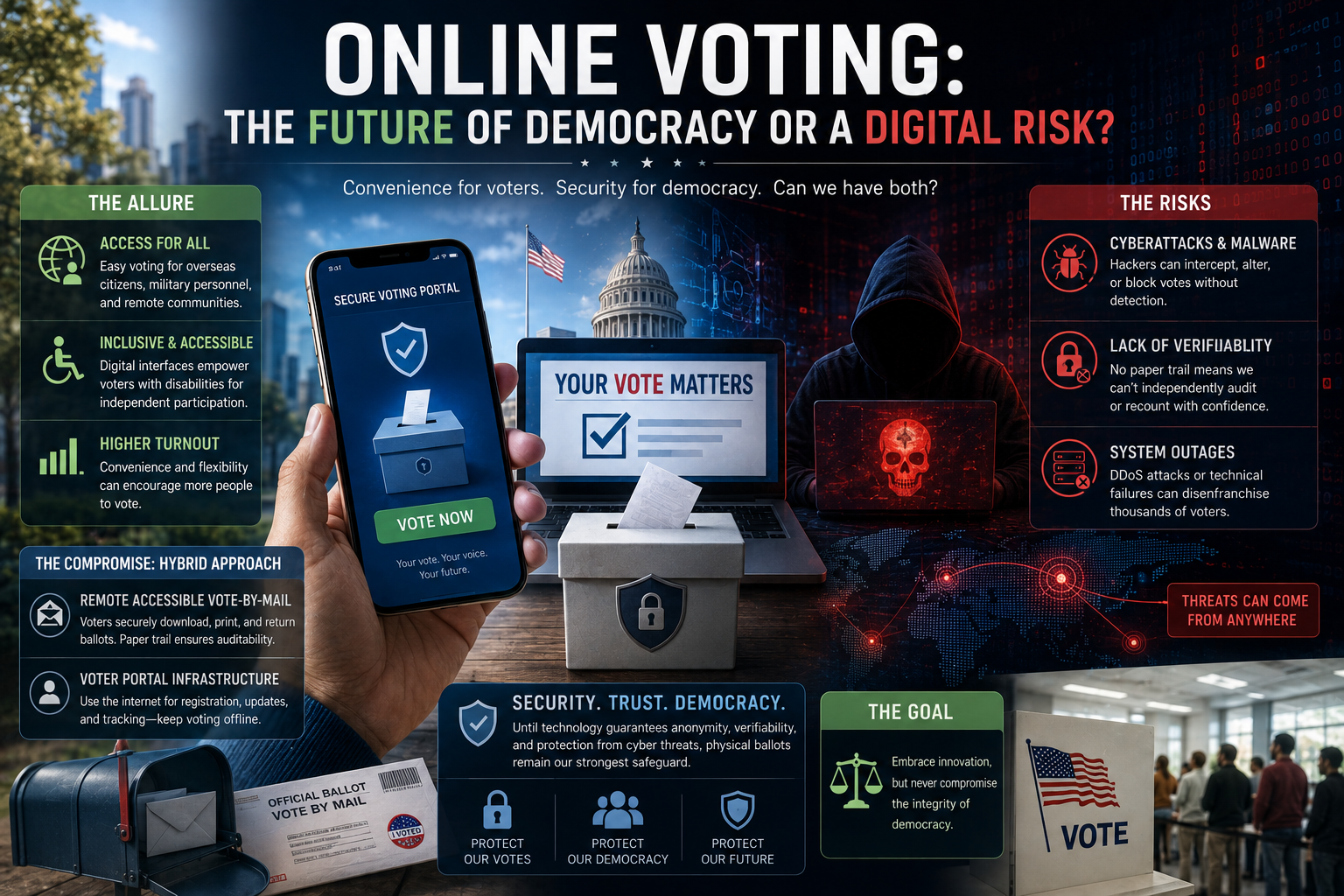
The primary driver behind the push for digital voting is the pursuit of inclusivity and engagement. Traditional voting infrastructure—relying heavily on physical polling stations, rigid operating hours, and paper mailing systems—presents systemic hurdles for specific demographics.

  • Accessibility for Overseas and Military Voters: Citizens living abroad or service members deployed on active duty face immense logistical challenges receiving and returning physical paper mail ballots within tight electoral windows. Remote electronic options offer immediate delivery.
  • Empowering Voters with Disabilities: Physical polling places frequently struggle to provide completely independent, private voting experiences for individuals with visual impairments or mobility restrictions. Digital interfaces can integrate seamlessly with assistive screen readers and alternative input devices.
  • Boosting Voter Turnout: Advocates frequently point out that modern convenience drives participation. In an era where younger generations manage their entire lives through mobile apps, removing the friction of traveling to a physical precinct on a Tuesday could theoretically revitalize sagging participation rates.

2. The Digital Divide: Why Internet Voting Is Not Online Banking

A common counter-argument used by tech optimists is that if online banking is secure enough to protect our life savings, online voting should easily meet the same standard. Cybersecurity professionals, however, emphasize that financial transactions and democratic elections operate under entirely different security frameworks.

In online banking, if a fraudulent transaction occurs or a database is breached, the financial institution can reverse the charge, issue a refund, or re-issue account credentials. Elections, conversely, possess a non-negotiable requirement that shatters this parallel: the secret ballot.

To prevent vote-buying, coercion, and political intimidation, election systems must guarantee absolute anonymity—meaning there must be no cryptographic link connecting a specific voter’s identity to their final ballot choice once it is cast. In banking, you want a definitive receipt tying your identity directly to your funds. In voting, a receipt proving how you voted creates an immediate market for voter coercion or vote selling. Achieving absolute voter authentication while maintaining impenetrable ballot secrecy remains one of the hardest unsolved problems in computer science.

3. The Severe Risks Facing Internet-Based Ballots

Until fundamental breakthroughs in cryptography occur, internet voting introduces severe vulnerabilities that could compromise the legitimacy of entire democratic frameworks.

A. Sophisticated Cyberattacks and Malware

Unlike physical ballot boxes that require localized tampering, an online voting platform is connected to the global internet—making it accessible to malicious actors anywhere on Earth. Personal computers, smartphones, and local election servers are routinely compromised by sophisticated malware, spyware, and zero-day exploits. A malicious actor or hostile nation-state could silently intercept, modify, or block votes at scale without the voter or election officials ever detecting the manipulation.

B. The Lack of Verifiability and Auditability

A secure election relies on "software independence"—the principle that an error or modification in computer software cannot alter the election outcome without being detected via a physical paper audit trail. Traditional paper ballots allow for independent hand recounts and physical audits. In a purely digital or remote online voting system, verifying whether votes were stored correctly and counted as cast becomes an exercise in blind trust. If a system is hacked, proving the true outcome becomes mathematically impossible.

C. Denial of Service (DoS) and Infrastructure Disruption

On election day, system availability is just as critical as data integrity. Online voting portals are prime targets for distributed denial-of-service (DDoS) attacks designed to flood servers with malicious traffic. As seen in past localized electronic voting glitches and international cyber incidents, a well-timed digital outage can lock thousands of citizens out of the democratic process entirely during critical voting windows.

4. Current Compromises: Where Technology and Tradition Meet

Recognizing both the severe security risks of full internet voting and the genuine accessibility needs of specific populations, many electoral jurisdictions have adopted measured hybrid approaches rather than fully migrating to online portals:

  • Remote Accessible Vote-by-Mail (RAVBM): Many regions utilize secure web systems strictly to allow voters with disabilities or overseas military personnel to securely download, fill out, and print their ballots at home. The physical paper ballot must then be printed and returned via traditional mail or a secure drop box—preserving the physical paper audit trail.
  • Voter Portal Infrastructure: The internet is safely utilized for administrative pre-voting tasks—such as online voter registration verification, checking polling place locations, and tracking mail-in ballot delivery status—while keeping the actual act of casting a vote entirely offline.

Conclusion: Proceeding with Extreme Caution

The evolution of digital democracy will continue to push boundaries, but the foundational axioms of election security cannot be sacrificed for the sake of mere consumer convenience. As major scientific bodies and cybersecurity experts consistently conclude, current internet infrastructure does not yet provide a secure enough environment to host high-stakes political elections.

Until mathematics and computer science deliver a breakthrough that can simultaneously guarantee uncompromised anonymity, resistance to nation-state cyberattacks, and verifiable paper-independent auditing, physical ballots and secure hybrid systems remain our strongest shield. In the architecture of democracy, security and trust must always outweigh speed and convenience.


Quick Summary

As the world moves increasingly digital, the debate over internet-based voting intensifies. Explore the massive promise of digital accessibility balanced against severe cybersecurity realities.

Key Takeaways

  • Accessibility for Overseas and Military Voters: Citizens living abroad or service members deployed on active duty face immense logistical challenges receiving and returning physical paper mail ballots within tight electoral windows. Remote electronic options offer immediate delivery.
  • Empowering Voters with Disabilities: Physical polling places frequently struggle to provide completely independent, private voting experiences for individuals with visual impairments or mobility restrictions. Digital interfaces can integrate seamlessly with assistive screen readers and alternative input devices.
  • Boosting Voter Turnout: Advocates frequently point out that modern convenience drives participation. In an era where younger generations manage their entire lives through mobile apps, removing the friction of traveling to a physical precinct on a Tuesday could theoretically revitalize sagging participation rates.
  • Remote Accessible Vote-by-Mail (RAVBM): Many regions utilize secure web systems strictly to allow voters with disabilities or overseas military personnel to securely download, fill out, and print their ballots at home. The physical paper ballot must then be printed and returned via traditional mail or a secure drop box—preserving the physical paper audit trail.
  • Voter Portal Infrastructure: The internet is safely utilized for administrative pre-voting tasks—such as online voter registration verification, checking polling place locations, and tracking mail-in ballot delivery status—while keeping the actual act of casting a vote entirely offline.

Quick Facts

Category: Politics
Published: August 5, 2026
Updated: October 8, 2026
Reading time: 5 min
61 views
Updated Oct 8, 2026 5 min read

Related Articles

View all

Popular

View all

Mixed Content

Politics
Article Politics

The Post-Automation Economy: Architecting Human Skill Premiums in the Age of Autonomy

The rapid proliferation of agentic workflows and large action models is structurally inverting the traditional corporate skill pyramid. While routine analytical processes and information retrieval tasks are being automated into low-cost utility, uncommoditizable human traits—emotional intelligence, strategic ambiguity management, and ethical governance—are commanding an unprecedented value premium. Succeeding in the post-automation enterprise requires re-engineering workforce development to focu

Mutwassim 3 min 72
The Decline of Friction: Inside the FinTech Revolution in Cross-Border Settlement and Digital Identity Politics
Article Politics

The Decline of Friction: Inside the FinTech Revolution in Cross-Border Settlement and Digital Identity

The traditional plumbing of global finance—characterized by multi-day delays, hidden fees, and fragmented identity silo—is undergoing a profound transformation. A new generation of FinTech architectures, combining distributed ledger technology (DLT), synchronized liquidity pools, and decentralized digital passports, is enabling cross-border instant payments with near-zero friction.

Mutwassim 1 min 44
The City as a Switch: Architecting IoT Logistics for the Post-Congestion Urban Era Politics
Article Politics

The City as a Switch: Architecting IoT Logistics for the Post-Congestion Urban Era

The traditional model of urban delivery—reliant on high-emission diesel vans navigating static street grids—is creating unsustainable levels of congestion and pollution in global metros. To reclaim urban space, cities are transitioning to IoT-orchestrated logistics. This data-driven framework utilizes autonomous delivery swarms, automated micro-fulfillment centers, and dynamic digital kerb-side management to route goods with the efficiency of internet packets, transforming static streets into fl

Mutwassim 4 min 71
Beyond the Coffee Shop: How Cross-Border Employment and Sovereign Visas Are Institutionalizing Remote Work Politics
Article Politics

Beyond the Coffee Shop: How Cross-Border Employment and Sovereign Visas Are Institutionalizing Remote Work

Remote work is transitioning from an informal perk into an institutionalized pillar of international commerce. Over 60 nations have launched dedicated digital nomad visa regimes, while multi-jurisdictional compliance platforms and Employer of Record (EOR) frameworks dismantle traditional geographic barriers. As knowledge workers disperse globally, enterprises and municipal governments are formalizing policies around tax residency, permanent establishment risk, and asynchronous operational workfl

Mutwassim 3 min 71
The Death of Syntax: Inside the Shift to Intent-Driven Software Engineering Politics
Article Politics

The Death of Syntax: Inside the Shift to Intent-Driven Software Engineering

The day-to-day discipline of software engineering is undergoing its most radical abstraction leap since the transition from assembly language to high-level compilers. Generative code synthesis and deterministic reasoning engines are automating boilerplate syntax, turning software developers into systems architects. Survival in this new paradigm demands mastering intent formalization, specification design, and continuous verification.

Mutwassim 3 min 71
The Post-Visual Threat: Architecting Zero-Trust Defense Against Weaponized Deepfakes Politics
Article Politics

The Post-Visual Threat: Architecting Zero-Trust Defense Against Weaponized Deepfakes

The rapid weaponization of real-time voice cloning and synthetic video generation has transformed social engineering from opportunistic phishing into targeted executive identity emulation. High-profile incidents involving multi-million-dollar wire transfers authorized via synthetic video calls prove that sight and sound can no longer authenticate authorization. Securing modern enterprises requires an uncompromising zero-trust identity layer capable of neutralizing synthetic deception.

Mutwassim 3 min 137
Beyond the Battery: How Electric Mobility Is Forcing a Overhaul of the Global Power Grid Politics
Article Politics

Beyond the Battery: How Electric Mobility Is Forcing a Overhaul of the Global Power Grid

The global transition toward electric vehicles is no longer constrained primarily by battery chemistry or vehicle range. Instead, the real bottleneck has shifted directly to the electrical grid. As commercial fleets and passenger cars electrify at scale, utilities and city planners are racing to deploy vehicle-to-grid (V2G) bidirectional systems, AI-driven dynamic load balancers, and decentralized microgrid storage to avoid grid failure.

Mutwassim 3 min 58
Cloud 3.0: The Shift Toward Sovereign Data Architectures and Edge Computing Politics
Article Politics

Cloud 3.0: The Shift Toward Sovereign Data Architectures and Edge Computing

The architectural assumption that enterprise compute and storage should reside in a handful of centralized hyperscaler data centers is fracturing. Driven by strict cross-border data sovereignty regulations and the demand for millisecond-latency AI inference, global IT leaders are pivoting to Cloud 3.0—a model centered on distributed, locally governed, and hybrid sovereign architectures.

Mutwassim 3 min 61