





Trump Election Files: What They Prove and What They Don’t
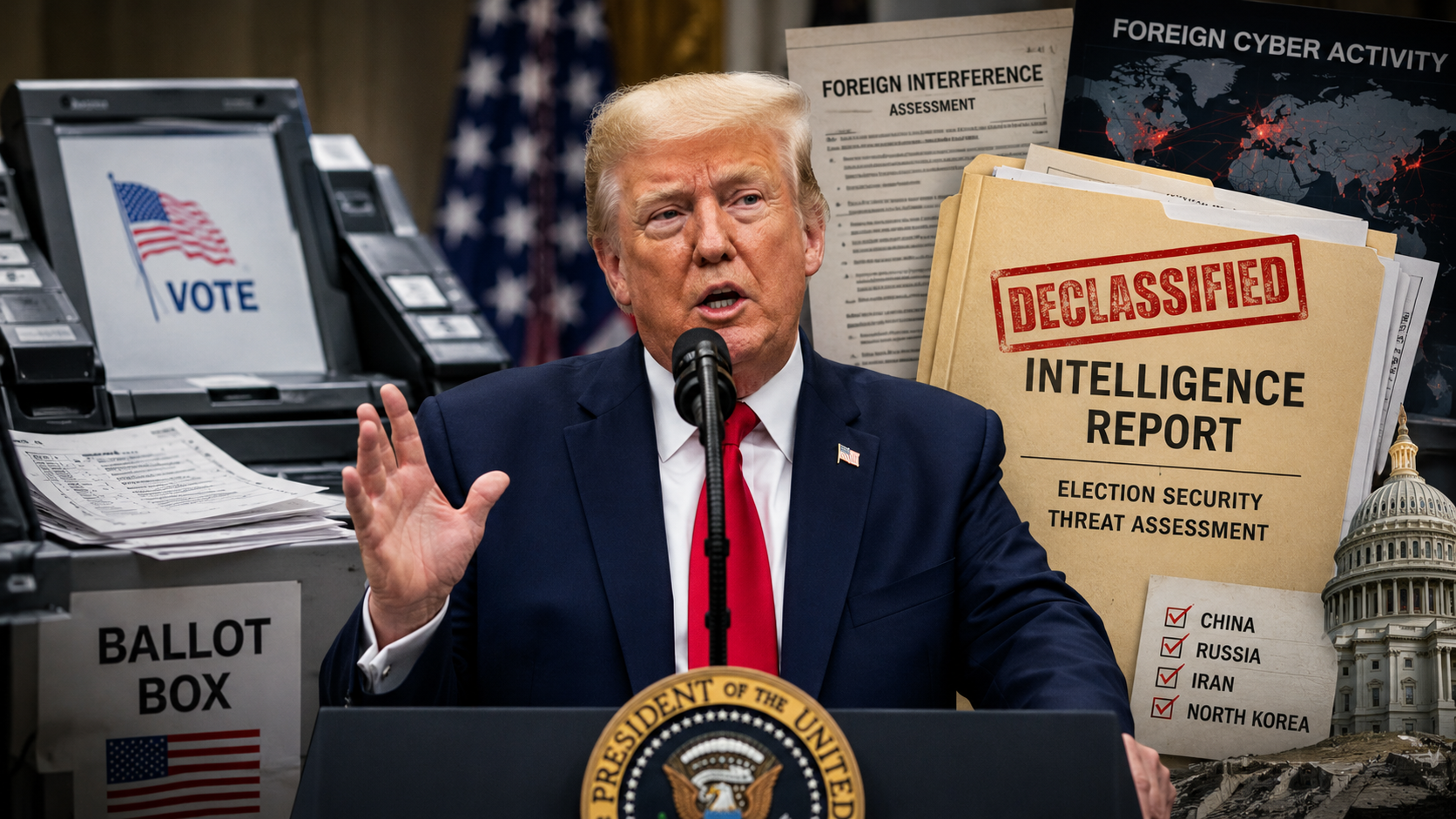
President Donald Trump used a televised White House speech to argue that newly declassified intelligence had exposed serious weaknesses in the American election system. He said the documents supported his long-running concerns about foreign interference, voting technology and voter registration.
The files do contain genuine security warnings. They discuss foreign interest in American voter information and possible weaknesses in election-related databases and technology. However, they do not prove that China or another foreign government changed votes or altered the outcome of the 2020 presidential election.
What Trump Said the Documents Revealed
The White House released reports covering electronic voting equipment, voter-registration databases, foreign intelligence activity and potentially ineligible registrations.
Trump placed particular attention on a claim that China had acquired information connected to approximately 220 million American voters. He described the incident as a major election-security breach and accused intelligence officials of previously downplaying the danger.
Foreign access to large amounts of personal information is a legitimate national-security concern. Voter data could be used to create political profiles, target influence campaigns or impersonate trusted organisations.
However, obtaining voter information is not the same as gaining access to ballots or changing vote totals. Public versions of voter files are already available in many states and are commonly used by political campaigns and researchers. According to Reuters, the information obtained by China was not confidential and could not itself be used to manipulate recorded votes.
A Vulnerability Is Not Proof of an Attack
The most important issue is the difference between a possible weakness and a confirmed compromise.
A cybersecurity report may show that an adversary has the ability to target a database, website or voting system. Investigators must then determine whether an attack actually occurred, whether it succeeded and whether it affected the result.
Trump’s speech often treated these different questions as if they had already been answered. The documents showed that foreign governments possess cyber capabilities and remain interested in American elections. They did not show that those capabilities were successfully used to change the 2020 result.
A 2021 intelligence assessment found no indication that a foreign actor altered voter registration, ballot casting, vote counting or the reporting of results during the 2020 election. It also concluded that manipulating vote totals on a scale large enough to change an election would be difficult to accomplish without detection.
What the Documents Say About Voting Systems
The released intelligence also discussed possible weaknesses in voting machines, electronic poll books, voter databases and official election websites.
These systems should never be treated as completely secure. Election authorities must continue testing equipment, controlling access, monitoring networks and correcting software vulnerabilities.
But American elections do not rely entirely on electronic machines. The U.S. Election Assistance Commission reported that more than 98 percent of election jurisdictions used equipment in 2024 that involved a paper ballot or produced an auditable paper record.
Paper records allow election officials to compare physical ballots with electronic totals during audits and recounts. They do not remove every possible risk, but they make large-scale manipulation harder to carry out without leaving evidence.
The Problem With Selective Declassification
Declassifying intelligence is not automatically irresponsible. Releasing government information can improve transparency, expose failures and help the public understand real threats.
The danger appears when raw or selected intelligence is presented without enough context. Intelligence reports often contain incomplete information, conflicting conclusions and different levels of confidence. Professionals normally compare multiple reports before deciding what the evidence actually proves.
When individual findings are placed inside a political speech, a possible threat can easily sound like a confirmed event. That can mislead audiences even when the original document uses cautious language.
The Associated Press reviewed the released material and found no evidence that China or another foreign entity manipulated votes. Some documents contained well-known security concerns, while others were heavily redacted or related to foreign elections rather than the American voting process.
Election Security Still Deserves Attention
Rejecting unsupported claims does not mean every concern about election security should be ignored.
Foreign governments attempt to influence political debate, collect voter information and search for weaknesses in public systems. State and local election offices need reliable funding, modern cybersecurity, tested equipment and clear audit procedures.
Claims that an election was stolen, however, require direct and verifiable evidence. General warnings about cyber threats cannot replace proof that ballots were altered or illegal votes changed the outcome.
Political leaders should explain exactly what intelligence confirms, what remains uncertain and what has not been demonstrated. Without those distinctions, attempts to increase trust can produce the opposite result.
Why the Debate Matters
Public confidence is damaged when officials pretend election systems have no weaknesses. It is also damaged when every technical vulnerability is presented as evidence of widespread fraud.
A democracy depends on citizens being able to question the process while still accepting results supported by audits, recounts and evidence. If voters only trust elections won by their preferred candidate, every future result becomes vulnerable to political rejection.
Trump was right to argue that election infrastructure must be protected from foreign threats. But his speech went further than the released evidence by connecting possible vulnerabilities with claims that the 2020 election had been manipulated.
Final Verdict
The declassified files show that American election infrastructure faces genuine cybersecurity and foreign-intelligence risks. They support stronger databases, secure equipment, paper records and transparent audits.
They do not prove that China or another foreign government changed votes or overturned the 2020 election result.
The fairest conclusion is that the documents contain important warnings, but Trump presented those warnings with more certainty than the evidence supports. Election security requires transparency, but transparency is only useful when intelligence is released with its full context.
Editorial Note: This article was inspired by the opinion of Massimo Calabresi and was independently restructured, expanded and fact-checked using government records and trusted reporting.