





In our daily lives, digitalization has become the default standard. We manage our bank accounts, file taxes, purchase real estate, and execute multi-million-dollar business contracts entirely online, backed by advanced encryption and multi-factor authentication. Given how seamlessly the internet governs modern commerce, a logical question continuously surfaces in civic design: Why can’t we just vote online?
The promise of internet voting—often termed i-voting or online balloting—is deeply alluring. Proponents argue it could revolutionize democratic participation, making voting as simple as tapping a smartphone screen. However, cybersecurity experts, election officials, and policy researchers urge extreme caution. While the opportunities for expanding access are immense, the risks to national security, ballot secrecy, and public trust are equally profound. Here is a comprehensive look at the complex future of online voting.
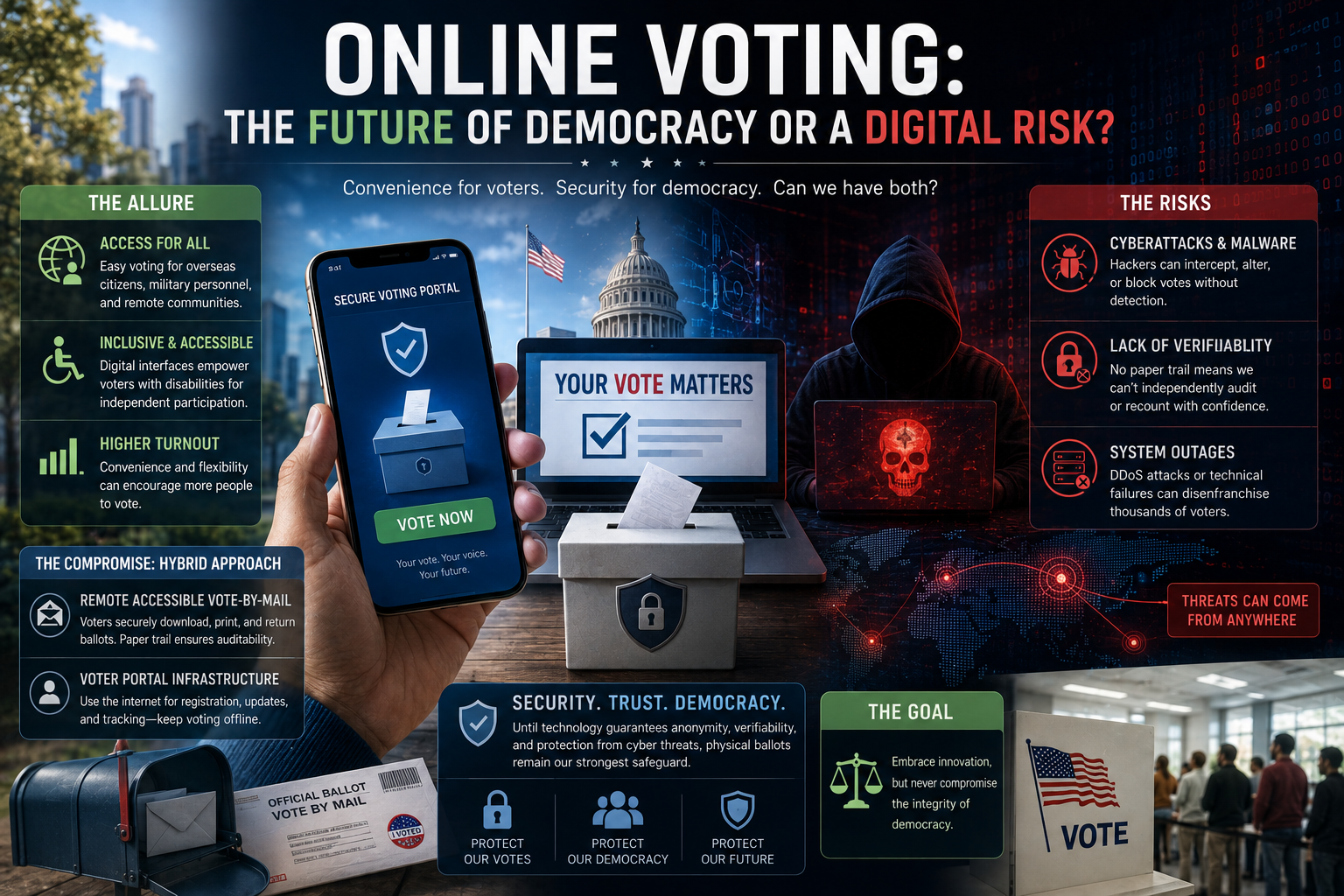
1. The Allure: Why Online Voting Is So Attractive
The primary driver behind the push for digital voting is the pursuit of inclusivity and engagement. Traditional voting infrastructure—relying heavily on physical polling stations, rigid operating hours, and paper mailing systems—presents systemic hurdles for specific demographics.
- Accessibility for Overseas and Military Voters: Citizens living abroad or service members deployed on active duty face immense logistical challenges receiving and returning physical paper mail ballots within tight electoral windows. Remote electronic options offer immediate delivery.
- Empowering Voters with Disabilities: Physical polling places frequently struggle to provide completely independent, private voting experiences for individuals with visual impairments or mobility restrictions. Digital interfaces can integrate seamlessly with assistive screen readers and alternative input devices.
- Boosting Voter Turnout: Advocates frequently point out that modern convenience drives participation. In an era where younger generations manage their entire lives through mobile apps, removing the friction of traveling to a physical precinct on a Tuesday could theoretically revitalize sagging participation rates.
2. The Digital Divide: Why Internet Voting Is Not Online Banking
A common counter-argument used by tech optimists is that if online banking is secure enough to protect our life savings, online voting should easily meet the same standard. Cybersecurity professionals, however, emphasize that financial transactions and democratic elections operate under entirely different security frameworks.
In online banking, if a fraudulent transaction occurs or a database is breached, the financial institution can reverse the charge, issue a refund, or re-issue account credentials. Elections, conversely, possess a non-negotiable requirement that shatters this parallel: the secret ballot.
To prevent vote-buying, coercion, and political intimidation, election systems must guarantee absolute anonymity—meaning there must be no cryptographic link connecting a specific voter’s identity to their final ballot choice once it is cast. In banking, you want a definitive receipt tying your identity directly to your funds. In voting, a receipt proving how you voted creates an immediate market for voter coercion or vote selling. Achieving absolute voter authentication while maintaining impenetrable ballot secrecy remains one of the hardest unsolved problems in computer science.
3. The Severe Risks Facing Internet-Based Ballots
Until fundamental breakthroughs in cryptography occur, internet voting introduces severe vulnerabilities that could compromise the legitimacy of entire democratic frameworks.
A. Sophisticated Cyberattacks and Malware
Unlike physical ballot boxes that require localized tampering, an online voting platform is connected to the global internet—making it accessible to malicious actors anywhere on Earth. Personal computers, smartphones, and local election servers are routinely compromised by sophisticated malware, spyware, and zero-day exploits. A malicious actor or hostile nation-state could silently intercept, modify, or block votes at scale without the voter or election officials ever detecting the manipulation.
B. The Lack of Verifiability and Auditability
A secure election relies on "software independence"—the principle that an error or modification in computer software cannot alter the election outcome without being detected via a physical paper audit trail. Traditional paper ballots allow for independent hand recounts and physical audits. In a purely digital or remote online voting system, verifying whether votes were stored correctly and counted as cast becomes an exercise in blind trust. If a system is hacked, proving the true outcome becomes mathematically impossible.
C. Denial of Service (DoS) and Infrastructure Disruption
On election day, system availability is just as critical as data integrity. Online voting portals are prime targets for distributed denial-of-service (DDoS) attacks designed to flood servers with malicious traffic. As seen in past localized electronic voting glitches and international cyber incidents, a well-timed digital outage can lock thousands of citizens out of the democratic process entirely during critical voting windows.
4. Current Compromises: Where Technology and Tradition Meet
Recognizing both the severe security risks of full internet voting and the genuine accessibility needs of specific populations, many electoral jurisdictions have adopted measured hybrid approaches rather than fully migrating to online portals:
- Remote Accessible Vote-by-Mail (RAVBM): Many regions utilize secure web systems strictly to allow voters with disabilities or overseas military personnel to securely download, fill out, and print their ballots at home. The physical paper ballot must then be printed and returned via traditional mail or a secure drop box—preserving the physical paper audit trail.
- Voter Portal Infrastructure: The internet is safely utilized for administrative pre-voting tasks—such as online voter registration verification, checking polling place locations, and tracking mail-in ballot delivery status—while keeping the actual act of casting a vote entirely offline.
Conclusion: Proceeding with Extreme Caution
The evolution of digital democracy will continue to push boundaries, but the foundational axioms of election security cannot be sacrificed for the sake of mere consumer convenience. As major scientific bodies and cybersecurity experts consistently conclude, current internet infrastructure does not yet provide a secure enough environment to host high-stakes political elections.
Until mathematics and computer science deliver a breakthrough that can simultaneously guarantee uncompromised anonymity, resistance to nation-state cyberattacks, and verifiable paper-independent auditing, physical ballots and secure hybrid systems remain our strongest shield. In the architecture of democracy, security and trust must always outweigh speed and convenience.