





For centuries, the practice of medicine has been largely reactive and analog. When disease struck, humanity responded by searching nature for active compounds, synthesizing chemical drugs in laboratories, or cutting away damaged tissue through surgery. While these conventional methods saved millions of lives, they share a fundamental limitation: they treat the human body like a mechanical machine composed of interchangeable, static parts, relying on blunt chemical instruments that often trigger widespread collateral damage.
Today, we are standing at the dawn of a profound paradigm shift. Rather than merely treating biology from the outside, scientists are learning to write it from the inside out. Welcome to the era of Synthetic Biology—an explosive fusion of molecular biology, engineering principles, and artificial intelligence that is fundamentally rewriting what is medically possible. By treating DNA as software and living cells as programmable hardware, synthetic biology is transforming medicine from a science of discovery into a science of engineering.
1. What Is Synthetic Biology? (Redefining Life as Code)
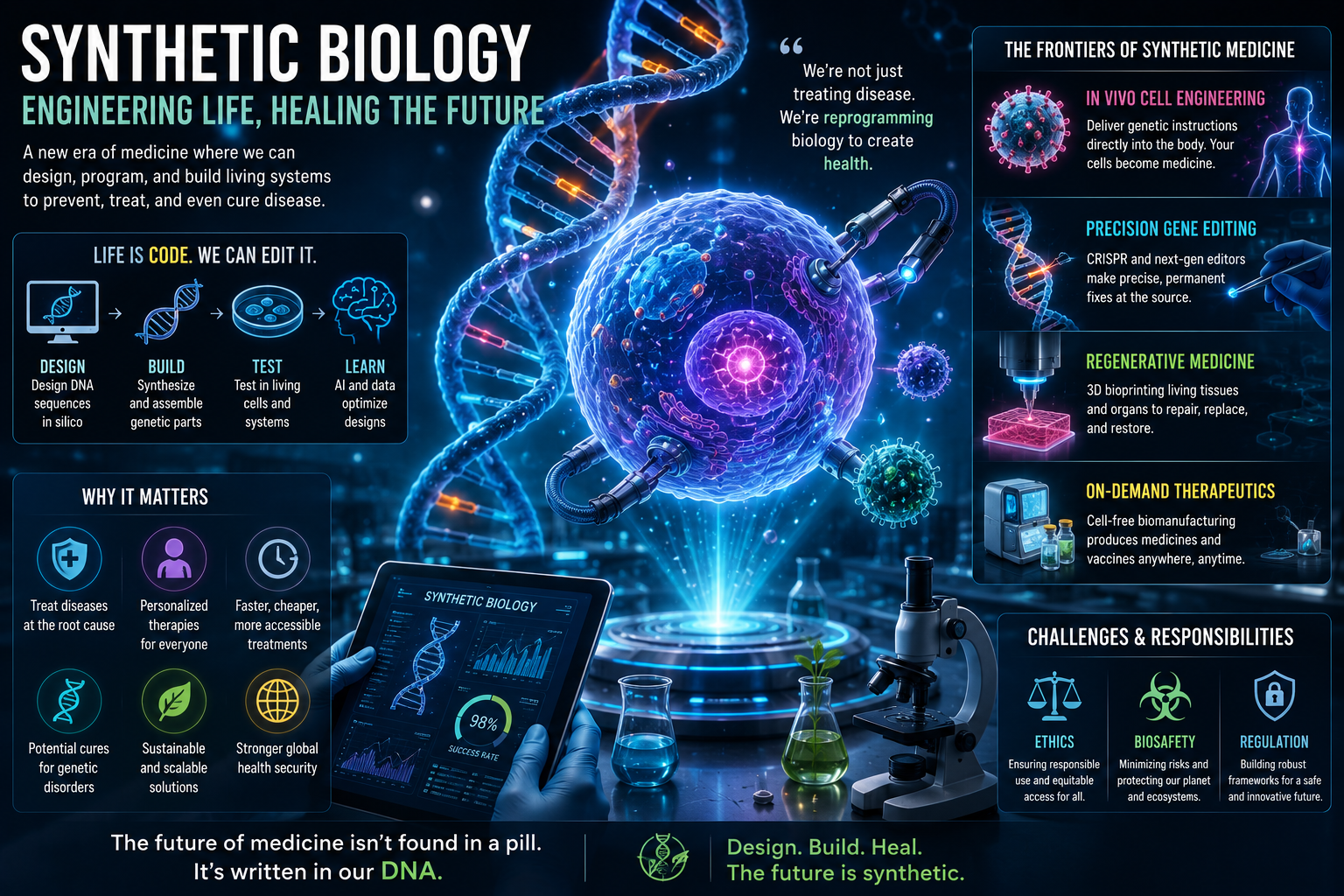
To understand the medical revolution currently unfolding, one must first grasp the core philosophy of synthetic biology. Traditional biotechnology generally involves tweaking what nature has already provided—modifying a natural gene or isolating a bacterial protein. Synthetic biology, by contrast, takes a modular, engineering-driven approach: the Design-Build-Test-Learn cycle.
Scientists can now design entirely synthetic DNA sequences on computers, print them chemically in the laboratory, and insert them into living cells to perform custom functions. Cells are no longer viewed simply as biological entities to be studied, but as programmable microscopic factories and smart therapeutic agents. They can be engineered to hunt down cancer cells, manufacture complex biologic drugs on demand inside the body, or release precise doses of insulin only when blood chemistry demands it.
2. The Frontier of Programmable Therapeutics: In Vivo Engineering
One of the most exciting breakthroughs in synthetic medicine is the shift from ex vivo treatments to in vivo cell and gene engineering.
Consider traditional CAR-T cell therapy, which revolutionized blood cancer treatment. Historically, this process required extracting a patient's T-cells, sending them to a specialized laboratory for weeks of genetic modification, multiplying them, and re-infusing them into the patient—a hyper-complex, immensely expensive procedure available to very few.
Synthetic biology is bypassing this bottleneck entirely through in vivo delivery systems. Using advanced lipid nanoparticles or engineered viral vectors, scientists can now deliver genetic instructions directly to a patient's T-cells *inside* their living body. The patient’s own body effectively becomes a self-manufacturing bioreactor for precision immunotherapy. This reduces manufacturing times from weeks to a single outpatient infusion, slashing costs and drastically expanding access for solid tumors, autoimmune disorders, and chronic conditions.
3. Precision Gene Editing: Moving Beyond Surgery
Gene editing has evolved light-years beyond early-generation tools. With the advent of highly refined CRISPR systems, base editors, and prime editors, synthetic biologists can now make single-letter corrections to the human genome without causing double-stranded DNA breaks.
This allows for unprecedented interventions. For instance, lipid nanoparticle-delivered gene editing can now target liver cells directly to permanently downregulate harmful cholesterol pathways, offering a one-time genetic alternative to lifelong pharmaceutical management. Genetic disorders like sickle cell anemia, cystic fibrosis, and muscular dystrophy, once viewed as lifelong life sentences, are now primary targets for permanent, curative synthetic rewrites.
4. Bioprinting and Regenerative Medicine: Growing the Future
What happens when an organ fails beyond repair? Historically, patients faced a grueling, uncertain wait for a human donor organ, constantly battling the risk of immune rejection. Synthetic biology and tissue engineering are dismantling this limitation.
Researchers are combining living human stem cells with biocompatible hydrogels and growth factors to create specialized "bioinks". Using advanced 3D bioprinting technology, laboratories can now deposit these living cells layer by layer to construct complex vascular networks, skin tissue, cartilage, and functional mini-organoids. While printing a fully functional human heart for routine transplantation remains a complex scaling challenge, bioprinted liver tissue and skin patches are already entering clinical testing, drastically changing trauma care, drug screening, and regenerative medicine.
5. Cell-Free Biomanufacturing and On-Demand Therapeutics
Traditionally, producing biologic drugs or vaccines required massive fermentation tanks filled with living cells—a slow, contamination-prone, and expensive process. Synthetic biology is pioneering cell-free biomanufacturing, a revolutionary technique that decouples biological production from living organisms.
By extracting the essential transcriptional and translational machinery of cells and stabilizing them in modular, freeze-dried systems, scientists can produce proteins, enzymes, and vaccines on demand. Funded heavily by global health initiatives, these portable, point-of-care manufacturing kits allow field medics or remote clinics to synthesize targeted treatments locally in real time, transforming emergency response and global pandemic preparedness.
The Challenges Ahead: Ethics, Biosafety, and Regulation
Despite its breathtaking potential, the rapid ascent of synthetic biology brings heavy responsibilities. Engineering living organisms introduces complex biosafety questions: What are the long-term ecological impacts of releasing engineered microbes? How do we govern the boundaries of human genetic modification and prevent misuse?
Regulatory bodies like the FDA and international equivalents are actively modernizing their evaluation frameworks to handle living therapeutics, adaptive AI-designed molecules, and personalized gene therapies. Establishing rigorous ethical guidelines, transparent data governance, and equitable global access will be paramount to ensuring that synthetic medicine benefits all of humanity, rather than a privileged few.
Conclusion: Redefining the Boundaries of Human Health
Synthetic biology represents the ultimate convergence of engineering ingenuity and biological discovery. By shifting our approach from treating symptoms with external chemicals to programming living systems from within, medicine is crossing an evolutionary threshold.
We are stepping into a future where diseases are intercepted before symptoms manifest, where failing organs are replaced by lab-grown living tissue, and where the human body is equipped with its own programmable defenses. The twenty-first century is turning biology into an engineering discipline—and in doing so, it is giving us the tools to cure the incurable.