






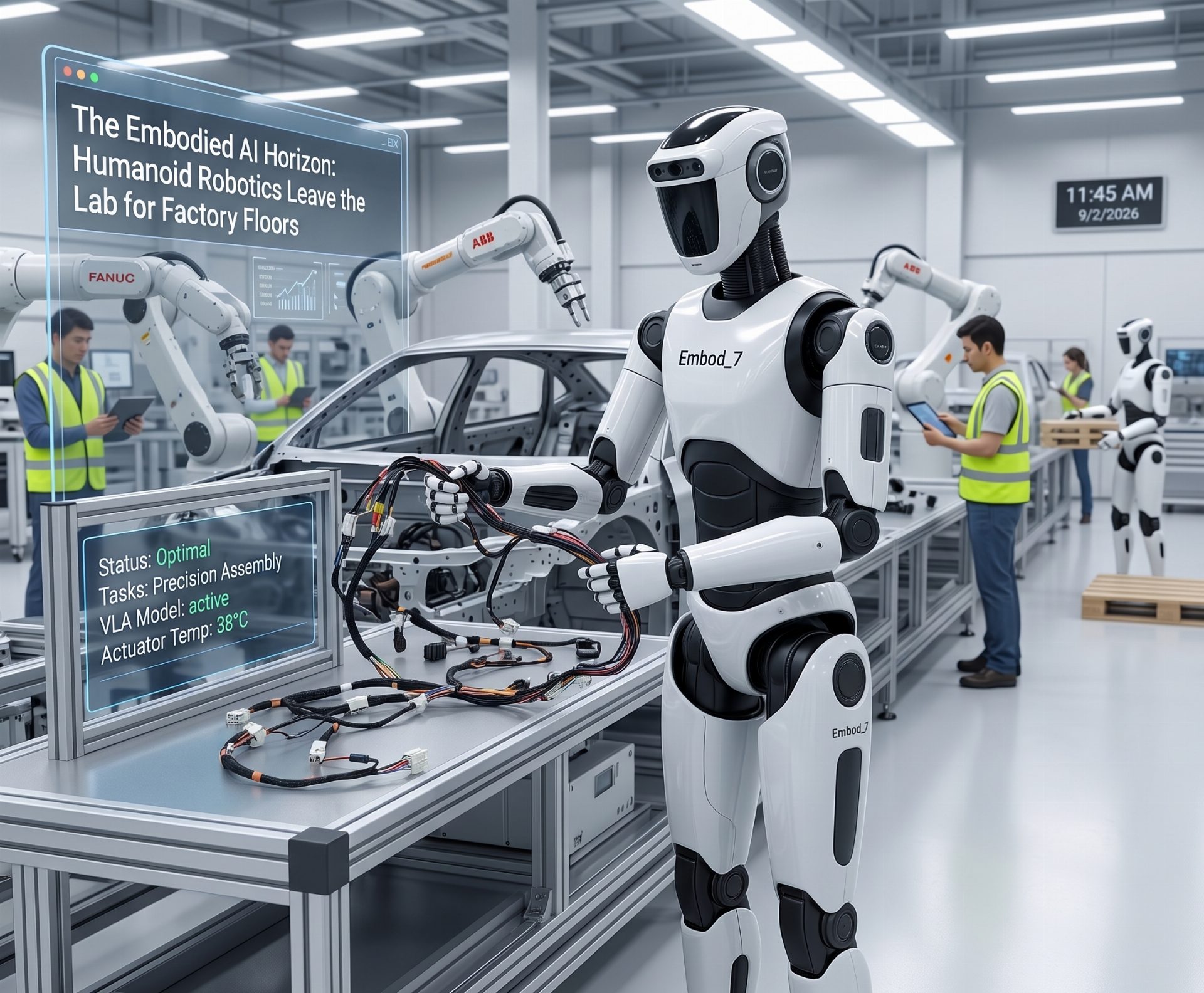
The Embodied AI Horizon: How General-Purpose Humanoid Robotics Are Leaving the Lab for Factory Floors

From Vision-Language-Action models to high-torque electric actuators, physical intelligence is moving from choreographed lab demos into scaled industrial assembly.

An industrial humanoid robot executing precision component handling inside an automated manufacturing facility. Unsplash / Industrial Tech Archive

For decades, the robotics industry was dominated by specialized, stationary robotic arms that operated within strictly segregated safety cages. However, the rapid advancement of Embodied Artificial Intelligence has broken that isolation, giving rise to general-purpose humanoid robots capable of navigating human-centric physical environments alongside human workers.

The Technological Confluence Driving Commercial Scale

The transition of humanoid platforms from research prototypes to production-ready machinery relies on key breakthroughs across the hardware and software stack:

  • Vision-Language-Action (VLA) Models: Rather than relying on hardcoded, repetitive trajectories, modern humanoids use integrated multimodal architectures. They interpret natural language tasks, perceive physical depth through high-speed computer vision, and calculate precise motor commands on the fly.

  • Synthetic Sim-to-Real Training: Physics-accurate neural simulation engines allow models to train on millions of operational cycles virtually, accelerating real-world task mastery and zero-shot adaptability without costly physical wear.

  • Actuation and Power Density: High-torque density frameless DC motors, harmonic drive gearboxes, and hot-swappable battery systems now provide the thermal stability and endurance needed to match industrial shift demands.

Industrial Validation Over Scripted Demonstrations

Automotive plants, cleanrooms, and global distribution hubs are serving as the primary proving grounds for early commercial adoption. Where automated guided vehicles (AGVs) hit architectural limits, bipedal and wheeled humanoids easily tackle vertical shelving, tight cabin inspections, and component kitting.

Looking Ahead: The Humanoids-as-a-Service Paradigm

As hardware supply chains mature and unit costs decline, enterprises are increasingly shifting toward Robotics-as-a-Service (RaaS) deployment models. This shift lowers the initial barrier to entry, letting businesses deploy adaptive robotic workforces that receive continuous over-the-air model upgrades to expand their capabilities.


Quick Summary

The convergence of advanced Vision-Language-Action (VLA) AI models, high-density actuation, and synthetic simulation training has propelled humanoid robotics into commercial reality. Major manufacturers across the globe are integrating general-purpose bipedal platforms into live production lines.

Key Takeaways

  • Vision-Language-Action (VLA) Models: Rather than relying on hardcoded, repetitive trajectories, modern humanoids use integrated multimodal architectures. They interpret natural language tasks, perceive physical depth through high-speed computer vision, and calculate precise motor commands on the fly.
  • Synthetic Sim-to-Real Training: Physics-accurate neural simulation engines allow models to train on millions of operational cycles virtually, accelerating real-world task mastery and zero-shot adaptability without costly physical wear.
  • Actuation and Power Density: High-torque density frameless DC motors, harmonic drive gearboxes, and hot-swappable battery systems now provide the thermal stability and endurance needed to match industrial shift demands.

Quick Facts

Category: Technology
Published: August 31, 2026
Updated: August 31, 2026
Reading time: 2 min
Updated Aug 31, 2026 2 min read

Mixed Content

The Quantum Infiltration Defense: Why Post-Quantum Cryptography (PQC) and Cryptographic Agility Are the Defining Cyber Battleground Technology
Article Technology

The Quantum Infiltration Defense: Why Post-Quantum Cryptography (PQC) and Cryptographic Agility Are the Defining Cyber Battleground

Public-key infrastructure is undergoing its most significant structural replacement in modern computing history. With NIST post-quantum standards finalized and adversaries executing large-scale data harvesting campaigns, global enterprises are transitioning from theoretical quantum awareness to full-scale post-quantum cryptographic migrations.

Mutwassim 9 min 0
One Piece Film God Valley: 2027 Movie, BAAD & What We Know Technology
Article Technology

One Piece Film God Valley: 2027 Movie, BAAD & What We Know

One Piece is getting two new theatrical movies. ONE PIECE FILM GOD VALLEY is scheduled for summer 2027, while ONE PIECE FILM BAAD is set for 2029. FindEdition breaks down the announcement, God Valley’s importance, the 2027 release window, what is known about BAAD, and what fans should expect next.

Agatha Christie 11 min 18