





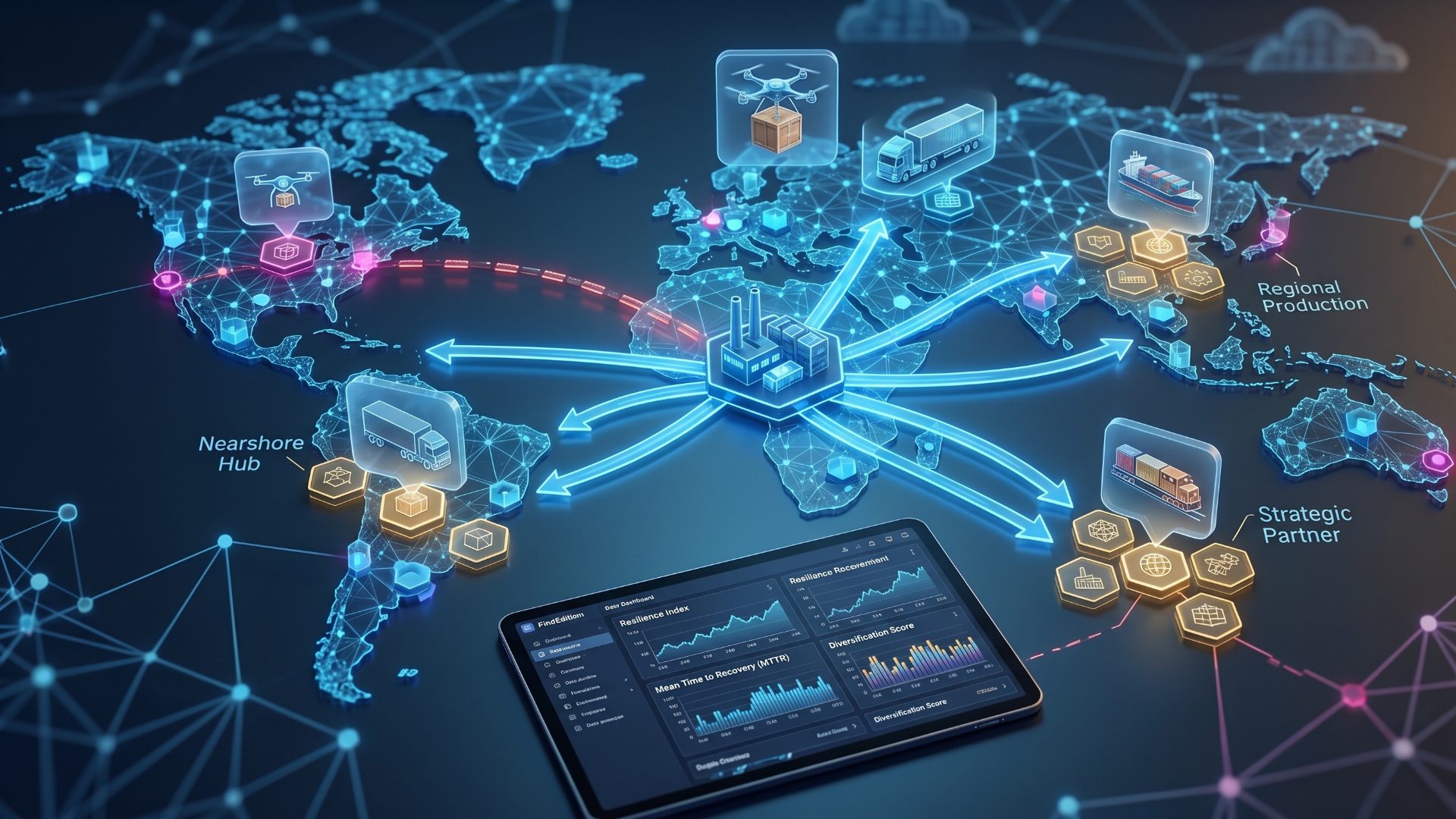
Beyond Offshoring: The Strategic Pivot to Multi-Hub Sourcing and Nearshore Resilience

Rising tariffs, geopolitical tensions, and logistics bottlenecks are forcing enterprises to replace single-source dependency with localized regional hubs.

Rows of shipping containers stacked beside gantry cranes at a deepwater industrial logistics port.
Automated cargo handling and container operations at a high-volume intermodal logistics corridor. Unsplash / Industrial Photography Collection

For more than three decades, the corporate procurement playbook adhered to a single dogmatic principle: minimize unit production costs by consolidating manufacturing within centralized, low-wage offshore hubs. Logistics networks were engineered to be hyper-lean, relying on just-in-time inventory delivery that assumed maritime shipping lanes and international trade agreements would remain permanently predictable.

That architecture is no longer viable.

The compounded impact of geopolitical friction, targeted industrial policy, export controls, and persistent disruptions across key shipping choke points has exposed the structural fragility of hyper-centralized sourcing. As a result, multinational enterprises are aggressively executing supply chain decoupling—not by abandoning international commerce entirely, but by replacing single-point failure networks with diversified multi-hub sourcing models.

The Fragility of Just-in-Time Logistics

The core vulnerability of traditional offshoring lies in its lack of operational slack. When an enterprise concentrates 70% or more of its component production in one geographical corridor, any local shock—whether a regulatory embargo, a regional power crunch, or a maritime canal blockage—creates downstream assembly halts worldwide.

The financial cost of these line-down incidents regularly outstrips the fractional labor arbitrage gained by producing abroad. Modern procurement leaders are rebalancing their key performance indicators: the historical metric of lowest landed cost is now competing directly against mean time to recovery (MTTR) and operational resilience.

The Core Pillars of Multi-Hub Architecture

Transitioning from an offshore monopoly to a resilient multi-hub network relies on three primary strategic maneuvers:

  1. The "China Plus One" and Multi-Region Expansion:

    Rather than fully divesting from established Asian manufacturing ecosystems, organizations are hedging operational risk by building parallel production capacity in secondary markets like Vietnam, India, Malaysia, and Indonesia. This guarantees redundant supply capacity while preserving access to raw component networks.

  2. Aggressive Nearshoring and Friendshoring:

    To compress delivery lead times and bypass volatile ocean freight rates, companies are establishing production sites geographically contiguous to their end consumers. In North America, this has triggered unprecedented capital inflow into Mexican manufacturing hubs under trade frameworks like the USMCA. In Europe, production is shifting into Central and Eastern European nations as well as North Africa, cutting transit cycles from weeks to days.

  3. Segmented and Dynamic Sourcing:

    Leading enterprises no longer source entire product lines through uniform channels. Commodity, high-volume, and price-sensitive parts remain in competitive overseas corridors, while high-margin, mission-critical, or IP-sensitive components are allocated to nearshore or domestic facilities equipped with high degrees of automation.

The Role of Digital Twins and Predictive Telematics

A distributed, multi-hub supply chain introduces severe logistical complexity. Managing inventory across five regional manufacturing facilities requires significantly greater coordination than managing a single centralized depot.

To orchestrate this fragmented footprint, enterprises are deploying supply chain digital twins and predictive telematics:

  • Scenario Modeling: Companies simulate factory shutdowns, currency devaluations, and tariff adjustments in software before committing capital investments.

  • Autonomous Route Optimization: Cloud-based logistics platforms dynamically adjust shipping routes, shifting cargo between road freight, rail, and short-sea shipping when transit bottlenecks emerge.

  • Tier-N Supplier Visibility: Modern auditing platforms map dependencies beyond Tier-1 vendors down to raw material extractors, identifying hidden single-source dependencies buried deep inside the tier hierarchy.

The Cost-Resilience Trade-Off

Decoupling is neither simple nor cost-neutral. Replicating tooling, building redundant manufacturing facilities, and training decentralized regional labor pools carry substantial capital overhead. In the short term, regional networks can increase baseline production costs by 10% to 15%.

However, enterprise executives increasingly view this margin premium as an essential insurance policy. In an unpredictable global operating environment, the companies that thrive will not be those that cut operational margins to the absolute lowest cent, but those whose production lines remain running when disruption hits.


Quick Summary

The era of hyper-optimized, single-country manufacturing has come to an end. Faced with regulatory friction, geopolitical realignment, and maritime chokepoint vulnerabilities, global corporations are trading the narrow margins of ultra-lean offshoring for redundant, regionalized production networks. This strategic decoupling is fundamentally rewriting global trade routes and capital expenditure priorities.

Key Takeaways

  • The "China Plus One" and Multi-Region Expansion:Rather than fully divesting from established Asian manufacturing ecosystems, organizations are hedging operational risk by building parallel production capacity in secondary markets like Vietnam, India, Malaysia, and Indonesia. This guarantees redundant supply capacity while preserving access to raw component networks.
  • Aggressive Nearshoring and Friendshoring:To compress delivery lead times and bypass volatile ocean freight rates, companies are establishing production sites geographically contiguous to their end consumers. In North America, this has triggered unprecedented capital inflow into Mexican manufacturing hubs under trade frameworks like the USMCA. In Europe, production is shifting into Central and Eastern European nations as well as North Africa, cutting transit cycles from weeks to days.
  • Segmented and Dynamic Sourcing:Leading enterprises no longer source entire product lines through uniform channels. Commodity, high-volume, and price-sensitive parts remain in competitive overseas corridors, while high-margin, mission-critical, or IP-sensitive components are allocated to nearshore or domestic facilities equipped with high degrees of automation.
  • Scenario Modeling: Companies simulate factory shutdowns, currency devaluations, and tariff adjustments in software before committing capital investments.
  • Autonomous Route Optimization: Cloud-based logistics platforms dynamically adjust shipping routes, shifting cargo between road freight, rail, and short-sea shipping when transit bottlenecks emerge.

Quick Facts

Category: Business
Published: September 4, 2026
Updated: September 4, 2026
Reading time: 3 min
Updated Sep 4, 2026 3 min read

Related Articles

View all
Start Small, Scale Fast: The Best Side Hustles You Can Launch With $0 Business
Article Business

Start Small, Scale Fast: The Best Side Hustles You Can Launch With $0

Think you need capital to start a business? In 2026, that narrative is officially outdated. With the rise of the creator economy and high-demand freelance markets, your most valuable assets are no longer financial—they are your skills, your time, and your ability to solve specific problems for others. Here is how to launch a profitable side hustle today with absolutely zero upfront investment.

Bisma 7 min 48
Digital vs. Physical Products: Choosing Your Business Model in 2026 Business
Article Business

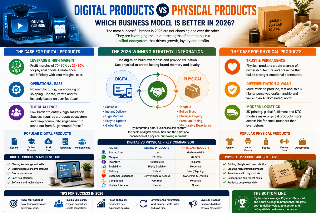
Digital vs. Physical Products: Choosing Your Business Model in 2026

The classic debate between digital and physical products has reached a new level of sophistication in 2026. While the digital gold rush offers unprecedented scale and margins, a counter-movement is seeing physical goods regain trust and emotional resonance. Whether you are a creator or an entrepreneur, understanding how these models interact is essential for building a resilient business.

Bisma 10 min 35

Popular

View all

Mixed Content

The Post-Visual Threat: Architecting Zero-Trust Defense Against Weaponized Deepfakes Business
Article Business

The Post-Visual Threat: Architecting Zero-Trust Defense Against Weaponized Deepfakes

The rapid weaponization of real-time voice cloning and synthetic video generation has transformed social engineering from opportunistic phishing into targeted executive identity emulation. High-profile incidents involving multi-million-dollar wire transfers authorized via synthetic video calls prove that sight and sound can no longer authenticate authorization. Securing modern enterprises requires an uncompromising zero-trust identity layer capable of neutralizing synthetic deception.

Mutwassim 3 min 0
Beyond the Battery: How Electric Mobility Is Forcing a Overhaul of the Global Power Grid Business
Article Business

Beyond the Battery: How Electric Mobility Is Forcing a Overhaul of the Global Power Grid

The global transition toward electric vehicles is no longer constrained primarily by battery chemistry or vehicle range. Instead, the real bottleneck has shifted directly to the electrical grid. As commercial fleets and passenger cars electrify at scale, utilities and city planners are racing to deploy vehicle-to-grid (V2G) bidirectional systems, AI-driven dynamic load balancers, and decentralized microgrid storage to avoid grid failure.

Mutwassim 3 min 0
Cloud 3.0: The Shift Toward Sovereign Data Architectures and Edge Computing Business
Article Business

Cloud 3.0: The Shift Toward Sovereign Data Architectures and Edge Computing

The architectural assumption that enterprise compute and storage should reside in a handful of centralized hyperscaler data centers is fracturing. Driven by strict cross-border data sovereignty regulations and the demand for millisecond-latency AI inference, global IT leaders are pivoting to Cloud 3.0—a model centered on distributed, locally governed, and hybrid sovereign architectures.

Mutwassim 3 min 0
The Rise of Autonomous Agentic Workflows: How Multi-Agent Systems Are Redefining Enterprise Operations Business
Article Business

The Rise of Autonomous Agentic Workflows: How Multi-Agent Systems Are Redefining Enterprise Operations

The generative AI paradigm is shifting from conversational assistants to goal-driven multi-agent architectures. Rather than waiting for manual inputs at every stage, autonomous agentic workflows now orchestrate complex reasoning, call external APIs, self-correct errors, and execute end-to-end tasks across distributed software ecosystems.

Mutwassim 3 min 0
Business
Article Business

The Edge Energy Revolution: How Silicon-Level Power Optimization and Next-Gen Battery Chemistries Are Redefining Modern Mobility and Connected Devices

Compute power has scaled dramatically over the last decade, but battery capacity and thermal limits have struggled to keep up. Now, a combined wave of high-density solid-state batteries, intelligent silicon power management, and local edge efficiency is closing the gap for electric vehicles, smartphones, and industrial sensors.

Mutwassim 9 min 15
The Quantum Infiltration Defense: Why Post-Quantum Cryptography (PQC) and Cryptographic Agility Are the Defining Cyber Battleground Business
Article Business

The Quantum Infiltration Defense: Why Post-Quantum Cryptography (PQC) and Cryptographic Agility Are the Defining Cyber Battleground

Public-key infrastructure is undergoing its most significant structural replacement in modern computing history. With NIST post-quantum standards finalized and adversaries executing large-scale data harvesting campaigns, global enterprises are transitioning from theoretical quantum awareness to full-scale post-quantum cryptographic migrations.

Mutwassim 9 min 16
One Piece Film God Valley: 2027 Movie, BAAD & What We Know Business
Article Business

One Piece Film God Valley: 2027 Movie, BAAD & What We Know

One Piece is getting two new theatrical movies. ONE PIECE FILM GOD VALLEY is scheduled for summer 2027, while ONE PIECE FILM BAAD is set for 2029. FindEdition breaks down the announcement, God Valley’s importance, the 2027 release window, what is known about BAAD, and what fans should expect next.

Agatha Christie 11 min 31