




Introduction
The business landscape has changed dramatically over the past decade. Entrepreneurs are no longer limited to opening physical stores or manufacturing products to build successful companies. Today, thanks to advances in technology, digital platforms, and artificial intelligence, anyone with valuable knowledge or a creative idea can launch a profitable business from almost anywhere in the world.
As we move through 2026, one of the biggest questions facing entrepreneurs is whether they should focus on selling digital products or physical products. Both business models have experienced remarkable growth, yet they offer very different opportunities, challenges, and long-term advantages.
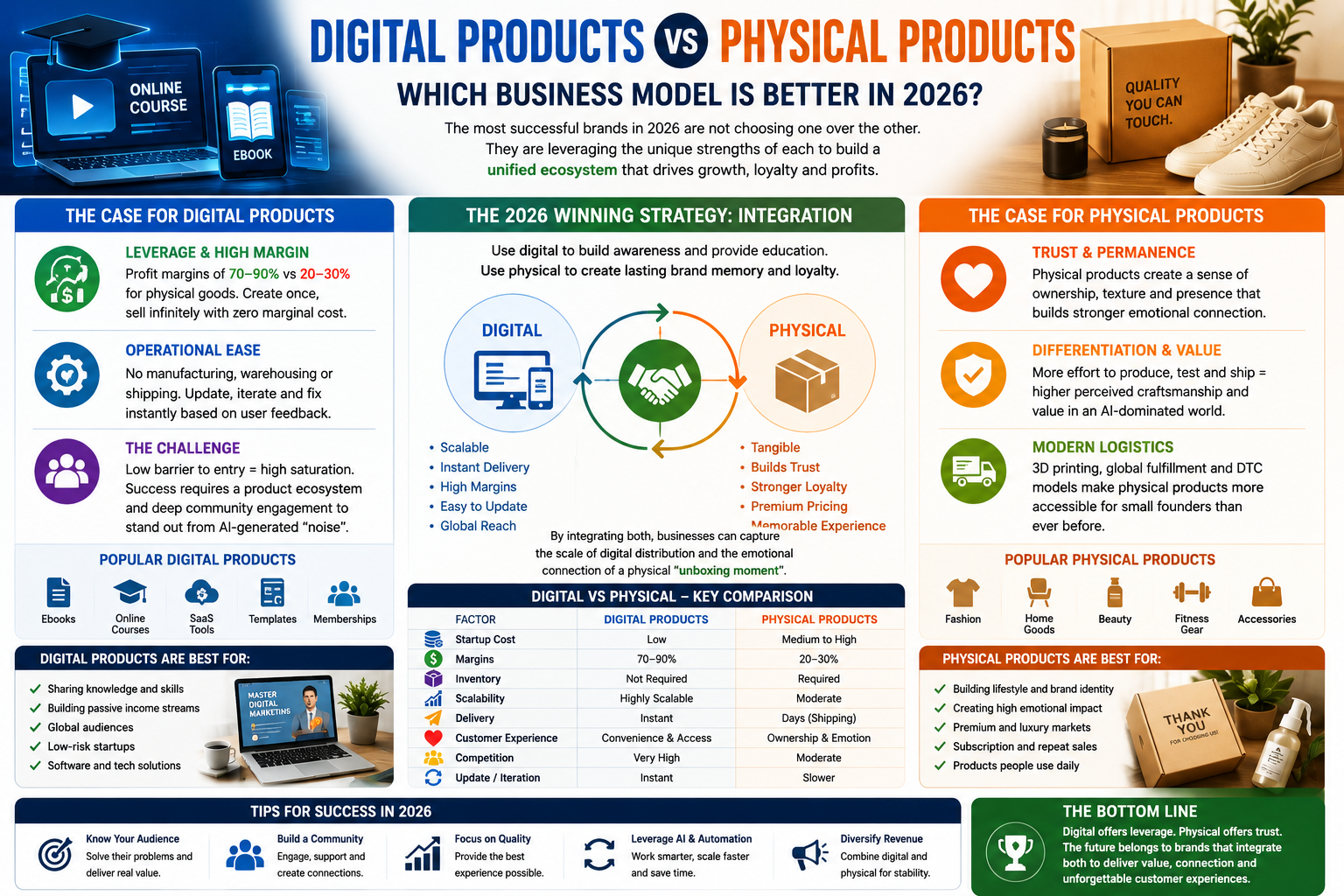
Digital products such as online courses, eBooks, software, templates, digital artwork, memberships, and downloadable resources have become increasingly popular because they require minimal inventory, offer high profit margins, and can be sold globally around the clock. At the same time, physical products continue to dominate consumer spending because people value tangible goods that provide real-world utility, emotional connection, and long-lasting ownership.
Rather than viewing these two models as direct competitors, many successful businesses are combining them into integrated ecosystems that maximize both profitability and customer loyalty. Digital products generate awareness, educate customers, and create recurring revenue, while physical products strengthen brand identity and deliver memorable customer experiences.
Choosing the right model depends on your goals, resources, target audience, and long-term business vision. Understanding the strengths and limitations of each approach will help entrepreneurs make smarter decisions in an increasingly competitive marketplace.
In this article, we compare digital products and physical products across profitability, scalability, customer experience, operational complexity, marketing, sustainability, and future growth to determine which business model offers the greatest opportunities in 2026.
Understanding Digital Products
Digital products are items delivered electronically rather than physically.
Customers purchase them online and receive instant access without shipping or manufacturing.
Examples include eBooks, online courses, software applications, mobile apps, templates, stock photography, music, digital planners, design resources, memberships, educational videos, and subscription-based platforms.
One of the greatest advantages of digital products is that they can be created once and sold repeatedly without producing additional inventory.
This creates exceptional scalability because serving one customer or one million customers often requires nearly identical operational effort.
Artificial intelligence has further accelerated digital product creation.
Modern creators use AI to develop educational content, design graphics, write marketing copy, generate videos, organize learning materials, and improve customer support.
As a result, entrepreneurs launch digital businesses faster than ever before.
The digital economy continues expanding as remote work, online education, creator platforms, and software services become increasingly integrated into everyday life.
For many entrepreneurs, digital products provide one of the most accessible paths toward building an online business.
Advantages of Digital Products
One of the strongest reasons entrepreneurs choose digital products is profitability.
Unlike physical goods, digital products require no manufacturing, packaging, warehousing, or shipping.
After the initial development process, additional sales generate very little extra cost.
This often results in significantly higher profit margins compared to traditional retail businesses.
Another major advantage is global accessibility.
Customers from different countries can purchase digital products instantly regardless of location.
Businesses operate continuously without being restricted by business hours or geographical limitations.
Automation further increases efficiency.
Payment processing, product delivery, customer onboarding, and email communication occur automatically through modern digital platforms.
Entrepreneurs also benefit from rapid product improvement.
If customers request additional features or identify errors, creators can release updates immediately without replacing physical inventory.
Digital businesses require relatively little startup capital.
Many successful creators begin with only a laptop, internet connection, and specialized knowledge.
This low financial barrier encourages innovation while reducing entrepreneurial risk.
Challenges of Digital Products
Despite their advantages, digital products present several challenges.
The low barrier to entry means competition has become increasingly intense.
Artificial intelligence enables almost anyone to generate digital content quickly, making it difficult for businesses to stand out.
Customers also face overwhelming numbers of choices.
Building trust therefore becomes essential.
Successful digital businesses focus on quality, expertise, customer support, and community engagement rather than simply producing large amounts of content.
Piracy presents another concern.
Unauthorized copying and distribution remain common challenges for software developers, course creators, designers, and authors.
Although digital rights management offers some protection, completely preventing piracy remains difficult.
Customer expectations also continue rising.
People expect regular updates, responsive support, intuitive user experiences, and continuous improvement.
Maintaining customer satisfaction requires ongoing attention long after product launch.
Success increasingly depends upon building an entire ecosystem rather than selling individual digital products alone.
Understanding Physical Products
Physical products remain the foundation of global commerce.
These include clothing, electronics, furniture, cosmetics, books, food, sporting equipment, household goods, medical devices, and countless other tangible items.
Unlike digital products, physical goods occupy space, require manufacturing, and involve logistics before reaching customers.
Despite rapid technological advancement, consumers continue valuing products they can touch, use, display, and integrate into everyday life.
Physical ownership creates emotional connections that digital downloads often cannot replicate.
A beautifully designed product becomes part of a customer’s home, office, wardrobe, or lifestyle.
This physical presence strengthens brand recognition while encouraging long-term customer loyalty.
Modern manufacturing technologies, global fulfillment services, and direct-to-consumer business models have made launching physical product businesses significantly easier than in previous decades.
Small entrepreneurs now compete internationally without owning factories or warehouses.
Advantages of Physical Products
Physical products offer several unique strengths that remain difficult for digital businesses to match.
One of the most important is customer trust.
People often associate tangible products with higher value because they involve visible craftsmanship, materials, packaging, and production processes.
Customers appreciate receiving professionally packaged items that create memorable unboxing experiences.
These moments strengthen emotional connections while encouraging social media sharing and word-of-mouth marketing.
Physical goods also create stronger brand visibility.
Products displayed in homes, offices, and public spaces continuously remind customers of the brand.
Many businesses benefit from repeat purchases.
Consumable products, cosmetics, supplements, household goods, and fashion items generate recurring customer demand.
Modern logistics have dramatically improved accessibility.
Third-party fulfillment services handle inventory management, shipping, returns, and international distribution.
Entrepreneurs therefore focus more on product development, branding, and marketing rather than operational complexity.
Challenges of Physical Products
Operating a physical product business involves significantly greater complexity.
Manufacturing requires investment, quality control, supplier management, and production planning.
Inventory introduces financial risk because unsold products occupy storage space while tying up business capital.
Shipping adds additional expenses.
Packaging materials, transportation costs, customs regulations, damaged products, and delivery delays affect profitability.
Supply chain disruptions also remain important considerations.
Material shortages, transportation delays, global events, and manufacturing interruptions may impact product availability.
Physical businesses generally require larger startup investments than digital businesses.
Entrepreneurs must carefully balance inventory levels against customer demand.
Managing these operational responsibilities requires stronger logistical planning than purely digital business models.
Comparing Profitability
Profitability depends upon multiple factors including pricing, production costs, marketing efficiency, customer acquisition, and operational expenses.
Digital products often generate exceptionally high profit margins because production costs occur primarily during development.
Once created, additional sales require minimal expense.
Physical products generally produce lower margins because businesses continuously purchase materials, manufacture inventory, package products, and pay shipping costs.
However, premium physical products often command significantly higher selling prices.
Luxury brands demonstrate that customers willingly pay substantial premiums for quality, craftsmanship, exclusivity, and emotional value.
Ultimately, profitability depends more on business strategy than product category alone.
Excellent execution creates successful businesses in both markets.
Customer Experience and Brand Loyalty
Customer relationships differ significantly between digital and physical products.
Digital experiences emphasize convenience, speed, accessibility, education, and ongoing value.
Customers appreciate instant access, continuous updates, and personalized learning experiences.
Physical products create memorable sensory experiences.
Texture, appearance, packaging, scent, weight, and quality all contribute to customer satisfaction.
Receiving a carefully packaged product often generates excitement unavailable through digital downloads.
Businesses increasingly combine both experiences.
Customers purchase physical products while receiving digital guides, exclusive memberships, educational videos, mobile applications, or online communities.
This integrated approach strengthens customer engagement while increasing lifetime value.
Scalability and Growth
Scalability represents one of the greatest differences between these business models.
Digital businesses scale remarkably efficiently.
Serving ten customers or ten thousand customers often requires similar operational effort.
Automation handles payment processing, delivery, customer onboarding, and communication.
Physical businesses scale differently.
Growing demand requires increased manufacturing, inventory, warehouse capacity, logistics, staffing, and supply chain coordination.
Although expansion requires greater operational planning, successful physical brands often achieve enormous long-term value through product innovation and customer loyalty.
Technology continues reducing operational barriers, making physical business growth more efficient than ever before.
The Role of Artificial Intelligence
Artificial intelligence now supports both digital and physical businesses.
Digital entrepreneurs use AI for content creation, software development, customer support, marketing automation, design, analytics, and personalization.
Physical businesses benefit through inventory forecasting, demand prediction, quality control, logistics optimization, customer service, product recommendations, and supply chain management.
AI improves decision-making across every stage of business operations.
Rather than replacing entrepreneurs, AI enhances productivity while allowing businesses to serve customers more efficiently.
Companies embracing intelligent automation gain stronger competitive advantages regardless of product category.
The Winning Strategy in 2026: Integration
The most successful businesses no longer choose between digital and physical products.
Instead, they integrate both into unified customer experiences.
A fitness company sells exercise equipment alongside digital workout programs.
A cosmetics brand offers skincare products with educational mobile applications.
A publishing company combines printed books with online learning platforms.
A clothing brand creates exclusive digital communities supporting physical merchandise.
Digital products educate customers, build trust, generate recurring revenue, and strengthen engagement.
Physical products reinforce brand identity while creating memorable ownership experiences.
This hybrid approach combines scalability with emotional connection.
Customers receive greater value while businesses diversify revenue streams.
Integration has become one of the defining characteristics of modern entrepreneurship.
Which Business Model Is Right for You?
The best choice depends upon individual goals and resources.
If you possess specialized knowledge, enjoy teaching, or prefer minimal startup investment, digital products may provide the ideal opportunity.
If you enjoy product design, branding, craftsmanship, and creating tangible customer experiences, physical products may better match your interests.
Many entrepreneurs eventually combine both approaches.
Starting with one model allows businesses to build experience before expanding into complementary offerings.
Regardless of your decision, customer value remains the most important factor.
Businesses succeed when they solve meaningful problems while consistently delivering exceptional experiences.
Final Thoughts
The debate between digital products and physical products is no longer about choosing one over the other.
Both models offer tremendous opportunities in 2026, each with unique strengths and challenges.
Digital products provide outstanding scalability, automation, global accessibility, and high profit margins.
Physical products create stronger emotional connections, higher perceived value, memorable customer experiences, and lasting brand loyalty.
Artificial intelligence has improved efficiency across both industries, allowing entrepreneurs to launch businesses faster, serve customers better, and operate more intelligently than ever before.
The most successful brands recognize that digital and physical products complement rather than compete with one another.
Digital experiences attract, educate, and engage customers.
Physical products deepen relationships and reinforce brand identity.
Businesses that integrate both strategies create resilient ecosystems capable of generating sustainable growth, stronger customer loyalty, and multiple revenue streams.
In the rapidly evolving business landscape of 2026, the winners will not simply sell products.
They will build complete experiences that combine the convenience of digital innovation with the lasting impact of physical ownership.