





Global Economy 2026: Navigating Geopolitical Uncertainty and the Rise of Artificial Intelligence
Introduction
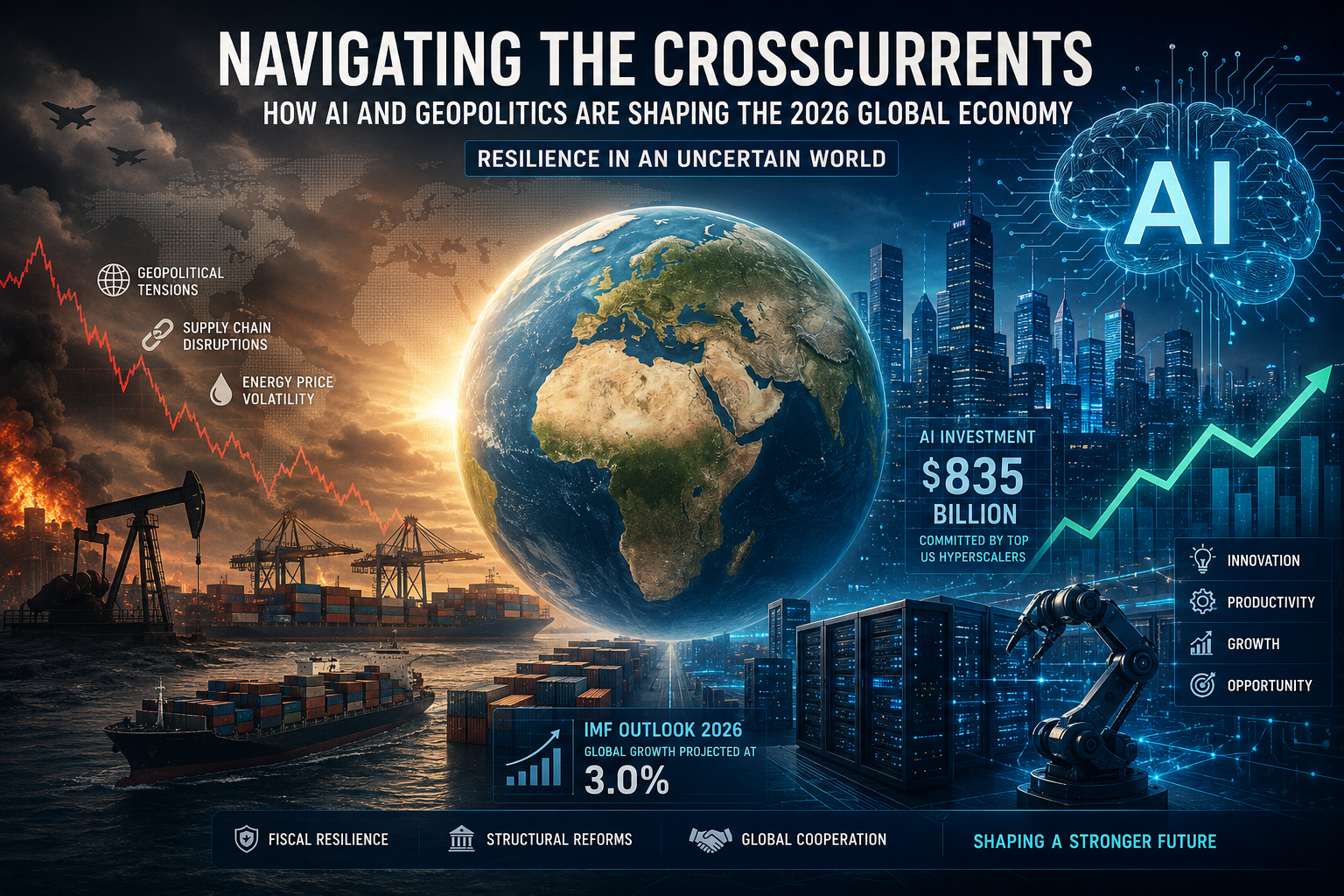
The global economy in 2026 stands at a fascinating crossroads. On one side, geopolitical tensions continue to create uncertainty for financial markets, international trade, energy supplies, and investor confidence. On the other, rapid advances in artificial intelligence are driving one of the largest waves of technological investment in decades, reshaping industries and creating new sources of economic growth.
Unlike previous periods where economic performance was dominated by a single factor, today's outlook is being shaped by the interaction of multiple global forces. Governments are managing inflation, central banks are balancing monetary policy, businesses are adapting to evolving supply chains, and technology companies are investing heavily in AI infrastructure that promises to transform productivity across nearly every sector.
Despite persistent geopolitical challenges, the International Monetary Fund (IMF) projects global economic growth of approximately 3.0% in 2026, indicating that the world economy continues to expand rather than contract. While growth remains uneven across regions, the forecast reflects the resilience of many economies amid ongoing external shocks. The IMF's latest World Economic Outlook notes that global growth is projected at about 3.0% in 2026, while emphasizing continued uncertainty from trade and geopolitical developments. International Monetary Fund
This combination of resilience and uncertainty has become one of the defining characteristics of the global economic landscape.
A Global Economy Defined by Two Powerful Forces
Economic conditions in 2026 cannot be explained by a single trend.
Instead, two major developments are shaping the outlook across virtually every region:
- Continued geopolitical instability affecting energy markets, trade, and investment.
- Accelerating adoption of artificial intelligence across industries.
These forces often pull economies in different directions.
While geopolitical uncertainty tends to slow investment and increase market volatility, technological innovation has created new opportunities for productivity, capital spending, and long-term growth.
The balance between these competing influences largely determines how individual economies perform throughout the year.
Geopolitical Tensions and Economic Pressure
Geopolitical events remain one of the most significant sources of uncertainty for the global economy.
Conflicts affecting strategic regions can influence:
- Energy prices.
- Shipping costs.
- Commodity markets.
- Investor confidence.
- International trade flows.
In particular, instability involving major energy-producing regions has renewed concerns about supply disruptions and transportation costs.
Although global supply chains have become more diversified in recent years, many industries continue to depend on stable international logistics networks.
Periods of heightened geopolitical tension often encourage businesses to strengthen contingency planning, diversify suppliers, and increase inventory management to reduce operational risk.
Energy Markets Under Pressure
Energy remains one of the most sensitive components of the global economy.
Oil and natural gas prices influence transportation, manufacturing, agriculture, and household expenses across nearly every country.
Energy-importing nations are generally more vulnerable to sudden price increases because higher import costs can contribute to inflation while reducing purchasing power for consumers and businesses.
Governments often respond by:
- Adjusting energy policies.
- Expanding strategic reserves.
- Supporting domestic energy production.
- Diversifying import sources.
- Encouraging energy efficiency initiatives.
Maintaining stable energy supplies remains a central economic priority for many countries.
Supply Chains Continue to Evolve
The disruptions experienced during recent years prompted businesses worldwide to rethink global supply chain strategies.
Rather than relying on single production hubs, many companies have invested in:
- Supplier diversification.
- Regional manufacturing.
- Inventory resilience.
- Digital logistics systems.
- Improved transportation planning.
Although these adjustments require significant investment, they are intended to improve long-term resilience against future disruptions.
As geopolitical conditions evolve, supply chain flexibility continues to play an increasingly important role in corporate decision-making.
Artificial Intelligence Becomes an Economic Growth Engine
While geopolitical developments have created challenges, artificial intelligence has emerged as one of the strongest drivers of investment and productivity.
AI is no longer viewed solely as an emerging technology.
Instead, it has become a strategic priority across multiple industries, including:
- Finance.
- Healthcare.
- Manufacturing.
- Retail.
- Software development.
- Scientific research.
- Transportation.
- Customer service.
Businesses increasingly view AI as a tool capable of improving efficiency, reducing operational costs, enhancing decision-making, and creating entirely new products and services.
As adoption expands, AI is becoming an increasingly important contributor to global economic activity.
Historic Investment in AI Infrastructure
One of the defining economic stories of 2026 is the enormous level of investment flowing into AI infrastructure.
Major technology companies continue to expand:
- Data centers.
- High-performance computing facilities.
- Semiconductor procurement.
- Cloud infrastructure.
- AI research laboratories.
According to industry reports, leading U.S. hyperscale technology companies are collectively planning hundreds of billions of dollars in capital expenditures dedicated largely to AI-related infrastructure and computing capacity over the coming years.
These investments support not only technology companies themselves but also manufacturers, construction firms, utilities, semiconductor producers, and numerous suppliers throughout the global economy.
The resulting capital expenditure has become an important source of broader economic momentum.
Technology's Expanding Economic Influence
The impact of AI extends well beyond the technology sector.
Many industries are already integrating AI into routine operations.
Examples include:
- Automating repetitive administrative work.
- Improving supply chain forecasting.
- Enhancing medical diagnostics.
- Accelerating software development.
- Optimizing manufacturing processes.
- Supporting financial risk analysis.
As organizations continue adopting AI, productivity gains may contribute to stronger long-term economic growth.
While the pace of adoption varies between industries and countries, the overall trend continues to expand.
Regional Differences in Growth
Not all economies experience identical conditions.
Countries more heavily exposed to geopolitical disruptions may encounter greater economic challenges, particularly if they depend on imported energy or vulnerable trade routes.
Meanwhile, economies with strong technology sectors, diversified industries, and substantial investment capacity often benefit more directly from AI-driven growth.
Several factors influence regional performance:
- Industrial structure.
- Trade relationships.
- Energy dependence.
- Labor market conditions.
- Technological readiness.
- Fiscal policy.
These differences help explain why economic growth projections vary considerably across regions despite similar global conditions.
Monetary Policy Remains a Key Factor
Central banks continue to balance two important objectives:
- Supporting sustainable economic growth.
- Maintaining price stability.
Interest rate decisions influence:
- Consumer borrowing.
- Business investment.
- Housing markets.
- Financial conditions.
- Currency values.
As inflation moderates in many economies, policymakers continue evaluating how monetary policy should evolve while remaining prepared to respond to unexpected economic developments.
Stable financial conditions remain essential for sustaining investment and consumer confidence.
Fiscal Resilience and Structural Reform
Many economists emphasize that long-term economic success depends not only on short-term growth but also on structural resilience.
Governments continue investing in areas such as:
- Infrastructure.
- Education.
- Digital transformation.
- Workforce development.
- Energy transition.
- Innovation ecosystems.
Structural reforms designed to improve productivity, encourage private investment, and strengthen public finances may enhance economic performance over the longer term.
Such measures also improve countries' ability to respond to future economic shocks.
Risks That Continue to Shape the Outlook
Although the overall global outlook remains positive, several risks continue to warrant close attention.
These include:
- Commodity price volatility.
- Geopolitical uncertainty.
- Supply chain disruptions.
- Inflationary pressures.
- Financial market volatility.
- Climate-related economic impacts.
Each of these factors has the potential to influence growth projections depending on how events evolve throughout the remainder of the year.
Businesses and policymakers therefore continue monitoring developments closely while maintaining contingency plans.
Why the Outlook Remains Positive
Despite ongoing uncertainty, the global economy has demonstrated considerable resilience.
Several factors contribute to continued expansion:
- Strong labor markets in many economies.
- Continued business investment.
- Technological innovation.
- Growing AI adoption.
- Improved supply chain flexibility.
- Expanding digital infrastructure.
Together, these developments help offset some of the pressures created by geopolitical uncertainty and slower growth in certain sectors.
Rather than pointing toward a synchronized global recession, many forecasts suggest a period of moderate but sustained expansion.
Looking Ahead
The second half of 2026 will likely be shaped by the interaction of technology, policy, and international developments.
Artificial intelligence is expected to remain a major driver of corporate investment and productivity improvements, while governments continue adapting to changing geopolitical and economic conditions.
Future performance will depend on several interconnected factors:
- Stability in global energy markets.
- Continued technological investment.
- Effective monetary and fiscal policy.
- Supply chain resilience.
- International cooperation on trade and investment.
Countries capable of balancing innovation with economic stability may be better positioned to benefit from the next phase of global growth.
Conclusion
The global economy in 2026 reflects a world navigating two powerful and opposing dynamics. Geopolitical tensions continue to challenge international trade, energy markets, and investor confidence, while the rapid expansion of artificial intelligence is generating unprecedented levels of technological investment and productivity growth. Together, these forces are reshaping how governments, businesses, and financial institutions approach economic planning.
Although uncertainty remains a defining feature of the current environment, the broader outlook continues to point toward measured expansion rather than contraction. Supported by resilient labor markets, ongoing AI-driven capital investment, and continued structural adaptation, many economies have demonstrated an ability to withstand external shocks while pursuing long-term growth.
As the year progresses, maintaining fiscal discipline, strengthening economic resilience, and embracing technological innovation will remain essential priorities. The nations and businesses that successfully combine these elements are likely to be best positioned to navigate an increasingly interconnected global economy while capitalizing on the opportunities created by the next generation of technological advancement.