


The Dawn of a New Rivalry: Mbappé and Haaland Lead Football Into a New Era
Introduction
For nearly two decades, world football revolved around one unforgettable rivalry. Lionel Messi and Cristiano Ronaldo set unprecedented standards, collecting trophies, breaking records, and inspiring millions across every corner of the globe. Their remarkable careers defined an entire generation of the sport, creating a benchmark that many believed would never be matched.
As those legendary careers gradually enter their final chapters, football finds itself at the beginning of a new era. Every generation eventually produces fresh stars capable of capturing the imagination of fans, and today's game appears to have found its next defining rivalry. Two players, each possessing extraordinary talent yet dramatically different styles of play, have emerged as the faces of modern football: Kylian Mbappé and Erling Haaland.
The rivalry between the French forward and the Norwegian striker is about far more than goals, trophies, or individual awards. It represents a fascinating contrast in football philosophy. Mbappé dazzles with explosive acceleration, technical brilliance, and creativity, while Haaland dominates through remarkable strength, intelligent positioning, and ruthless finishing. One thrives by creating moments of breathtaking speed and skill; the other overwhelms opponents through relentless efficiency and an uncanny ability to find the back of the net.
As both players continue to compete at the highest level for Europe's biggest clubs, their careers are becoming increasingly intertwined. Every domestic season, every UEFA Champions League campaign, every international tournament, and every individual award adds another chapter to a rivalry that could define football for the next decade.
A New Generation Takes Center Stage
Every era of football eventually experiences a changing of the guard. Legends retire, emerging talents mature, and the sport continually reinvents itself through new personalities and playing styles.
The transition from the Messi-Ronaldo era has been closely watched by supporters, analysts, and former players alike. Questions about who would inherit football's biggest stage persisted for years. While several outstanding footballers enjoyed periods of brilliance, two names gradually separated themselves from the rest through consistent performances and extraordinary production.
Kylian Mbappé and Erling Haaland represent a new generation of elite footballers whose influence extends well beyond statistics. Their performances have reshaped tactical discussions, altered defensive strategies, and generated excitement among supporters eager to witness football's next great rivalry.
Unlike previous comparisons that often relied on similar player profiles, Mbappé and Haaland offer strikingly different approaches to attacking football. Their contrasting strengths make comparisons particularly compelling because each excels in areas where the other possesses a different type of advantage.
Two Superstars, Two Football Philosophies
One of the reasons the rivalry resonates so strongly with modern audiences is that it showcases two distinct interpretations of attacking excellence.
Mbappé's football is built around movement, unpredictability, and acceleration. He can transform an ordinary attacking situation into a dangerous opportunity within seconds through quick decision-making, close control, and explosive pace. Defenders often find themselves reacting rather than anticipating because of his ability to change direction while maintaining remarkable speed.
Haaland approaches the game differently. His effectiveness comes from extraordinary positioning, physical presence, timing, and finishing ability. Rather than relying primarily on elaborate dribbling, he consistently places himself in areas where scoring opportunities are most likely to develop. His movement inside the penalty area has become one of the defining characteristics of his game.
This contrast creates an ongoing debate among football supporters. Some admire Mbappé's creativity and dynamic attacking style, while others appreciate Haaland's relentless consistency and remarkable efficiency in front of goal.
Kylian Mbappé: Football's Lightning Bolt
Speed That Changes Matches
Few players in football history have possessed acceleration comparable to Kylian Mbappé.
His greatest weapon is not simply maximum speed but the combination of rapid acceleration, balance, and technical control. Within only a few strides, he can create significant separation from defenders, forcing opposing teams to adjust their entire defensive structure whenever he is on the field.
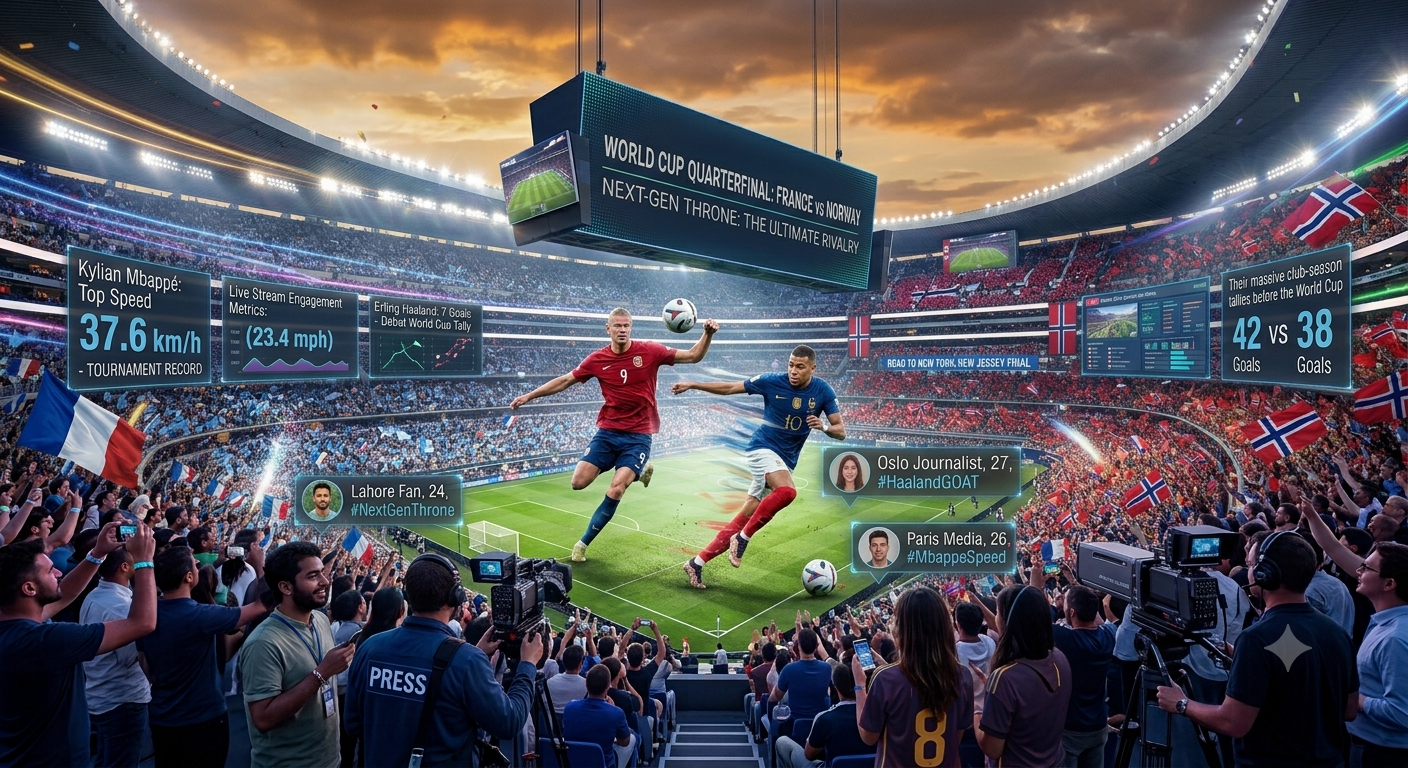
During the 2026 FIFA World Cup, Mbappé once again demonstrated why he is widely regarded as one of the fastest footballers in the game. Official tournament tracking recorded a top speed of 37.6 km/h (23.4 mph), placing him at the top of the tournament's speed rankings.
What makes this achievement particularly impressive is that such pace remains effective even against the world's strongest national teams, where defenders are among the fastest and most tactically disciplined in international football.
However, Mbappé's game extends far beyond speed alone.
He combines acceleration with:
- Outstanding dribbling ability.
- Intelligent movement into space.
- Clinical finishing.
- Creative passing.
- Tactical versatility across the front line.
These qualities allow him to influence matches in multiple ways rather than relying exclusively on pace.
Erling Haaland: The Ultimate Modern Number Nine
Built for Goals
While Mbappé often creates excitement through spectacular runs, Haaland has built his reputation on something equally valuable: scoring goals with astonishing regularity.
Standing among football's premier centre-forwards, Haaland combines physical strength, composure, and exceptional finishing into a profile that perfectly suits the demands of modern attacking football.
His size allows him to compete aerially and hold off defenders, while his movement ensures he consistently arrives in dangerous positions. Rather than requiring numerous opportunities, Haaland frequently converts a high percentage of the chances that come his way.
His debut FIFA World Cup campaign further reinforced this reputation. Despite Norway's quarterfinal exit against England, Haaland finished the tournament with seven goals, immediately establishing himself as one of international football's most dangerous strikers.
For many observers, his performances confirmed that his remarkable club scoring records could successfully translate to the biggest stage in world football.
Speed Versus Strength
Perhaps no aspect of the rivalry better captures public imagination than the physical contrast between the two players.
Mbappé's Athletic Profile
Mbappé thrives in open space.
His acceleration enables him to:
- Attack defensive lines.
- Launch devastating counterattacks.
- Exploit gaps behind defenders.
- Create numerical advantages during transitions.
Opponents often attempt to defend deeper simply to reduce the amount of space available for his runs.
Haaland's Physical Presence
Haaland presents an entirely different challenge.
Rather than outrunning defenders over long distances, he frequently overpowers them through positioning, timing, and strength.
His athletic profile allows him to:
- Dominate aerial duels.
- Shield possession.
- Finish from difficult angles.
- Convert crosses consistently.
- Remain effective inside crowded penalty areas.
Together, these contrasting styles illustrate that elite forwards can achieve success through very different skill sets.
Domestic Dominance
Club football remains the primary stage where both players build their reputations over the course of a long season.
Representing two of Europe's biggest clubs ensures that every campaign becomes another opportunity to compare their achievements.
Last season highlighted just how closely matched they remain.
Kylian Mbappé
Representing Real Madrid, Mbappé produced 42 goals in all competitions, demonstrating remarkable consistency while contributing across domestic and European competitions.
His influence extended beyond scoring, with his movement and creativity regularly shaping Madrid's attacking play.
Erling Haaland
Manchester City's Norwegian striker responded with 38 goals in all competitions, once again confirming his status as one of football's most reliable finishers.
His remarkable consistency has become one of his defining characteristics, providing City with a dependable source of goals across every competition.
Although their scoring totals differ slightly, both continue to perform at levels that place them among football's most productive attackers.
Champions League: The Ultimate Battleground
While domestic leagues provide consistency over many months, the UEFA Champions League remains football's greatest annual club competition.
For Mbappé and Haaland, Champions League nights have become defining moments within their growing rivalry.
Success in Europe often carries lasting significance because it places the world's strongest clubs against one another under enormous pressure.
Every knockout round presents opportunities for:
- Memorable goals.
- Match-winning performances.
- Individual recognition.
- Historic achievements.
As long as Real Madrid and Manchester City continue competing among Europe's elite, supporters can expect the Champions League to remain one of the rivalry's most compelling stages.
International Success
International football introduces a different dimension to the comparison.
Unlike club football, where squads can be strengthened through transfers, national teams depend on the available player pool within each country.
France has consistently entered major tournaments among the strongest national teams in world football, providing Mbappé with regular opportunities to compete for international trophies.
His performances in World Cup tournaments have further strengthened his reputation as a player capable of delivering under the sport's greatest pressure.
Haaland faces a different challenge with Norway. Although the national team continues to develop, international success depends on collective progress rather than individual brilliance alone.
Nevertheless, Haaland's impressive World Cup debut demonstrated that he can influence tournaments even without the depth traditionally associated with football's strongest nations.
The Race for Individual Honors
The Ballon d'Or has long represented one of football's most prestigious individual awards.
As the Messi and Ronaldo era fades into history, the competition for future Ballon d'Or titles appears increasingly centered around Mbappé and Haaland.
Supporters often evaluate several factors when discussing potential winners:
- Individual statistics.
- Team trophies.
- Performances in major tournaments.
- Consistency throughout the season.
- Influence during decisive matches.
Mbappé's ability to excel in international competitions strengthens his case, while Haaland's remarkable scoring efficiency at club level ensures he remains an equally compelling contender.
Each season introduces new variables, making predictions increasingly difficult.
More Than Statistics
Although goals and assists remain important indicators of performance, the rivalry extends beyond numerical comparisons.
Mbappé frequently influences games by stretching defenses, creating opportunities for teammates, and forcing tactical adjustments through his movement.
Haaland impacts matches differently, often requiring only a handful of touches to determine the outcome through clinical finishing.
Their contrasting approaches remind supporters that football greatness cannot always be measured by identical criteria.
Different styles can produce equally extraordinary results.
Inspiring the Next Generation
One of the defining characteristics of every football generation is the emergence of role models for young players.
Children practicing in parks, academies, and school grounds increasingly imitate the distinctive qualities of Mbappé and Haaland.
Some aspire to reproduce Mbappé's explosive dribbles and lightning-fast counterattacks. Others seek to emulate Haaland's movement, finishing, and physical dominance inside the penalty area.
Their influence is already shaping how future attackers develop their skills and approach the modern game.
Can This Rivalry Match Messi and Ronaldo?
Comparisons with Messi and Ronaldo are inevitable, but they should be approached carefully.
The previous rivalry benefited from extraordinary longevity, sustained excellence, and countless memorable encounters over nearly two decades.
Mbappé and Haaland are writing their own story rather than attempting to replicate another.
Their rivalry has the potential to become one of football's defining narratives, but its legacy will depend on years of continued excellence, adaptability, and success at both club and international levels.
Rather than replacing the previous generation, they represent the beginning of football's next great chapter.
The Future of Football's Biggest Rivalry
Looking ahead, the rivalry appears poised to intensify.
With both players competing at elite clubs, challenging for domestic championships, European titles, and international honors, opportunities for comparison will only continue to grow.
Each season promises fresh storylines, whether through remarkable goal-scoring achievements, dramatic Champions League encounters, or performances on the international stage.
Supporters around the world have already begun choosing sides, fueling debates that will likely continue for years to come.
Conclusion
As football enters a new era, Kylian Mbappé and Erling Haaland stand at the forefront of the sport's evolving landscape. Their contrasting styles—one built on breathtaking speed, creativity, and technical brilliance, the other on strength, precision, and relentless finishing—offer fans two equally compelling visions of attacking excellence.
Their achievements at both club and international level have already established them among the game's elite, and each passing season adds new chapters to a rivalry that could define the next decade of world football.
Whether history ultimately favors Mbappé's electrifying artistry or Haaland's extraordinary efficiency remains impossible to predict. What is already clear, however, is that football has found two exceptional talents capable of carrying the sport into its next golden age. For supporters everywhere, the privilege lies not only in witnessing their individual brilliance but also in watching a new rivalry emerge that promises to shape the future of the beautiful game for years to come.