




Introduction
Artificial intelligence has transformed from a simple marketing buzzword into the foundation of the modern smartphone experience. For years, AI-powered features depended heavily on cloud computing, requiring users to stay connected to the internet for tasks like voice recognition, image enhancement, and language translation. While these cloud-based systems introduced exciting capabilities, they also created concerns about privacy, speed, and reliability. Every request required sensitive data to travel to remote servers before returning with a result, often causing delays and raising questions about data security.
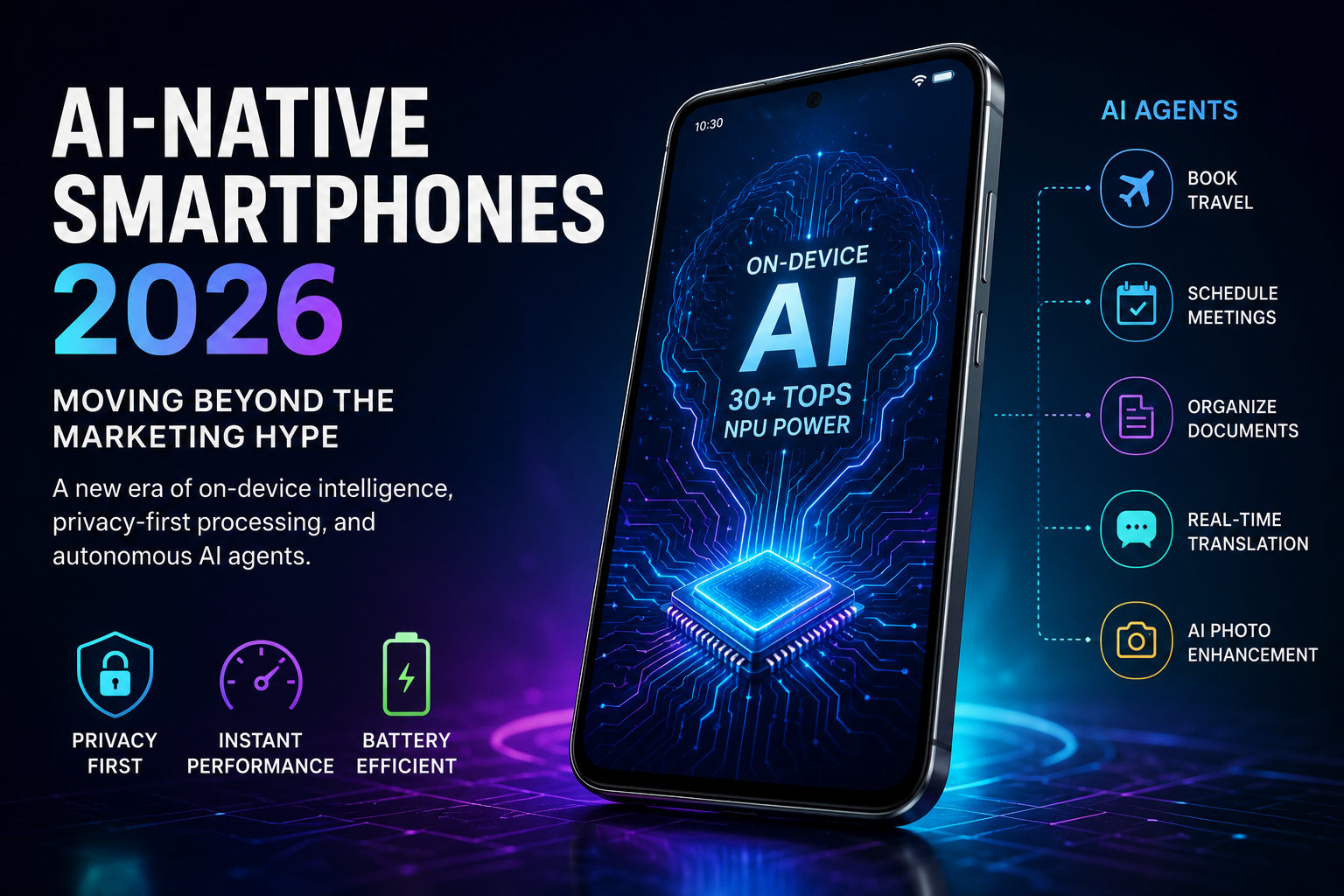
In 2026, the smartphone industry has entered a new era with the arrival of AI-native smartphones. Unlike previous generations, these devices are designed with specialized hardware capable of running complex artificial intelligence models directly on the phone. Instead of depending on cloud servers, AI-native smartphones process information locally using advanced Neural Processing Units (NPUs), delivering faster performance, stronger privacy protection, lower power consumption, and a significantly more intelligent user experience.
This shift is transforming smartphones from passive devices into proactive digital companions. They can now understand user habits, anticipate needs, automate workflows, and provide intelligent assistance even without an internet connection. As AI technology becomes more affordable, these capabilities are also expanding beyond premium flagship devices, making advanced mobile intelligence accessible to millions of users worldwide.
Understanding AI-Native Smartphones
An AI-native smartphone is a mobile device specifically engineered to perform artificial intelligence tasks directly on its internal hardware instead of relying on remote cloud servers. These smartphones contain dedicated AI processors that are optimized for machine learning operations, allowing them to complete billions of calculations every second.
Unlike traditional smartphones that send information over the internet for processing, AI-native devices analyze and process data locally. Whether editing photographs, translating conversations, summarizing documents, or recognizing objects in real time, these operations happen entirely on the device.
This local processing results in faster responses, improved security, lower latency, and greater reliability, especially in areas with weak or no internet connectivity.
The Power of Neural Processing Units (NPUs)
The biggest technological advancement behind AI-native smartphones is the Neural Processing Unit, commonly referred to as the NPU.
Unlike CPUs that handle general computing tasks or GPUs designed for graphics, NPUs are built specifically for artificial intelligence. Modern smartphone NPUs in 2026 deliver processing power exceeding 30 TOPS (Tera Operations Per Second), enabling them to perform sophisticated AI calculations almost instantly.
These processors accelerate tasks such as:
- Facial recognition
- Voice processing
- Live language translation
- AI photo enhancement
- Document summarization
- Predictive typing
- Scene recognition
- Smart battery optimization
Because NPUs are purpose-built for machine learning, they complete these tasks far more efficiently than conventional processors while consuming considerably less power.
Privacy-First Processing
Privacy has become one of the strongest selling points of AI-native smartphones.
Traditional cloud-based AI systems required users to upload sensitive information to external servers before processing could begin. This included photographs, messages, documents, health records, and voice recordings.
AI-native smartphones eliminate much of this concern by performing all major AI computations directly on the handset.
This privacy-first approach offers several important advantages.
Greater Data Security
Sensitive personal information remains stored on the device rather than being transmitted across the internet. This significantly reduces the risk of unauthorized access or data breaches.
Improved User Privacy
Since information never leaves the smartphone during processing, users gain greater confidence when using intelligent AI features for everyday tasks.
Compliance with Privacy Regulations
Many organizations and businesses increasingly prefer on-device AI because it helps satisfy stricter global privacy regulations by minimizing cloud data transfers.
Speed and Reliability Without the Cloud
One of the most noticeable improvements of AI-native smartphones is their incredible speed.
Cloud-based artificial intelligence requires information to travel from the smartphone to remote servers before returning with a response. Even with fast internet connections, this process introduces delays.
By processing information locally, AI-native smartphones complete tasks almost instantly.
Users experience immediate results when:
- Translating conversations
- Editing photographs
- Searching documents
- Generating summaries
- Recognizing objects
- Processing voice commands
Perhaps even more importantly, these features continue working without an internet connection, making AI-native devices significantly more dependable while traveling or in remote locations.
Better Battery Efficiency
Artificial intelligence workloads are extremely demanding.
When handled by standard CPUs or GPUs, these operations consume significant amounts of battery power.
Dedicated NPUs solve this problem by performing AI calculations much more efficiently.
As a result, AI-native smartphones can continuously analyze user behavior, optimize applications, monitor battery health, and improve system performance while consuming minimal energy.
Battery-saving AI features include:
- Adaptive charging
- Background app management
- Intelligent power allocation
- Smart display optimization
- Predictive battery management
These improvements extend both daily battery life and long-term battery health.
The Evolution from Assistants to AI Agents
Perhaps the biggest transformation in 2026 is the shift from traditional voice assistants to autonomous AI agents.
Earlier assistants could respond to simple commands such as setting reminders or opening applications.
Modern AI agents go much further.
They understand user context, analyze multiple applications simultaneously, and complete entire workflows automatically.
For example, a single request such as:
“Plan my business trip next week.”
may automatically:
- Search flights
- Compare hotel prices
- Book reservations
- Create calendar events
- Generate travel itineraries
- Organize documents
- Set reminders
- Share schedules
This intelligent automation dramatically increases productivity while reducing repetitive manual tasks.
Cross-App Intelligence
AI-native smartphones now understand relationships between different applications instead of treating each app independently.
For example, after receiving an email containing meeting information, an AI agent can automatically:
- Create a calendar appointment
- Save the attached documents
- Generate navigation directions
- Notify participants
- Schedule reminders
This seamless interaction between apps creates a much more intelligent and efficient smartphone experience.
Smarter Photography Through AI
Photography continues to benefit enormously from on-device artificial intelligence.
Instead of relying solely on hardware improvements, AI-native smartphones now analyze every scene before capturing an image.
They automatically optimize:
- Lighting
- Exposure
- White balance
- Dynamic range
- Portrait separation
- Skin tones
- Noise reduction
- HDR processing
These intelligent enhancements produce consistently impressive photographs regardless of lighting conditions.
Generative AI Editing
Generative AI has become one of the most exciting smartphone innovations of 2026.
Users can now perform advanced photo editing using simple instructions.
Popular AI editing features include:
- Removing unwanted objects
- Expanding image backgrounds
- Changing skies
- Improving portraits
- Eliminating reflections
- Repairing damaged photos
- Reconstructing missing image details
These capabilities allow professional-quality editing directly from a smartphone without specialized software.
AI-Powered Productivity
AI-native smartphones are becoming indispensable productivity tools for professionals, students, and businesses.
Modern devices can assist with:
- Writing emails
- Summarizing documents
- Creating meeting notes
- Organizing files
- Transcribing conversations
- Translating languages
- Generating presentations
These intelligent features help users complete everyday work more efficiently while saving valuable time.
Real-Time Language Translation
Communication across different languages has become faster and more natural.
AI-native smartphones now provide instant translation during:
- Phone calls
- Video meetings
- Face-to-face conversations
- Text messaging
- Email communication
Because processing occurs locally, translations remain fast, secure, and available even when internet access is limited.
AI for Personalized User Experiences
Artificial intelligence is increasingly learning how individual users interact with their devices.
By studying daily habits, smartphones can:
- Predict commonly used applications
- Suggest reminders
- Recommend travel routes
- Adjust brightness automatically
- Prioritize notifications
- Optimize charging schedules
This personalization creates an experience tailored specifically to each user’s lifestyle.
The Democratization of Artificial Intelligence
Perhaps the most important development in 2026 is that advanced AI is no longer limited to expensive flagship smartphones.
Chip manufacturers are integrating increasingly powerful NPUs into mid-range processors, allowing affordable devices to offer premium AI features.
Consumers can now enjoy:
- AI image editing
- Smart object removal
- AI writing assistants
- Intelligent voice transcription
- Scene recognition
- Battery optimization
- Live translation
without paying flagship prices.
This democratization is accelerating AI adoption across the entire smartphone market.
Choosing an AI-Native Smartphone
When purchasing an AI-native smartphone, buyers should consider several important features:
- Powerful Neural Processing Unit (30 TOPS or higher)
- Long software support
- Advanced AI photography
- Excellent battery efficiency
- Strong privacy protections
- Offline AI capabilities
- Cross-app automation
- Reliable thermal management
Choosing a device with these capabilities ensures long-term performance as AI technology continues evolving.
The Future of AI-Native Smartphones
The future of AI-native smartphones is incredibly promising. As neural processors become more powerful and efficient, smartphones will evolve into even smarter personal assistants capable of anticipating user needs before they are expressed.
Future innovations are expected to include advanced health monitoring, smarter augmented reality experiences, more sophisticated autonomous AI agents, improved creative tools, and even deeper integration across smart home devices and wearable technology. On-device AI will continue reducing dependence on cloud services while delivering faster, more secure, and more personalized experiences.
Conclusion
The emergence of AI-native smartphones represents one of the most significant shifts in the history of mobile technology. By moving artificial intelligence from cloud-based systems to powerful on-device Neural Processing Units, smartphones in 2026 have become faster, more private, more efficient, and considerably more intelligent. From instant language translation and professional-grade photo editing to autonomous AI agents capable of managing complex tasks, these devices are redefining how people interact with technology.
Equally important is the growing accessibility of these innovations. As advanced NPUs become standard across mid-range processors, premium AI features are no longer exclusive to flagship smartphones. This democratization ensures that millions of users can benefit from intelligent mobile experiences regardless of budget.
AI-native smartphones are no longer simply communication devices—they are becoming trusted digital companions that enhance productivity, creativity, security, and everyday convenience. As on-device artificial intelligence continues to evolve, it will shape the future of mobile computing and establish a new benchmark for what users expect from their smartphones.