





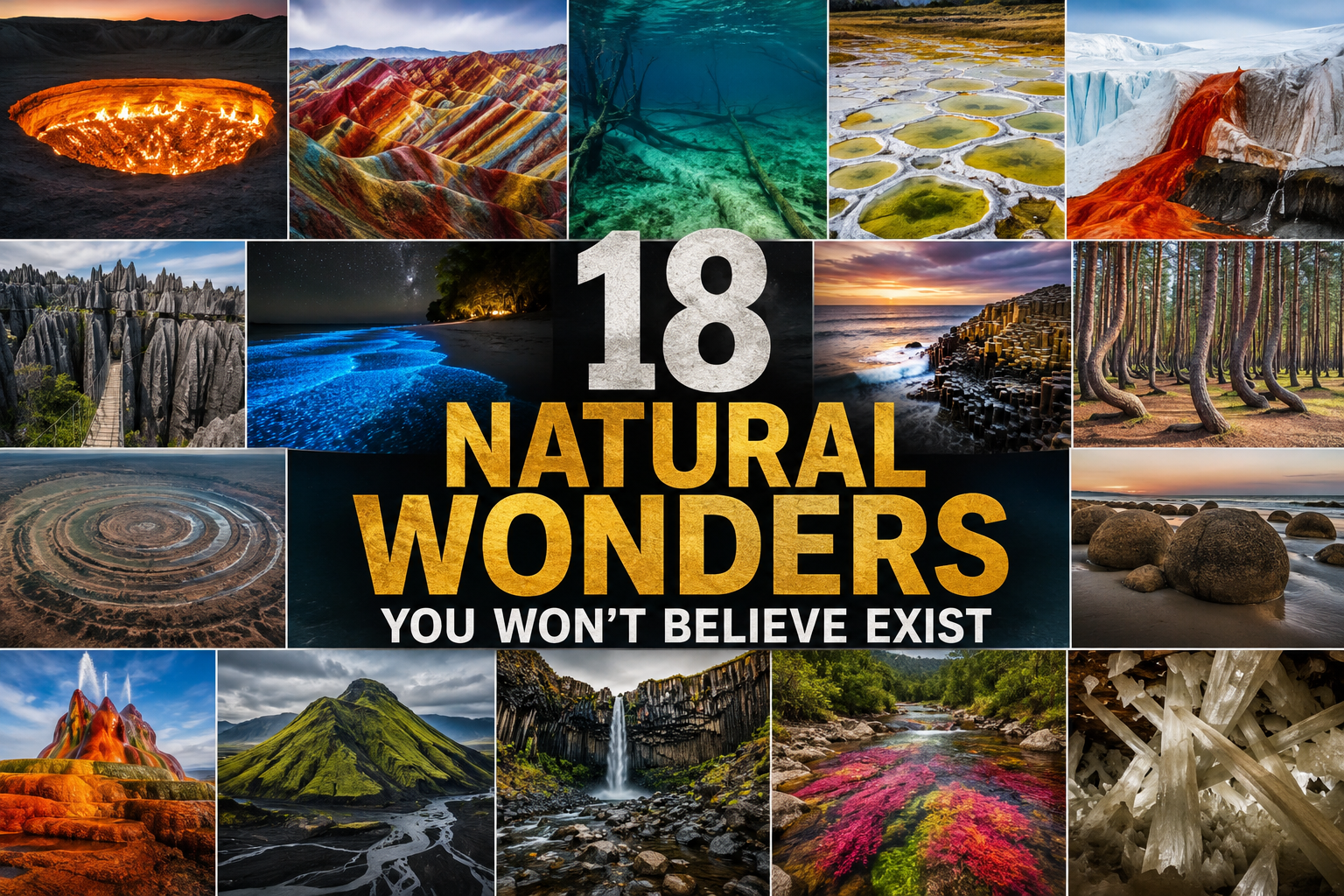
Our planet is an artist, a sculptor, and an architect of the surreal. While we often celebrate the famous icons—the Grand Canyon, Everest, Victoria Falls—hidden in the folds of the Earth are landscapes so bizarre, so colorful, and so defying of logic that they feel ripped from the pages of fantasy. Prepare to have your sense of reality challenged as we explore 18 natural wonders that you won't believe exist.
1. The Door to Hell (Darvaza Gas Crater) - Turkmenistan
Imagine a fiery pit, glowing with intense heat and light, that has been burning continuously for over five decades. Located in the Karakum Desert, the Darvaza Gas Crater is a collapsed natural gas field that Soviet engineers set ablaze in 1971, expecting it to burn out in a few weeks. Instead, it became an eternal, mesmerizing inferno, a glowing crater 69 meters (226 ft) wide and 30 meters (98 ft) deep. It’s a terrifyingly beautiful testament to the raw, uncontainable power locked beneath the Earth's crust.
2. The Rainbow Mountains (Zhangye Danxia) - China
If you took a paintbrush to a mountain range, you might create something like the Zhangye Danxia Landform. These mountains look less like geology and more like a vibrant, flowing silk tapestry. Layers of different colored sandstone and mineral deposits were pressed together over millions of years, then folded by tectonic plates and sculpted by wind and rain into a kaleidoscopic series of rolling hills. The colors range from deep crimson and maroon to bright yellows and emerald greens, creating a surreal landscape that seems too perfect to be real.
3. The Underwater River (Cenote Angelita) - Mexico
Descending into the depths of the Cenote Angelita, a sinkhole in the Yucatan Peninsula, divers encounter a scene that defies the laws of physics: a flowing river, complete with banks and trees, moving along the ocean floor. This "river" is actually a thick layer of hydrogen sulfide—a dense cloud of decaying organic matter—that has separated from the saltwater above. As you sink through the freshwater, you pass through this misty, ethereal layer, looking down onto a spectral landscape that appears exactly like a river winding through a submerged forest.
4. The Spotted Lake (Klip) - Canada
Each summer, as the intense heat of the British Columbia sun evaporates most of the water in Spotted Lake, the landscape transforms into a polka-dot pattern of alien pools. The lake is incredibly rich in various minerals, including calcium sulfate, sodium sulfate, and magnesium sulfate. When the water recedes, these minerals crystallize into hardened rings around hundreds of separate, circular pools, each taking on a different hue (from pale yellow to deep blue and green) depending on its unique mineral composition. It looks less like a lake and more like an artist’s palette or a strange, alien landing site.
5. The Blood Falls - Antarctica
In the stark, white expanse of Antarctica's Taylor Glacier, a gash of deep, terrifying red bleeds onto the pristine ice. This is Blood Falls. The source isn't a gruesome secret, but a scientific marvel. A sub-glacial lake, trapped for millions of years and completely isolated from light and oxygen, is rich in iron and microbes. When this ancient, briny water finds a fissure to the surface, it reacts with the air, instantly rusting and turning the water a shocking, vibrant crimson against the white backdrop, creating a hauntingly beautiful, high-contrast scene.
6. The Stone Forest (Tsingy de Bemaraha) - Madagascar
Imagine an entire forest made not of trees, but of razor-sharp, towering limestone needles. The Tsingy de Bemaraha Strict Nature Reserve in Madagascar is a labyrinth of karst formations, known locally as "tsingy," which translates to "where one cannot walk barefoot." This alien landscape was formed over millennia as groundwater carved deep fissures into the limestone plateau, leaving behind a dense, jagged "forest" of spires that can reach up to 120 meters (394 ft) high. It is a fortress of rock, nearly impassable and home to unique species found nowhere else on Earth.
7. The Bioluminescent Shores (Vaadhoo Island) - Maldives
By day, the beaches of Vaadhoo Island are tropical paradises. By night, they transform into a mirror of the starry sky. The waves lapping against the shore glow with a mystical, electric blue light, an effect created by bioluminescent phytoplankton in the water. When these tiny marine organisms are disturbed by the movement of the waves, they emit a flash of light as a defense mechanism. The result is a breathtaking, ethereal spectacle where you can walk along the water's edge and leave footprints that glow in the dark, a truly magical experience.
8. The Giant’s Causeway - Northern Ireland
It's easy to see why this formation inspired legends of giants. The Giant’s Causeway consists of about 40,000 interlocking basalt columns, the result of an ancient volcanic fissure eruption. As the molten basalt cooled rapidly, it contracted and fractured into perfectly geometric polygonal columns—mostly hexagons—that fit together like tiles. The columns create stepping stones that lead from the cliff face and disappear into the sea, forming a geometric pathway that looks too orderly to be a natural formation.
9. The Crooked Forest (Krzywy Las) - Poland
Just outside the village of Nowe Czarnowo, a grove of 400 pine trees holds a strange secret. Each tree in this forest takes a sharp, 90-degree turn near its base, growing horizontally for a short distance before curving back upwards to grow vertically. The trunks are curved like a question mark. The cause of this bizarre deformation remains a mystery, though it’s widely believed to be the result of human intervention in the 1930s, perhaps for furniture making, but the trees were abandoned before they could be harvested. Whatever the cause, the result is a haunting and inexplicable woodland.
10. The Richat Structure (Eye of the Sahara) - Mauritania
From space, the Sahara Desert is punctuated by a massive, concentric bullseye, a formation so large (50 km / 30 miles wide) it was used as a landmark by early astronauts. The Richat Structure, often called the Eye of the Sahara, looks like a cosmic impact crater, but it's actually a deeply eroded, symmetrical geological dome that has been exposed by wind and erosion. The alternating layers of resistant quartzite form the distinct rings, creating a geological masterpiece that appears as if a giant eye is staring back at the cosmos.
11. The Moeraki Boulders - New Zealand
Scattered along Koekohe Beach like oversized, alien marbles are the Moeraki Boulders. These massive, spherical concretions—some weighing several tonnes and measuring two meters across—are naturally formed over millions of years. They started as calcite deposits around a core (like a shell or bone) within the seabed mud and grew outward, layer by layer, much like a pearl. As the softer mudstone cliffs eroded, these giant stone spheres were released and now rest on the beach, a collection of perfect, giant marbles waiting for a giant game.
12. The Fly Geyser - USA
In the middle of the Black Rock Desert in Nevada, a geyser erupts not from the ground, but from a colorful, alien-looking mound. The Fly Geyser was created accidentally in 1964 during a geothermal well-drilling test. The plug failed, allowing continuously boiling mineral-rich water to escape. Over decades, dissolved minerals have built up a travertine mound, covered in thermophilic algae that thrive in the hot water, painting the structure in vibrant shades of red, orange, and green. It’s a constant, colorful fountain that looks like it belongs on another planet.
13. The Maelifell Volcano - Iceland
Rising from the stark, black volcanic ash of the Mýrdalsjökull glacier is Maelifell, a perfectly conical, vibrant green mountain. This volcano is covered in thick, lush, bright green moss (Grimmia), which contrasts dramatically with the surrounding dark desert of black volcanic sand and glacial rivers. It is a beacon of life in a dead landscape. Accessible only in the summer and requiring a 4x4 vehicle to ford rivers, it is one of Iceland’s most remote and visually arresting sights.
14. The Svartifoss Waterfall - Iceland
Svartifoss, or "Black Fall," is a relatively small waterfall in Iceland, but its setting is dramatic. It is framed by massive, sheer walls of black hexagonal basalt columns, similar in formation to the Giant's Causeway but acting as a dark, organ-pipe backdrop to the white water. The contrast between the dark, geometric rock and the soft, flowing water makes it a photographer's dream and a powerful visual statement of nature's sculptural abilities.
15. The Cano Cristales (River of Five Colors) - Colombia
For most of the year, Cano Cristales is an unremarkable river. But for a short period between the wet and dry seasons (usually from July to November), the riverbed explodes into a riot of color. This is due to the endemic plant species *Macarenia clavigera*, which turns brilliant shades of red, pink, yellow, green, and blue depending on the water level and sunlight. The effect is mesmerizing, as if a liquid rainbow is flowing through the Colombian jungle, making it widely considered the most beautiful river in the world.
16. The Cave of the Crystals (Naica Mine) - Mexico
Located 300 meters (1,000 ft) below the surface in a working mine, this is a place of deadly beauty. The Cave of the Crystals is a geode containing some of the largest natural selenite crystals ever found, with some beams measuring 12 meters (39 ft) long and weighing 55 tons. These giant crystals formed over hundreds of thousands of years in a stable, flooded, and geothermally heated environment. It’s an inhospitable environment—hot and humid—but for those who enter, it’s like stepping into a fortress of light, a place where the Earth has grown colossal jewels.
17. The Grand Prismatic Spring - USA
Yellowstone National Park is a land of geothermal wonders, but none are as vibrant as the Grand Prismatic Spring. It is the largest hot spring in the United States and the third largest in the world. Its stunning rainbow of colors—a brilliant blue center surrounded by bands of orange, yellow, green, and red—is not an optical illusion. The colors are created by different species of thermophilic (heat-loving) bacteria and archaea that live in the progressively cooler water radiating from the center. The blue center is sterile due to extreme heat, while the colored rings are "mats" of millions of microbes.
18. The Waitomo Glowworm Caves - New Zealand
Venture deep underground into the Waitomo Caves and you'll find yourself under a galaxy of your own. The cave walls and ceiling are covered by thousands of native New Zealand glowworms (*Arachnocampa luminosa*). These tiny creatures create constellations of soft, blue-green light that illuminate the darkness, reflecting in the underground river below. It is a silent, serene, and magical experience that makes you feel as though you have left the Earth and are floating through deep space.
Conclusion
The world is far stranger, far more colorful, and far more creative than we often give it credit for. From fiery pits and mountains of color to submerged rivers and glowing caves, these 18 natural wonders are proof that reality can be more fantastical than any fiction. They remind us of the immense geological forces that shape our planet and the delicate, tenacious life that finds a way to thrive in the most extreme conditions. To visit these places is to be humbled by the sheer audacity of nature’s imagination.