



Apple vs. Samsung in 2026: The Ultimate Showdown for AI Supremacy
The smartphone landscape of 2026 is unrecognizable from just a few years ago. The spec wars—megapixel counts and gigahertz speeds—have taken a back seat to a new, more cerebral battleground: Artificial Intelligence. As we analyze the latest offerings from Cupertino and Seoul, the perennial rivalry between Apple and Samsung has evolved into a high-stakes competition for AI supremacy, determining not just which phone is faster, but which one knows you better.
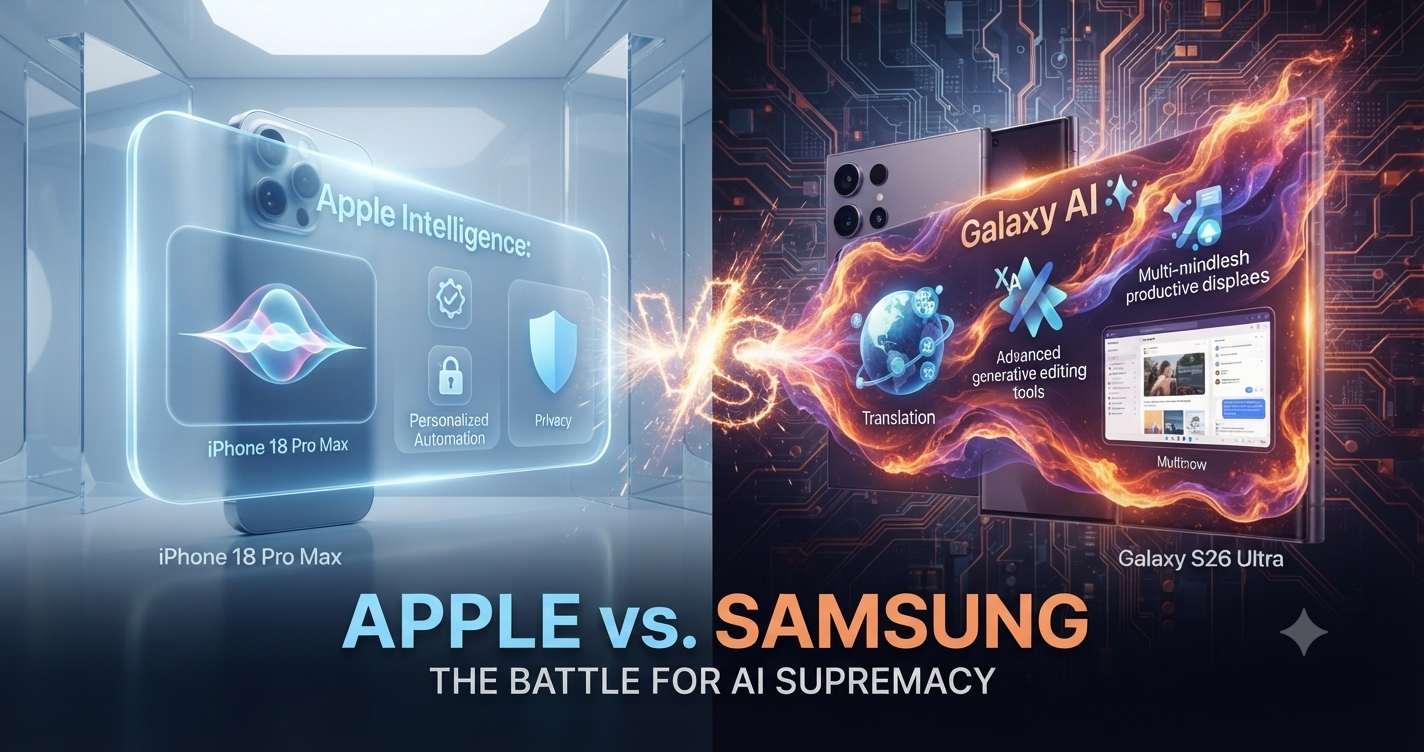
This year, the choice isn't just about iOS versus Android; it's about Apple Intelligence versus Galaxy AI. Let's dive into the five key pillars defining the Apple vs. Samsung battle in 2026.
1. The Brains: Apple Intelligence vs. Galaxy AI
By 2026, both Apple and Samsung have deeply integrated AI into the core of their operating systems, but their approaches differ significantly.
- Apple Intelligence (iOS 20+): Apple has focused on a highly personalized, privacy-first approach. Siri has been completely rebuilt, functioning not just as a voice assistant, but as a proactive, on-device agent that understands the context of your entire digital life—your emails, messages, calendar, and photos. It acts as the ultimate personal assistant, anticipating needs and automating complex multi-app tasks seamlessly. The emphasis is on security, with most processing happening on-device.
- Galaxy AI (One UI 8+): Samsung, leveraging its partnership with Google, offers a broader, more experimental AI suite. Galaxy AI is characterized by its versatility and "power user" features. It excels in real-time, cross-language communication, advanced generative photo and video editing, and deep integration with Google's vast ecosystem of services. Samsung's AI is more about augmenting creativity and productivity with powerful, often cloud-based tools.
2. Design and Hardware: Iteration vs. Innovation
This is where the traditional philosophies of the two companies shine through.
Apple continues its path of iterative refinement. The iPhone 18 Pro Max features an even more durable, aerospace-grade titanium alloy chassis with subtly curved edges that improve ergonomics. The significant change is under the display: the "Dynamic Island" is gone, replaced by a completely invisible, under-display Face ID and camera system, offering a true, uninterrupted all-screen experience. The focus is on flawless execution and premium feel.
Samsung, conversely, pushes the boundaries of form factor. The Galaxy S26 Ultra retains its boxy, S Pen-integrated design but is astonishingly thin and light. The real star is the S26 Fold (and its more affordable cousin, the S26 Flip), which have matured into mainstream devices. The crease is virtually imperceptible, and the hinge mechanism is robust, making the foldable experience truly viable for daily use. Samsung caters to those who want technology that transforms.
3. Camera Capabilities: Computational Photography vs. Zoom Versatility
Both companies have incredible camera systems, but they excel in different areas.
Apple’s camera system is a masterpiece of computational photography. The iPhone 18 Pro Max introduces a groundbreaking quad-pixel sensor that excels in low-light performance and dynamic range. Its "Photonic Engine" uses AI to reconstruct images, resulting in stunningly realistic and balanced photos in any condition. It is the undisputed king of video recording, offering unparalleled stabilization, cinematic depth, and ProRes workflows that professionals rely on.
Samsung’s Galaxy S26 Ultra, however, is the zoom champion. Its 200MP primary sensor is impressive, but the headline remains the 10x optical telephoto lens, which combines with AI-enhanced digital zoom to deliver usable, clear shots at 100x. Samsung also offers a more extensive suite of creative shooting modes, including improved AstroHyperlapse and AI-powered director's view, appealing to creative experimenters.
4. Performance and Battery Life: Efficiency vs. Power
Under the hood, the competition is fierce.
Apple’s custom A20 Bionic chip continues to set the benchmark for power efficiency. Built on a cutting-edge 2nm process, it delivers blistering single-core performance, making iOS fluid and responsive. More importantly, its efficiency, combined with Apple's tight hardware-software integration, results in class-leading battery life that easily lasts through two days of moderate use.
Samsung, utilizing the latest Snapdragon for Galaxy processor (also on a 2nm process), focuses on raw, multi-core power to handle its demanding AI tasks. The S26 Ultra is a multitasking powerhouse, capable of running complex AI models while juggling multiple apps. While its battery life is excellent and charges faster than the iPhone, it generally falls just short of Apple’s endurance crown.
5. Ecosystem Lock-in: The Walled Garden vs. The Open Playground
This is often the deciding factor for consumers.
Apple’s ecosystem remains a formidable "walled garden." The synergy between the iPhone, Mac, iPad, Apple Watch, and Vision Pro headset is unmatched. Features like Universal Control, Handoff, and AirDrop create a frictionless experience that "just works." Once you're in, it's incredibly difficult (and expensive) to leave.
Samsung offers an "open playground," leveraging its partnership with Google and Windows. The Galaxy S26 Ultra integrates seamlessly with Windows PCs (Phone Link), Google services, and a wide array of smart home devices (SmartThings). Samsung also offers a diverse ecosystem of tablets, wearables, and appliances, giving users more freedom and flexibility in how they build their digital life.
The Verdict: Which Titan Wins Your Pocket in 2026?
The Apple vs. Samsung rivalry in 2026 is more a reflection of personal values than a simple judgment of better or worse hardware.
- Choose Apple if: You prioritize a seamless, privacy-focused AI experience that integrates flawlessly into your life; you value premium, durable design; you need the best-in-class video capabilities; and you are deeply invested in (or enticed by) the Apple ecosystem.
- Choose Samsung if: You want cutting-edge, versatile hardware, including the option of foldables or the S Pen; you crave powerful, feature-rich AI tools for communication and creativity; you need an unmatched zoom camera; and you prefer the flexibility of an open ecosystem.
The battle for AI supremacy is far from over. In 2026, both Apple and Samsung have delivered their most compelling devices yet. The winner, ultimately, is you, the consumer, who now has more powerful and intelligent tools than ever before.