




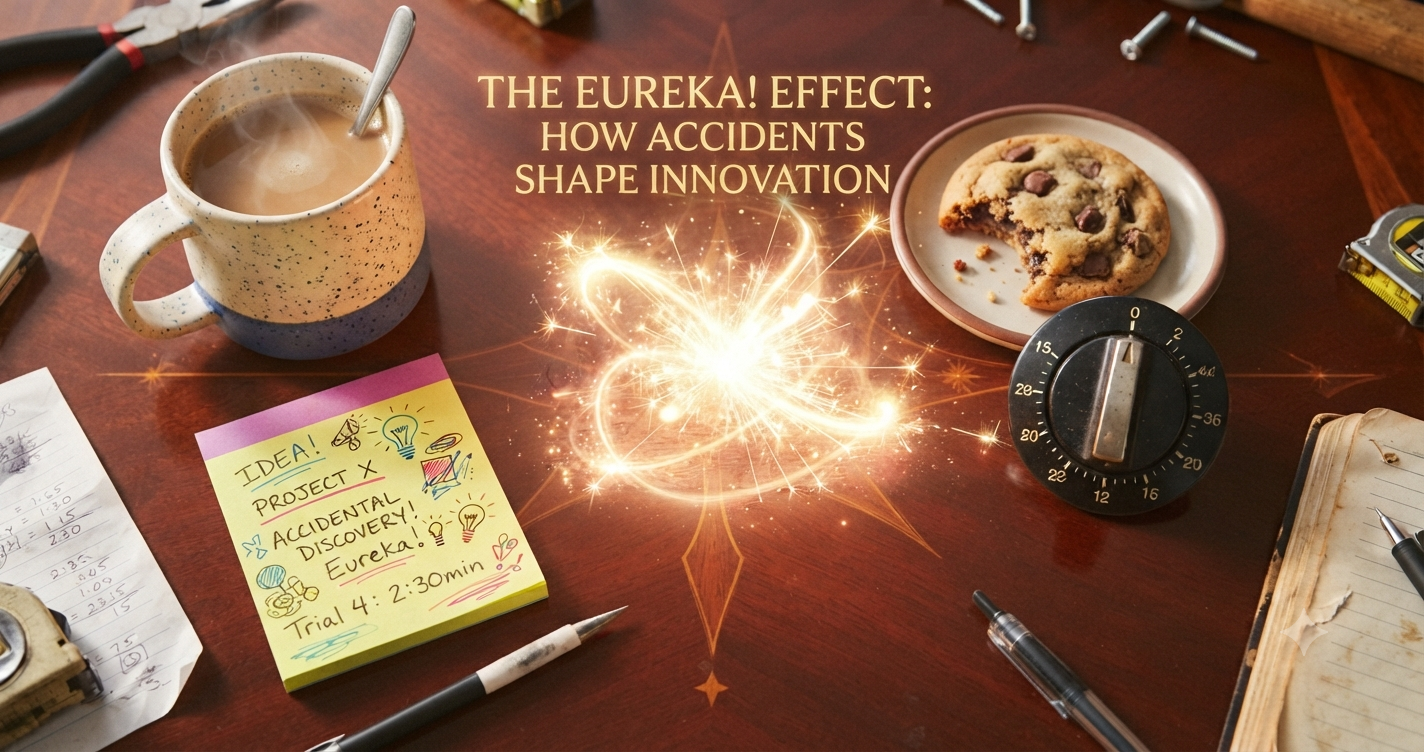
Necessity is often called the mother of invention. Throughout human history, brilliant minds have spent decades drawing blueprints, running rigorous experiments, and burning the midnight oil to solve complex technological puzzles. However, if you look closely at the history books, you will find that a shocking number of items we rely on every single day were not engineered at all. They were complete and utter accidents.
Sometimes, science and innovation are propelled forward not by meticulous planning, but by sheer serendipity—a distracted researcher, a melted candy bar, or a failed adhesive. Let us dive into the fascinating stories behind everyday objects that were invented completely by mistake.
1. The Microwave Oven: A Melted Candy Bar in a Pocket
It is hard to imagine modern life without the microwave oven. Whether you are reheating last night's takeout or popping a bag of popcorn, this kitchen appliance is a staple of convenience. Its creation, however, came down to a sticky candy bar and a piece of military radar equipment.
In 1945, an American engineer named Percy Spencer was working for the Raytheon Corporation building magnetrons—vacuum tubes used in radar systems. One day, while standing in front of an active radar set, Spencer felt a strange sensation in his pocket. He reached down and discovered that his peanut cluster candy bar had completely melted into a gooey liquid mess.
Intrigued, Spencer decided to test the phenomenon. He placed popcorn kernels near the magnetron, and they popped all over the lab. Next, he tried an egg, which exploded in a colleague's face due to the rapid internal steam buildup. Spencer realized that low-density microwave radiation could cook food quickly from the inside out. Raytheon patented the technology, leading to the first commercial microwave ovens in the late 1940s—which initially weighed over 600 pounds and cost thousands of dollars.
2. Post-it Notes: A "Failed" Adhesive Looking for a Purpose
Every office worker, student, and organized planner has relied on bright yellow Post-it Notes at some point. Yet, the sticky note was born from one of the most famous product failures in corporate history.
In 1968, a scientist named Dr. Spencer Silver working for 3M was attempting to develop a super-strong acrylic adhesive for use in aerospace construction. Instead, he accidentally created a very weak, pressure-sensitive adhesive that stuck lightly to surfaces, could be peeled off easily without leaving residue, and could even be reused multiple times.
For four years, Silver tried to find a practical application for his "solution without a problem." Then, in 1974, a fellow 3M scientist named Art Fry attended one of Silver’s seminars. Fry was frustrated because scraps of paper kept falling out of his church hymnal as bookmarks. He realized that Silver’s weak adhesive would make the perfect bookmark that stayed put without ripping the book pages. After refining the manufacturing process, the Post-it Note launched nationwide in 1980 and became an office revolution.
3. Velcro: A Walk in the Woods That Changed Fasteners
If you have ever strapped on running shoes, secured a blood pressure cuff, or fastened outdoor gear, you have used Velcro. This ubiquitous hook-and-loop fastener was inspired by nature's clever hitchhikers.
In 1941, a Swiss electrical engineer named George de Mestral went hunting in the Alps with his dog. When they returned home, Mestral noticed that his clothes and his dog's fur were completely covered in burrs from the burdock plant. Annoyed, he pulled them off under a microscope. To his astonishment, he saw that the burrs were covered in hundreds of tiny, microscopic hooks that latched tightly onto the loops of fabric and hair.
Recognizing the brilliant mechanical design, Mestral spent over a decade trying to replicate the natural hook-and-loop system using nylon. Textile manufacturers initially laughed at his idea, but by the 1960s, Velcro became a massive commercial success—and even played a vital role in securing equipment for NASA astronauts during the Apollo moon landings.
4. Bubble Wrap: Wallpaper That Became Packaging Royalty
Popping the air-filled bubbles on a sheet of plastic packaging is a universal guilty pleasure. Yet, Bubble Wrap was originally invented to be an interior design product.
In 1957, two engineers named Alfred Fielding and Marc Chavannes were attempting to create a novel, textured plastic wallpaper by sealing two shower curtains together in a way that trapped air bubbles. The trendy textured wallpaper flopped miserably in the marketplace.
Realizing they needed to pivot, Fielding and Chavannes marketed the material as greenhouse insulation, which also failed to gain traction. Finally, in 1959, IBM introduced the IBM 1401 computer, which required fragile, sensitive electronic components to be safely shipped across long distances. Fielding and Chavannes realized their trapped-air plastic sheets were the ultimate protective packaging material. They founded the Sealed Air Corporation, and the rest is packaging history.
5. Safety Glass: A Shattered Beaker in a French Laboratory
Before the invention of laminated safety glass, automobile windshields were made of plain glass. In the event of a car crash, shattered shards would fly everywhere, causing horrific injuries to drivers and passengers.
The solution was discovered entirely by accident in 1903 by a French chemist and artist named Édouard Bénédictus. Bénédictus accidentally knocked a glass flask off a high laboratory shelf. The flask hit the floor, but remarkably, it did not shatter into a thousand flying pieces. Instead, the glass cracked inward, holding its overall shape.
Bénédictus checked the flask's history and discovered it had previously contained liquid cellulose nitrate (plastic collodion). As the liquid evaporated over time, it left behind a thin, tough plastic film coating the inside of the glass. When the flask dropped, the plastic layer glued the fractured glass pieces together. Though it took years for the automotive industry to widely adopt laminated safety glass, Bénédictus's dropped beaker has saved countless lives on global roadways.
6. Chocolate Chip Cookies: A Mistaken Batch of Sweetness
The chocolate chip cookie is an American baking classic. However, it was never part of a calculated recipe development process at a major culinary institute.
In 1930, Ruth Wakefield ran the Toll House Inn in Whitman, Massachusetts. While preparing a batch of chocolate butter cookies, she realized she was completely out of baker's chocolate. Hoping for the best, she chopped up a bar of semi-sweet Nestlé chocolate and stirred the small chunks into the dough, assuming the chocolate would melt entirely into the batter during baking.
Instead, the solid chocolate chunks held their shape, creating pockets of soft, gooey chocolate goodness. The cookies became an instant local sensation. When Wakefield published the recipe in a cookbook, Nestlé noticed a massive surge in sales of their semi-sweet chocolate bars. They struck a deal with Wakefield to print her recipe on their packaging in exchange for a lifetime supply of chocolate.
Conclusion: Embrace the Happy Accidents
These stories prove that perfection is overrated. Some of the greatest breakthroughs in human comfort, technology, and culinary history came not from strict adherence to a plan, but from curious minds paying attention when things went wrong.
So, the next time an experiment blows up in your face, a project goes off the rails, or a sticky note fails to stick the way you wanted, don't despair. You might just be one happy accident away from changing the world.