






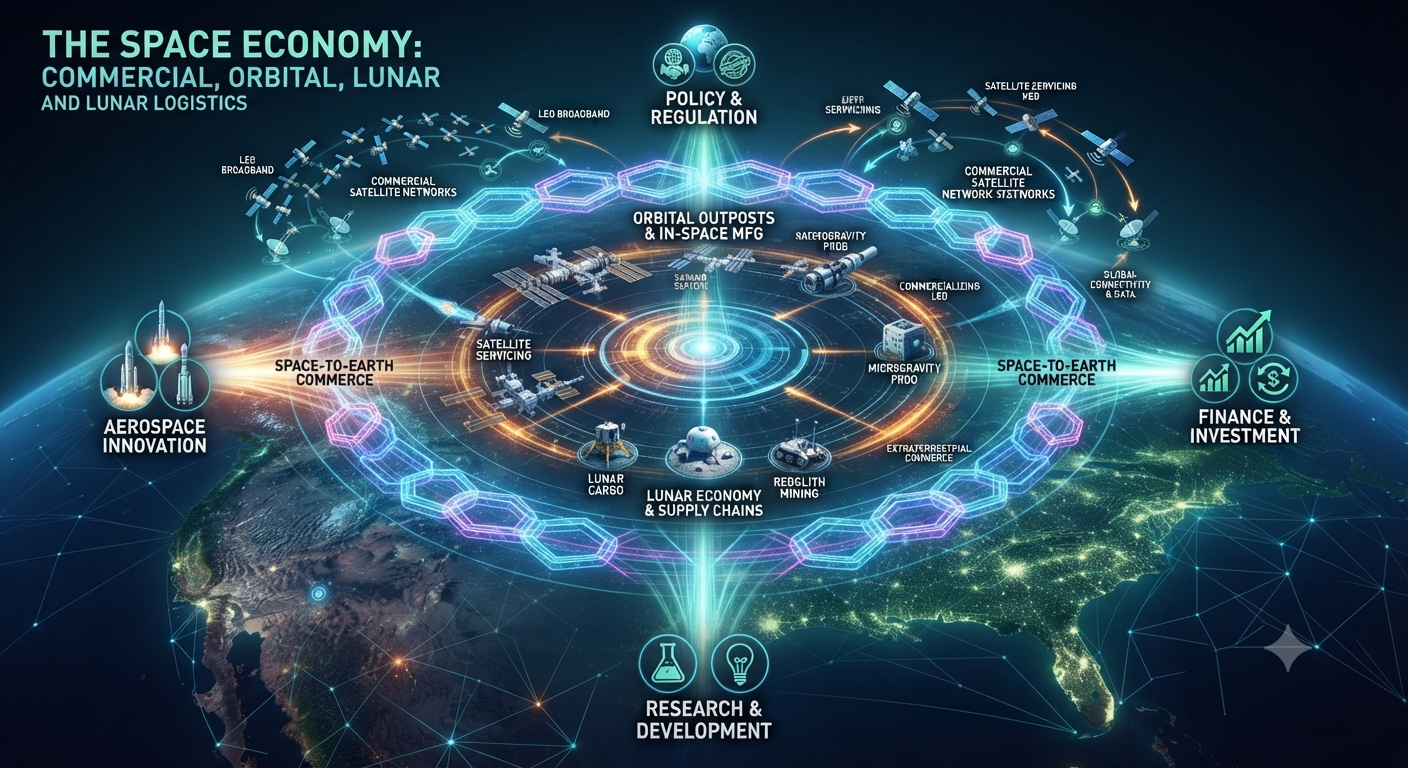
The Commercialization of Space
For much of the modern space age, exploration beyond Earth was dominated by national governments and publicly funded space agencies.
That era is changing.
Advances in reusable launch systems, satellite miniaturization, artificial intelligence, and private investment have dramatically lowered the barriers to entering the space industry.
Today, commercial companies are developing launch vehicles, operating satellite networks, building space stations, providing communications services, and planning infrastructure for future missions to the Moon.
The result is the emergence of a new space economy—one that extends far beyond traditional rocket launches.
From global broadband connectivity to lunar logistics, the commercial space sector is developing into a complex ecosystem that could reshape telecommunications, defense, transportation, manufacturing, and scientific research.
Private Aerospace Innovation
One of the biggest drivers of the modern space economy is the rapid growth of private aerospace.
Reusable launch technology has become a central focus of the industry.
Traditional rockets were generally designed for one-time use, making access to orbit extremely expensive. Reusable systems aim to reduce launch costs by recovering and flying key components multiple times.
Lower launch costs create new commercial possibilities.
Companies can deploy more satellites, conduct more frequent scientific missions, and test new technologies without facing the same financial barriers that once restricted access to space.
Private aerospace companies are also expanding into areas that were historically controlled almost entirely by governments.
These include:
Commercial launch services.
Satellite communications.
Earth observation.
Space logistics.
In-orbit servicing.
Commercial space stations.
Lunar transportation.
As competition increases, the space industry is becoming more similar to other technology sectors—driven by private investment, rapid iteration, and commercial demand.
The Rise of Low-Earth Orbit Megaconstellations
Low-Earth orbit, or LEO, has become one of the most important commercial zones in space.
Large satellite constellations are being deployed to provide global connectivity, Earth observation, navigation support, and other services.
Unlike traditional communications satellites positioned much farther from Earth, LEO satellites operate at relatively low altitudes.
This can provide lower communication latency and enable new applications that require faster data transmission.
The emergence of megaconstellations is particularly significant for global internet access.
In remote regions where traditional broadband infrastructure is difficult or expensive to build, satellite connectivity can potentially provide an alternative route to digital access.
This could have major implications for education, healthcare, commerce, and economic development.
The Infrastructure Challenge in Orbit
The rapid expansion of satellite networks also creates new challenges.
As thousands of spacecraft enter orbit, space traffic management becomes increasingly important.
Operators must coordinate satellite trajectories, prevent collisions, and manage the growing population of orbital debris.
The long-term sustainability of the space environment will depend on responsible satellite design, tracking systems, debris mitigation, and international cooperation.
Space is becoming more commercially accessible, but the orbital environment remains a shared resource.
The success of the space economy will therefore depend on balancing rapid expansion with responsible stewardship.
The Emerging Lunar Economy
The next major frontier is the Moon.
As launch costs decline and private space capabilities improve, the Moon is increasingly being viewed not only as a destination for scientific exploration but also as a potential commercial ecosystem.
Future lunar missions may require a complex network of services.
These could include:
Cargo transportation.
Surface communications.
Navigation systems.
Power generation.
Robotic construction.
Scientific equipment delivery.
Resource prospecting.
Human habitat support.
This is the beginning of what could become a commercial lunar supply chain.
Instead of every mission carrying everything it needs from Earth, future lunar operations could rely on specialized companies providing transportation, infrastructure, communications, and other services.
The Moon as a Logistics Hub
The Moon could eventually serve as more than a scientific destination.
Its proximity to Earth makes it a potential testing ground for technologies required for deeper space exploration.
Companies could develop systems for operating in extreme environments, producing resources locally, and maintaining long-term infrastructure away from Earth.
The concept of in-situ resource utilization, or ISRU, is particularly important.
Rather than transporting every resource from Earth, future missions could potentially use materials found on the Moon to support operations.
Water ice, for example, could become strategically valuable if accessible in sufficient quantities.
Through advanced processing, lunar resources could potentially support life-support systems or contribute to the production of propellants.
While many of these capabilities remain under development, the economic implications are significant.
Building a Trillion-Dollar Space Economy
The space economy is not limited to rockets and satellites.
Its broader ecosystem includes manufacturing, software, telecommunications, insurance, finance, data analytics, robotics, artificial intelligence, and specialized materials.
Earth-based industries are already benefiting from space-derived data.
Satellite imagery can support:
Agriculture.
Climate monitoring.
Disaster response.
Logistics.
Infrastructure planning.
Maritime tracking.
Environmental management.
As satellite networks become more capable, the value of space-based data could continue to increase.
The space economy may therefore become less about selling access to space and more about integrating space infrastructure into everyday economic activity.
The Role of Artificial Intelligence
Artificial intelligence is becoming an increasingly important component of space operations.
AI systems can analyze enormous quantities of satellite imagery, optimize spacecraft operations, identify potential equipment failures, and assist autonomous robotic systems.
As missions move farther from Earth, autonomous decision-making will become increasingly valuable.
Communication delays make constant human control impractical for many deep-space operations.
AI-powered systems could eventually enable spacecraft and robots to respond independently to changing conditions, improving efficiency and reducing operational costs.
A New Era of Competition
The commercial space race is creating a new competitive environment.
Private companies are competing to develop reusable launch systems, satellite networks, lunar landers, and space-based services.
At the same time, governments are increasingly viewing commercial space infrastructure as strategically important.
This creates a complex relationship between public institutions and private companies.
Governments provide funding, regulation, scientific expertise, and national security contracts.
Private companies contribute capital, technological innovation, and rapid development cycles.
The partnership between the two could become one of the defining characteristics of the next phase of space exploration.
The Challenges Ahead
Despite the enormous potential, the new space economy faces significant obstacles.
Launch systems remain technically complex.
Building and maintaining large satellite networks requires substantial capital.
Space debris presents growing environmental and operational risks.
Lunar infrastructure remains expensive and technologically challenging.
There are also unresolved questions surrounding international law, resource utilization, orbital congestion, and the governance of commercial activity beyond Earth.
The expansion of space commerce will therefore require international cooperation alongside technological innovation.
Conclusion
The space industry is undergoing a fundamental transformation.
Private aerospace innovation is lowering the cost of reaching orbit.
Low-Earth orbit megaconstellations are turning satellite infrastructure into a critical component of global connectivity.
At the same time, the development of commercial lunar missions is laying the groundwork for supply chains that could eventually extend beyond Earth.
Together, these developments are creating an entirely new economic frontier.
The trillion-dollar space economy will not emerge from a single breakthrough. It will be built through the gradual integration of launch systems, satellite networks, AI, robotics, communications, and lunar infrastructure.
The next chapter of the space age is no longer exclusively about reaching new worlds.
It is about building an economic ecosystem capable of operating across them.
As private companies and governments expand their presence beyond Earth, space is evolving from a destination for exploration into a fundamental layer of the global economy.