




The New Era of Cybersecurity
In an increasingly interconnected digital world, cybersecurity is no longer simply an IT maintenance function.
It has become a fundamental pillar of national security, economic stability, and corporate survival.
Governments, businesses, healthcare systems, financial institutions, and critical infrastructure increasingly depend on digital networks to operate. As this dependence grows, so does the potential impact of cyberattacks.
At the same time, threat actors are becoming more sophisticated.
Artificial intelligence is helping attackers automate reconnaissance, improve social engineering campaigns, and identify vulnerabilities at unprecedented speed.
Traditional security models built around a fixed network perimeter are struggling to keep pace.
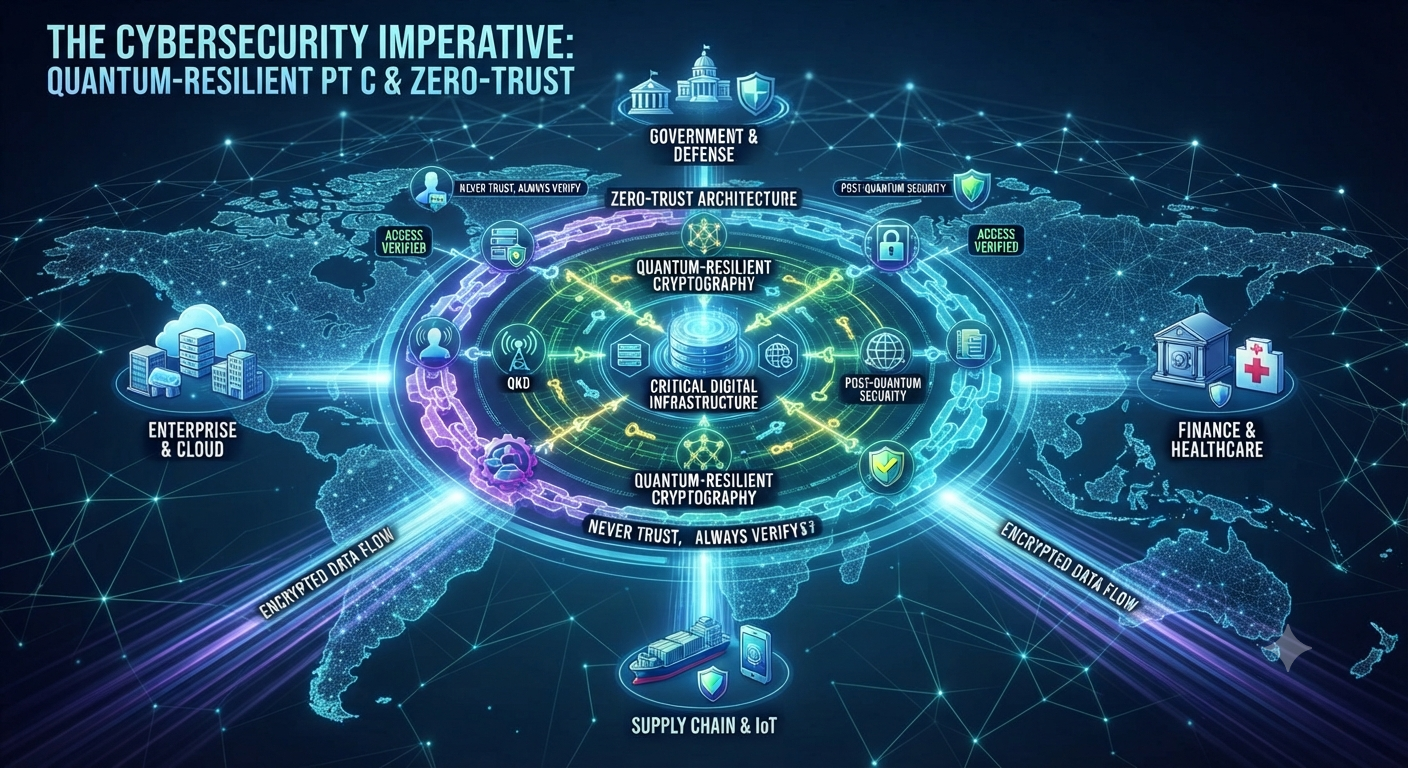
To address these challenges, organizations are increasingly focusing on two major cybersecurity strategies:
Zero Trust security for today's threat environment and post-quantum cryptography for the emerging risks of tomorrow.
The Shift to Zero Trust Security
For decades, enterprise cybersecurity was built around the idea of a digital perimeter.
The model was often compared to a castle surrounded by a moat.
Users and devices outside the network faced strict security controls. Once they successfully authenticated and entered the trusted environment, however, they were often granted broader access.
This approach worked reasonably well when employees primarily worked from corporate offices and applications were hosted within centralized data centers.
The modern workplace is very different.
Employees now work remotely. Businesses rely on cloud services. Personal and corporate devices frequently connect from different locations. Third-party vendors and contractors require access to internal systems.
As a result, the traditional network perimeter has effectively disappeared.
"Never Trust, Always Verify"
Zero Trust is built around a fundamentally different philosophy:
Never trust, always verify.
Under this model, no user, device, application, or network request is automatically trusted simply because it originates from inside a corporate environment.
Instead, access decisions are continuously evaluated based on factors such as:
User identity.
Device security status.
Location and network conditions.
Application requirements.
Resource sensitivity.
Behavioral patterns.
Current security risks.
Access is granted according to the principle of least privilege, meaning users and systems receive only the permissions necessary to perform their specific tasks.
This limits the potential damage if an account is compromised.
Why Zero Trust Matters
One of the greatest advantages of Zero Trust is its ability to reduce lateral movement.
In traditional networks, an attacker who successfully compromises one account or device may attempt to move deeper into the organization.
A properly designed Zero Trust environment makes this significantly more difficult by continuously validating access and limiting permissions.
This creates multiple layers of protection.
Instead of assuming that a user is trustworthy after a single login, the system continuously evaluates whether access should remain authorized.
For organizations operating across cloud infrastructure, remote work environments, and complex supply chains, this approach is becoming increasingly important.
Preparing for the Post-Quantum Era
While Zero Trust addresses many of today's cybersecurity challenges, organizations must also prepare for a future threat that could fundamentally change digital security: quantum computing.
Modern digital infrastructure relies heavily on public-key cryptographic systems to protect sensitive communications and transactions.
Algorithms such as RSA and elliptic-curve cryptography are widely used across the internet and in financial, governmental, and commercial systems.
Powerful enough quantum computers could eventually threaten some of these cryptographic methods.
This is because quantum algorithms may be capable of solving certain mathematical problems far more efficiently than conventional computers.
The result could be a major disruption to the cryptographic foundations that protect today's digital economy.
The "Harvest Now, Decrypt Later" Threat
One of the most concerning aspects of the quantum threat is that organizations do not necessarily have to wait for a powerful quantum computer to exist before facing consequences.
Attackers can potentially collect encrypted information today and store it for future decryption.
This strategy is commonly described as "harvest now, decrypt later."
Sensitive information with a long lifespan—including government records, intellectual property, financial information, and confidential communications—could remain valuable for many years.
If sufficiently capable quantum computers become available in the future, previously captured encrypted data could potentially become vulnerable.
This creates a cybersecurity challenge that must be addressed before the technology itself reaches maturity.
The Rise of Post-Quantum Cryptography
The cybersecurity community is responding through the development and standardization of Post-Quantum Cryptography (PQC).
Rather than relying on cryptographic systems vulnerable to quantum attacks, PQC algorithms are designed around mathematical problems believed to remain difficult for both conventional and quantum computers.
The transition will not happen overnight.
Organizations must identify where vulnerable cryptographic systems are being used, determine which data requires long-term protection, and develop migration strategies.
This process can be particularly challenging for large enterprises with decades-old infrastructure and complex technology environments.
Why Cryptographic Agility Matters
One of the most important concepts emerging from the post-quantum transition is cryptographic agility.
Organizations need the ability to replace cryptographic algorithms without completely rebuilding their technology infrastructure.
A system designed with cryptographic agility can adapt as new vulnerabilities are discovered or stronger standards become available.
This flexibility is essential because cybersecurity is not a one-time investment.
New threats will continue to emerge, and organizations must be capable of responding quickly.
Building a Resilient Digital Future
The future of cybersecurity will require organizations to think beyond individual security tools.
Zero Trust represents a shift in how access and identity are managed today.
Post-quantum cryptography represents preparation for the technological threats of tomorrow.
Together, these strategies form part of a broader cybersecurity transformation.
Organizations will need to combine:
Continuous identity verification.
Least-privilege access controls.
Strong encryption.
Modern endpoint security.
Threat intelligence.
Security monitoring.
Cryptographic agility.
Comprehensive incident response planning.
The goal is not to create a system that can never be attacked.
That is unrealistic.
The objective is to build systems that are difficult to compromise, limit the impact of successful attacks, and recover quickly when incidents occur.
Conclusion
Cybersecurity is entering a new era.
The rise of cloud computing, remote work, AI-powered threats, and interconnected infrastructure has made traditional perimeter-based defenses increasingly inadequate.
Zero Trust provides a framework for securing modern digital environments by continuously verifying users, devices, and access requests.
At the same time, the development of quantum computing is forcing organizations to reconsider the cryptographic systems that protect sensitive information today.
The transition toward post-quantum cryptography will require years of planning, testing, and infrastructure upgrades.
Organizations that begin preparing early will be better positioned to protect long-lived data and maintain trust in an increasingly complex digital ecosystem.
The future of cybersecurity will not be defined by a single technology.
It will depend on continuous verification, adaptable encryption, resilient infrastructure, and the willingness to prepare for threats before they become crises.