





Historical Mysteries That May Never Be Solved: Secrets Lost to Time

From lost colonies and unsolved codes to vanished treasures and royal disappearances, history is filled with dark enigmas that modern science and investigation still cannot explain.

Historical Mysteries That May Never Be Solved: Secrets Lost to Time

History is written by the victors, as the old saying goes. But sometimes, history is written in invisible ink, torn to shreds, or buried so deep that no amount of modern archaeological wizardry can bring it back to the light. Despite our technological advancements, DNA sequencing, satellite imaging, and global data archives, some doors from the past remain firmly shut.

Humanity is endlessly fascinated by the unknown because puzzles demand a solution. Yet, certain historical enigmas defy explanation, mocking our desire for closure. Let us journey back through the corridors of time to examine some of the most haunting historical mysteries that may never be solved.

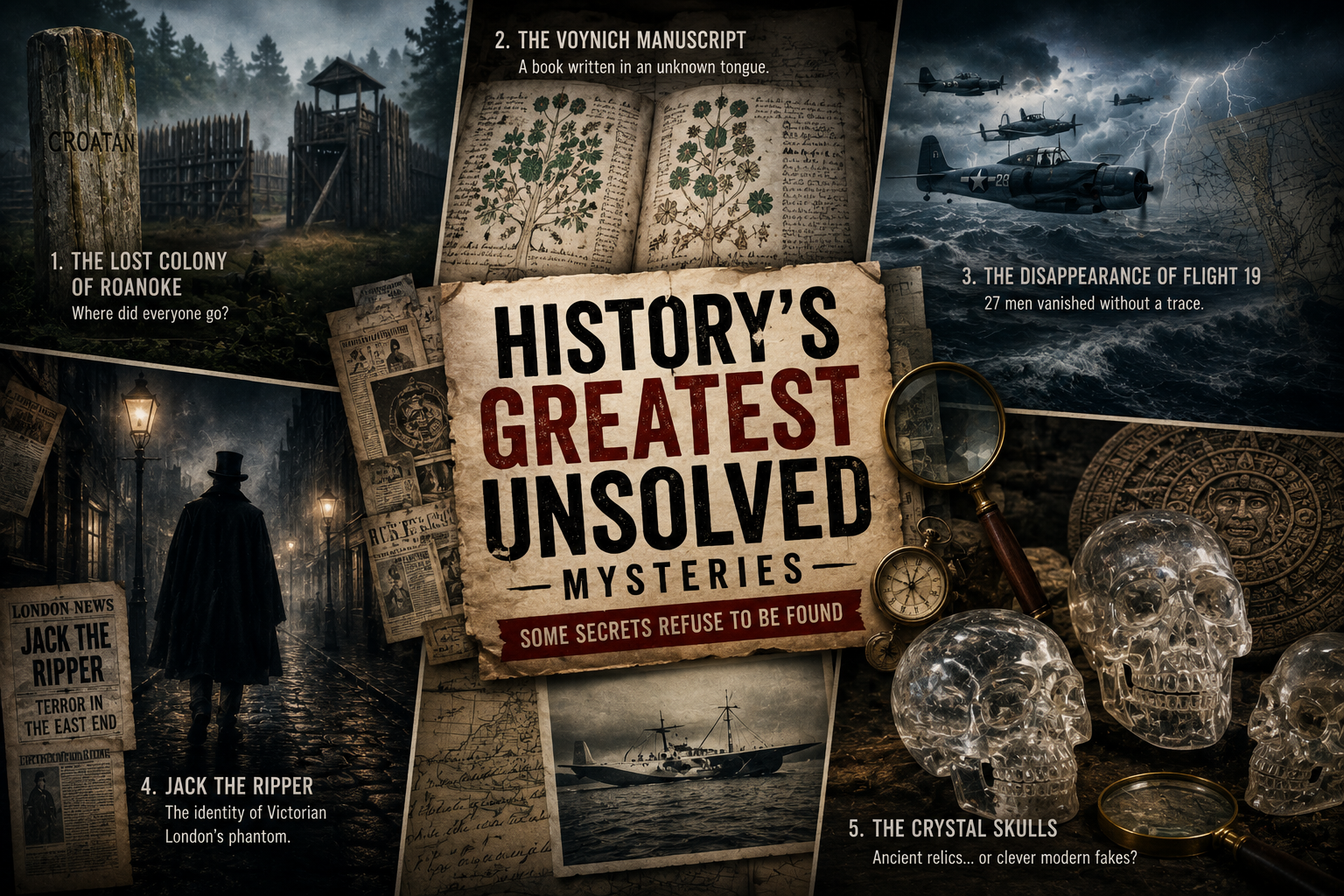
1. The Lost Colony of Roanoke: Where Did Everyone Go?

In 1587, a group of roughly 115 English settlers led by John White established a colony on Roanoke Island, off the coast of modern-day North Carolina. Supplies quickly ran low, forcing Governor White to sail back to England for emergency provisions.

Due to the outbreak of the Anglo-Spanish War, White’s return was delayed for three agonizing years. When he finally stepped foot back on Roanoke Island in 1590, the settlement was completely deserted. There were no signs of a struggle, no bodies, and no fortifications dismantled. The only clues left behind were a single word carved into a wooden post—"CROATAN"—and the letters "CRO" carved into a nearby tree.

To this day, historians debate whether the colonists integrated peacefully with the local Croatan Native American tribe, were captured, or attempted to build a boat and sail back to England, perishing at sea. Despite extensive archaeological digs, the fate of the Lost Colony remains an American ghost story.

2. The Voynich Manuscript: A Book Written in an Unknown Tongue

Discovered in an Italian monastery in 1912 by antique book dealer Wilfrid Voynich, this illustrated codex dates back to the early 15th century. Written on fine vellum, the book contains strange illustrations of botanical species that do not exist on Earth, astrological charts, biological diagrams of nude women bathing in bizarre green fluids, and pages of dense, flowing text.

The catch? No one can read it.

The manuscript is written in an entirely unknown script that has baffled the world's greatest cryptographers, including codebreakers from both World Wars. Some argue it is an elaborate, sophisticated hoax from the Renaissance era meant to scam wealthy patrons; others believe it represents a lost natural language or a completely synthetic writing system. Without a bilingual translation key, the secrets of the Voynich Manuscript remain locked behind its mysterious letters.

3. The Disappearance of Flight 19: The Birth of the Bermuda Triangle

On December 5, 1945, a squadron of five U.S. Navy TBM Avenger torpedo bombers took off from Fort Lauderdale, Florida, on a routine training navigation flight. Led by Lieutenant Charles Taylor, an experienced combat veteran, the flight plan was straightforward: fly east, drop practice bombs, and return.

Instead, things went horribly wrong. Radio transmissions intercepted from the squadron indicated utter confusion. Lieutenant Taylor reported that his compasses were malfunctioning and that he could not recognize the land below him, believing they were over the Florida Keys when they were likely somewhere over the Bahamas. Weather conditions deteriorated rapidly, and the planes flew out to sea until their fuel ran out.

Even more eerie? A rescue flying boat sent out to search for the missing squadron also vanished without a trace, taking 13 crew members with it. Though military investigations blamed navigational error, the total evaporation of six aircraft and 27 men fueled the enduring myth of the Bermuda Triangle.

4. The Identity of Jack the Ripper: Victorian London’s Phantom

In the autumn of 1888, the impoverished district of Whitechapel in East London was terrorized by a serial killer known as "Jack the Ripper." At least five women were brutally murdered, their bodies mutilated in a manner that suggested the killer possessed anatomical or surgical knowledge.

Scotland Yard launched a massive investigation, interviewing thousands of suspects and receiving hundreds of hoax letters allegedly written by the killer himself. Yet, the perpetrator was never caught.

Over a century later, true-crime enthusiasts, amateur sleuths, and forensic experts have proposed dozens of suspects, ranging from minor royals and painters to local butchers and doctors. Because police files from the era are incomplete and forensic DNA testing on century-old letters remains inconclusive or contaminated, Jack the Ripper will likely remain an anonymous specter of Victorian gloom.

5. The Crystal Skulls: Ancient Artifacts or Modern Frauds?

Discovered in various parts of Mesoamerica during the 19th and 20th centuries, several hyper-polished human skulls carved entirely from clear quartz crystal captured the public imagination. Associated with ancient Maya, Aztec, or mystical origins, believers claimed these skulls possessed supernatural healing powers or encoded ancient wisdom.

However, modern scientific examination by institutions like the British Museum and the Smithsonian shattered the magic. Microscopic analysis under electron microscopes revealed distinct rotational tool marks—scratches left by modern steel rotary cutters and diamond-tipped abrasives that did not exist in pre-Columbian times.

While science proved many of these skulls were manufactured in 19th-century Europe (likely in Germany), the exact provenance, motivation, and master carvers behind some of the more famous specimens remain shrouded in mystery.

Conclusion: The Beauty of the Unsolved

We live in an age where answers are usually just a click away. Google, artificial intelligence, and global databases allow us to look up facts, figures, and satellite imagery in seconds. Yet, these historical mysteries remind us of the vast, untamed expanse of human history.

Some secrets are buried too deep for time to exhume. Perhaps that is part of their magic—they remind us that our world is full of wonder, shadows, and stories that refuse to be neatly filed away.


Quick Summary

From lost colonies and unsolved codes to vanished treasures and royal disappearances, history is filled with dark enigmas that modern science and investigation still cannot explain.

Quick Facts

Category: Education
Published: August 1, 2026
Updated: October 1, 2026
Reading time: 5 min
44 views
Updated Oct 1, 2026 5 min read

Related Articles

View all
Future-Proof Skills: What Every Student Needs to Master in 2026 Education
Article Education

Future-Proof Skills: What Every Student Needs to Master in 2026

As we navigate 2026, the definition of success is shifting from what you know to what you can do. With AI and automation transforming the job market, students who prioritize transferable, human-centric, and tech-fluent skills are the ones who will lead the future. Here is your roadmap for staying ahead.

Joyce, James 8 min 51

Popular

View all

Mixed Content

Education
Article Education

The Post-Automation Economy: Architecting Human Skill Premiums in the Age of Autonomy

The rapid proliferation of agentic workflows and large action models is structurally inverting the traditional corporate skill pyramid. While routine analytical processes and information retrieval tasks are being automated into low-cost utility, uncommoditizable human traits—emotional intelligence, strategic ambiguity management, and ethical governance—are commanding an unprecedented value premium. Succeeding in the post-automation enterprise requires re-engineering workforce development to focu

Mutwassim 3 min 72
The Decline of Friction: Inside the FinTech Revolution in Cross-Border Settlement and Digital Identity Education
Article Education

The Decline of Friction: Inside the FinTech Revolution in Cross-Border Settlement and Digital Identity

The traditional plumbing of global finance—characterized by multi-day delays, hidden fees, and fragmented identity silo—is undergoing a profound transformation. A new generation of FinTech architectures, combining distributed ledger technology (DLT), synchronized liquidity pools, and decentralized digital passports, is enabling cross-border instant payments with near-zero friction.

Mutwassim 1 min 44
The City as a Switch: Architecting IoT Logistics for the Post-Congestion Urban Era Education
Article Education

The City as a Switch: Architecting IoT Logistics for the Post-Congestion Urban Era

The traditional model of urban delivery—reliant on high-emission diesel vans navigating static street grids—is creating unsustainable levels of congestion and pollution in global metros. To reclaim urban space, cities are transitioning to IoT-orchestrated logistics. This data-driven framework utilizes autonomous delivery swarms, automated micro-fulfillment centers, and dynamic digital kerb-side management to route goods with the efficiency of internet packets, transforming static streets into fl

Mutwassim 4 min 71
Beyond the Coffee Shop: How Cross-Border Employment and Sovereign Visas Are Institutionalizing Remote Work Education
Article Education

Beyond the Coffee Shop: How Cross-Border Employment and Sovereign Visas Are Institutionalizing Remote Work

Remote work is transitioning from an informal perk into an institutionalized pillar of international commerce. Over 60 nations have launched dedicated digital nomad visa regimes, while multi-jurisdictional compliance platforms and Employer of Record (EOR) frameworks dismantle traditional geographic barriers. As knowledge workers disperse globally, enterprises and municipal governments are formalizing policies around tax residency, permanent establishment risk, and asynchronous operational workfl

Mutwassim 3 min 71
The Death of Syntax: Inside the Shift to Intent-Driven Software Engineering Education
Article Education

The Death of Syntax: Inside the Shift to Intent-Driven Software Engineering

The day-to-day discipline of software engineering is undergoing its most radical abstraction leap since the transition from assembly language to high-level compilers. Generative code synthesis and deterministic reasoning engines are automating boilerplate syntax, turning software developers into systems architects. Survival in this new paradigm demands mastering intent formalization, specification design, and continuous verification.

Mutwassim 3 min 71
The Post-Visual Threat: Architecting Zero-Trust Defense Against Weaponized Deepfakes Education
Article Education

The Post-Visual Threat: Architecting Zero-Trust Defense Against Weaponized Deepfakes

The rapid weaponization of real-time voice cloning and synthetic video generation has transformed social engineering from opportunistic phishing into targeted executive identity emulation. High-profile incidents involving multi-million-dollar wire transfers authorized via synthetic video calls prove that sight and sound can no longer authenticate authorization. Securing modern enterprises requires an uncompromising zero-trust identity layer capable of neutralizing synthetic deception.

Mutwassim 3 min 137
Beyond the Battery: How Electric Mobility Is Forcing a Overhaul of the Global Power Grid Education
Article Education

Beyond the Battery: How Electric Mobility Is Forcing a Overhaul of the Global Power Grid

The global transition toward electric vehicles is no longer constrained primarily by battery chemistry or vehicle range. Instead, the real bottleneck has shifted directly to the electrical grid. As commercial fleets and passenger cars electrify at scale, utilities and city planners are racing to deploy vehicle-to-grid (V2G) bidirectional systems, AI-driven dynamic load balancers, and decentralized microgrid storage to avoid grid failure.

Mutwassim 3 min 58
Cloud 3.0: The Shift Toward Sovereign Data Architectures and Edge Computing Education
Article Education

Cloud 3.0: The Shift Toward Sovereign Data Architectures and Edge Computing

The architectural assumption that enterprise compute and storage should reside in a handful of centralized hyperscaler data centers is fracturing. Driven by strict cross-border data sovereignty regulations and the demand for millisecond-latency AI inference, global IT leaders are pivoting to Cloud 3.0—a model centered on distributed, locally governed, and hybrid sovereign architectures.

Mutwassim 3 min 61