





Space is big. Really big. You just won't believe how vastly, hugely, mind-bogglingly big it is. But beyond its sheer scale, the universe is also profoundly weird. When you step away from textbook physics and look closer at what happens out in the cosmos, reality starts to sound like pure science fiction.
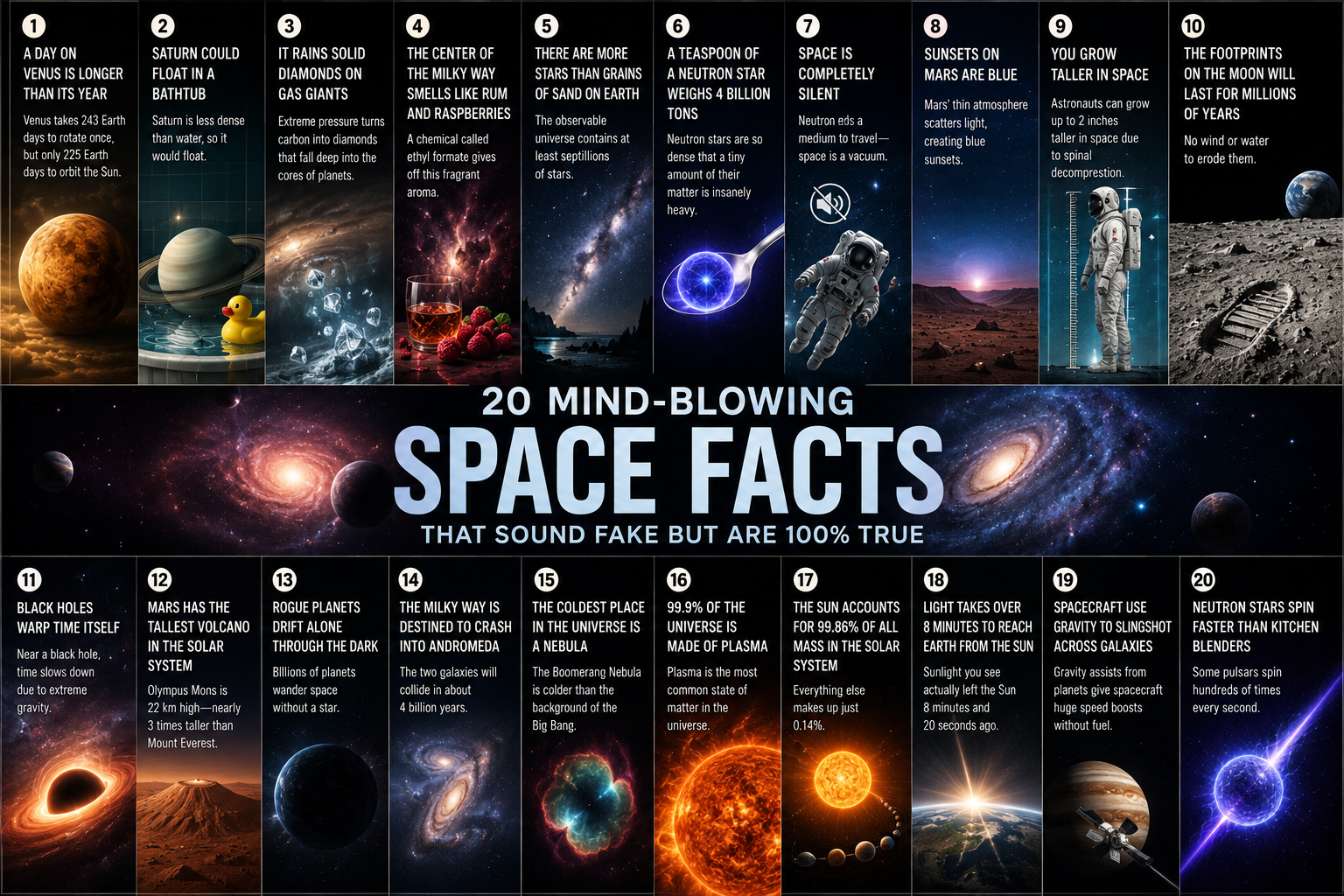
If you told someone that a teaspoon of a dead star weighs billions of tons, or that the center of our galaxy smells like alcohol, they would likely laugh it off. Yet, modern astronomy proves these bizarre realities. Here are 20 incredible space facts that sound completely fake, but are 100% true.
1. A Day on Venus is Longer Than Its Year
Venus rotates on its axis so agonizingly slowly that it takes 243 Earth days to complete just one single rotation. Meanwhile, its orbit around the Sun takes only 225 Earth days. This creates a bizarre cosmic paradox: a single day on Venus lasts longer than an entire year!
2. Saturn Could Float in a Bathtub
Saturn is the second-largest planet in our solar system, and it is made almost entirely of hydrogen and helium. Because gas is so lightweight, Saturn has an overall density lower than water. If you could find a cosmic ocean big enough, the ringed giant would float like a giant rubber duck.
3. It Rains Solid Diamonds on Gas Giants
On planets deep within our solar system like Jupiter and Saturn, intense atmospheric pressure and colossal lightning storms shatter methane molecules, releasing free carbon. As the carbon drops deeper into the scorching core, it hardens into graphite and eventually precipitates down as a heavy shower of solid diamonds!
4. The Center of the Milky Way Smells Like Rum and Raspberries
Astronomers studying a massive dust cloud near the center of our galaxy called Sagittarius B2 discovered that it is packed with a chemical compound called ethyl formate. This is the exact chemical that gives raspberries their distinct flavor and contributes to the smell of rum.
5. There Are More Stars Than Grains of Sand on Earth
If you gathered every single grain of sand on every beach, desert, and coastline across planet Earth, the total number would be dwarfed by the stars in the observable universe. Scientists estimate there are at least septillions of stars out there.
6. A Teaspoon of a Neutron Star Weighs 4 Billion Tons
When massive stars collapse, they form neutron stars—objects so dense that a single teaspoon of their material would weigh roughly 4 billion tons on Earth, out-massing entire mountain ranges packed into a tiny cubic centimeter.
7. Space Is Completely Silent
In cinematic sci-fi epics, starfighters zoom past with roaring engine explosions. In reality, space is a vacuum with almost no air particles. Because sound waves require a medium like gas or liquid to travel through, nobody can hear you scream in space.
8. Sunsets on Mars Are Blue
While Earth features brilliant red and orange sunsets due to light scattering through our nitrogen-rich atmosphere, the thin, dusty carbon dioxide atmosphere of Mars scatters light differently, casting a striking blue glow across the Martian twilight.
9. You Grow Taller in Space
Without the crushing force of Earth's gravity pulling down on your spine, astronauts living in microgravity experience spinal decompression. During a stint on the International Space Station, astronauts can temporarily grow up to two inches taller.
10. The Footprints on the Moon Will Last for Millions of Years
Because the Moon has no atmosphere, wind, or active weather systems, there is nothing to erode or wash away footprints. The historic bootprints left behind by Apollo astronauts will remain pristine for millions of years.
11. Black Holes Warp Time Itself
Einstein’s theory of relativity proved that gravity affects time. Near the event horizon of a supermassive black hole, gravity is so extreme that time slows down drastically compared to the rest of the universe, acting as a natural time-dilation engine.
12. Mars Hosts the Tallest Volcano in the Solar System
Olympus Mons on Mars is a giant shield volcano standing a staggering 22 kilometers high. To put that into perspective, it is nearly three times taller than Mount Everest and spans an area roughly the size of the entire state of Arizona.
13. Rogue Planets Drift Alone Through the Dark
Not all planets orbit a star. Billions of "rogue planets" have been cast away from their original solar systems due to gravitational disruptions. They wander silently and freezing cold through interstellar space without a sun.
14. The Milky Way Is Destined to Crash Into Andromeda
Our home galaxy is not sitting still. It is hurtling through space on a direct collision course with our nearest galactic neighbor, the Andromeda Galaxy. While it won't happen for another 4 billion years, the two giants will eventually merge into a magnificent new mega-galaxy.
15. The Coldest Place in the Universe is a Nebula
Located roughly 5,000 light-years away, the Boomerang Nebula reaches a bone-chilling temperature of minus 272 degrees Celsius (only one single degree above absolute zero), making it colder than the background radiation of the Big Bang itself.
16. 99.9% of the Universe is Made of Plasma
While we interact primarily with solids, liquids, and gases on Earth, 99.9% of normal matter in the wider universe exists as plasma—a supercharged, electrically conductive state of matter found in stars and nebulae.
17. The Sun Accounts for 99.86% of All Mass in the Solar System
Our Sun is so overwhelmingly massive that it contains 99.86% of all the physical mass in the entire solar system. Everything else—including Jupiter, Saturn, Earth, comets, and asteroid belts—shares the remaining fraction of a percent.
18. Light Takes Over 8 Minutes to Reach Earth from the Sun
The Sun sits roughly 93 million miles away from Earth. Because light travels at a finite speed, the sunshine warming your face right now actually left the surface of the Sun about 8 minutes and 20 seconds ago.
19. Spacecraft Can Use Gravity to Slingshot Across Galaxies
Space agencies frequently use "gravitational assists." By steering a probe close to a massive planet like Jupiter, engineers can steal a tiny fraction of the planet's orbital momentum to accelerate spacecraft to incredible speeds without using extra fuel.
20. Neutron Stars Spin Faster Than Kitchen Blenders
When giant stars collapse into neutron stars, conservation of momentum causes them to spin at dizzying rates. Some pulsars (magnetized rotating neutron stars) spin hundreds of times every single second, flashing beams of radiation like cosmic lighthouses.
Conclusion: The Universe Keeps Its Secrets
The more we learn about space, the clearer it becomes that reality is far stranger than fiction. These twenty facts are just scratching the surface of an infinite, breathtaking universe that continues to challenge our imaginations every single day.