





For more than half a century, humanity looked toward the Moon with a mixture of nostalgia and ambition. Since the Apollo era ended in the early 1970s, astronauts have remained within low Earth orbit, conducting scientific research aboard space stations while engineers quietly worked toward the next great leap in exploration. The Artemis program represents that next chapter. Designed to take humanity beyond Earth once again, it aims not only to revisit the Moon but to establish a long-term human presence that will ultimately prepare astronauts for future missions to Mars. As the program progresses through its critical milestones, every successful mission brings the dream of sustainable deep-space exploration closer to reality.
The Orion spacecraft stands at the heart of this ambitious vision. Unlike previous spacecraft designed primarily for short-duration missions close to Earth, Orion has been engineered specifically for deep-space travel. Built to operate hundreds of thousands of miles from our planet, it combines advanced navigation systems, next-generation life-support technology, improved radiation protection, and a durable heat shield capable of surviving the extreme conditions experienced during high-speed re-entry. Together with NASA’s powerful Space Launch System (SLS), Orion forms the foundation of humanity’s next generation of lunar exploration.
Every major space program depends upon rigorous testing before astronauts can safely travel into unexplored environments. Rather than rushing toward lunar landings, NASA has adopted a carefully planned, step-by-step approach that prioritizes crew safety, engineering reliability, and long-term mission sustainability. Each Artemis mission is designed to validate new technologies, collect valuable scientific data, and improve operational procedures before even more ambitious expeditions are attempted. This cautious strategy reflects decades of engineering lessons learned from previous human spaceflight programs.
One of the defining goals of the Artemis program is to demonstrate that modern spacecraft can safely transport astronauts far beyond the protective environment of low Earth orbit. Unlike missions to the International Space Station, deep-space travel exposes crews to significantly higher levels of cosmic radiation, greater communication delays, and complete independence from immediate rescue capabilities. Every onboard system—from power generation and navigation to environmental control and emergency response—must perform flawlessly for extended periods while operating hundreds of thousands of miles from Earth.
Modern deep-space missions also represent a remarkable achievement in international cooperation. The Artemis program brings together contributions from NASA, the Canadian Space Agency, the European Space Agency, the Japan Aerospace Exploration Agency, and numerous commercial aerospace companies. This collaborative approach reflects the growing recognition that the future of space exploration depends upon shared knowledge, technological partnerships, and global scientific cooperation rather than competition alone. By combining expertise from multiple nations, the program benefits from decades of engineering innovation while reducing costs and expanding scientific opportunities.
Beyond testing spacecraft hardware, future Orion missions will play a crucial role in understanding how the human body adapts to prolonged deep-space travel. Astronauts operating outside Earth’s protective magnetic field encounter unique biological challenges that scientists continue to study. Researchers closely monitor muscle health, bone density, cardiovascular performance, cognitive function, sleep quality, immune system responses, and radiation exposure throughout each mission. The knowledge gained from these investigations will directly influence the design of future lunar habitats, long-duration missions, and eventually human expeditions to Mars.
Radiation remains one of the greatest obstacles facing deep-space exploration. Outside the protective shield of Earth’s magnetosphere, astronauts are continuously exposed to energetic particles originating from the Sun and distant cosmic sources. Engineers have therefore developed sophisticated shielding systems while scientists carefully evaluate exposure levels throughout every mission. These studies are essential for determining how future crews can safely remain in deep space for months or even years as humanity expands its presence beyond Earth.
Another critical objective involves validating Orion’s life-support systems under realistic operating conditions. Every aspect of human survival—from breathable air and clean drinking water to temperature regulation and waste management—must function continuously without failure. Unlike missions in low Earth orbit, deep-space crews cannot rely on rapid resupply missions or emergency evacuations. As a result, Orion’s environmental control systems are designed with multiple layers of redundancy, ensuring astronauts remain safe even if individual components experience unexpected technical issues.
Communication technology also undergoes extensive evaluation during deep-space missions. Maintaining reliable contact between astronauts and mission control becomes increasingly complex as spacecraft travel farther from Earth. Engineers test advanced communication networks capable of transmitting voice, scientific data, navigation updates, and high-definition video across vast distances while minimizing delays. These systems will become even more important as future lunar bases and Mars expeditions require constant coordination with Earth-based operations.
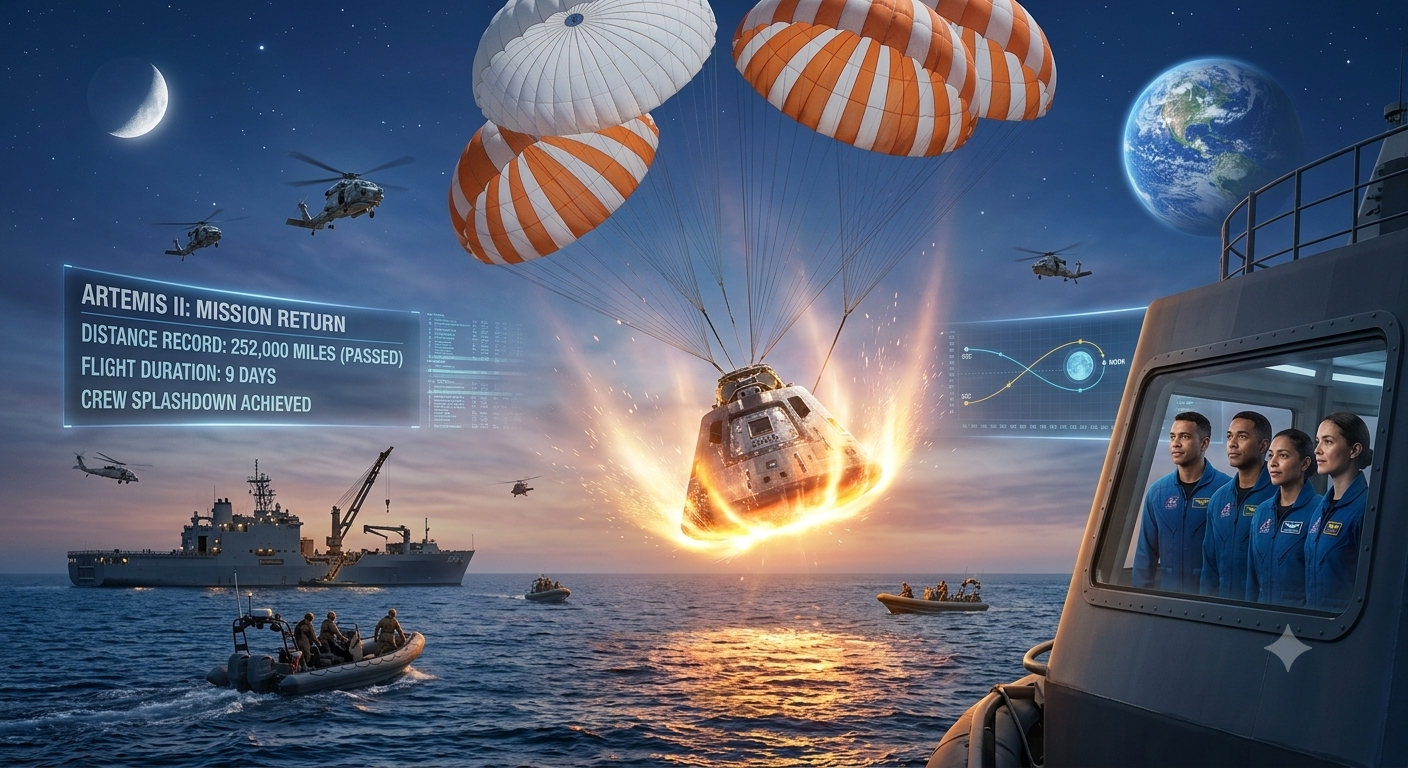
The engineering challenges do not end once the spacecraft reaches deep space. Returning safely to Earth represents one of the most demanding phases of any mission. During atmospheric re-entry, spacecraft experience extreme aerodynamic forces as they decelerate from incredible velocities. Temperatures around the capsule can exceed several thousand degrees, requiring highly advanced thermal protection systems to shield both the vehicle and its crew. Orion’s heat shield, parachute deployment system, and recovery procedures are therefore among the most extensively tested components of the entire mission architecture.
Successful recovery operations provide engineers with an enormous amount of valuable technical data. Every sensor onboard the spacecraft records information regarding structural performance, heat distribution, vibration levels, parachute deployment timing, and overall system behavior throughout the mission. This information is carefully analyzed after landing to identify opportunities for further improvements before future crewed lunar expeditions begin. Continuous refinement remains one of the defining principles of modern aerospace engineering.
The Artemis program also represents an important milestone in creating a more inclusive future for space exploration. Modern astronaut crews increasingly reflect the diversity of humanity itself, bringing together individuals from different backgrounds, experiences, and nations. This broader representation inspires future generations of scientists, engineers, pilots, and researchers around the world while demonstrating that the exploration of space belongs to all humanity rather than any single country.
Beyond its scientific objectives, the Artemis program serves as a powerful catalyst for technological innovation on Earth. Developing advanced spacecraft requires breakthroughs in materials science, robotics, artificial intelligence, computing, telecommunications, energy storage, and manufacturing. Many of these technologies eventually find practical applications in healthcare, transportation, environmental monitoring, disaster response, and countless other industries, creating long-term economic benefits that extend far beyond the space sector.
The program is also laying the foundation for an entirely new space economy. Future lunar missions will support the construction of permanent infrastructure, including the Lunar Gateway space station, surface habitats, scientific laboratories, communication networks, and resource utilization systems. These developments could eventually enable commercial industries such as lunar mining, space manufacturing, satellite servicing, and deep-space logistics, transforming the Moon from a destination into an operational hub for future exploration.
Perhaps the greatest significance of Orion lies not in any single mission but in what it represents for humanity’s future. For generations, the Moon symbolized the furthest destination humans could reach. Today, it is increasingly viewed as the first stepping stone toward an even greater objective: becoming a truly multi-planetary civilization. Every successful Artemis mission moves humanity closer to establishing a sustainable presence beyond Earth while providing the experience and confidence necessary for eventual journeys to Mars and beyond.
The return of Orion therefore marks far more than another successful spacecraft test. It symbolizes the beginning of a new chapter in human exploration—one built upon decades of scientific progress, international cooperation, and technological innovation. As engineers continue refining the systems that will carry future astronauts deeper into space, the Artemis program demonstrates that humanity is once again preparing to venture beyond familiar horizons. The road ahead remains challenging, but each milestone brings us one step closer to a future where permanent lunar bases, commercial space operations, and human missions to Mars become part of everyday reality rather than distant dreams.