





Amazing Facts About Earth That Sound Fake But Are True: The Bizarre Truth of Our Planet

From a core as hot as the Sun and gold buried deep inside the earth to trees older than mountains and a planet that isn’t actually round, discover mind-blowing facts about Earth.

Amazing Facts About Earth That Sound Fake But Are True: The Bizarre Truth of Our Planet

We spend our entire lives walking, running, building, and living on planet Earth. Because it is our home, we tend to take its existence for granted. We look out our windows, see familiar trees, pavement, blue skies, and oceans, and assume we understand the mechanics of the world beneath our feet. Yet, beneath our mundane daily routines lies a planet so wild, violent, bizarre, and counterintuitive that it sounds like pure science fiction.

If you were told these facts by a stranger on the street, you would assume they were making things up. However, every single one of these mind-boggling phenomena is backed by rigorous scientific reality. Here are some of the most amazing facts about Earth that sound completely fake, but are 100% true.

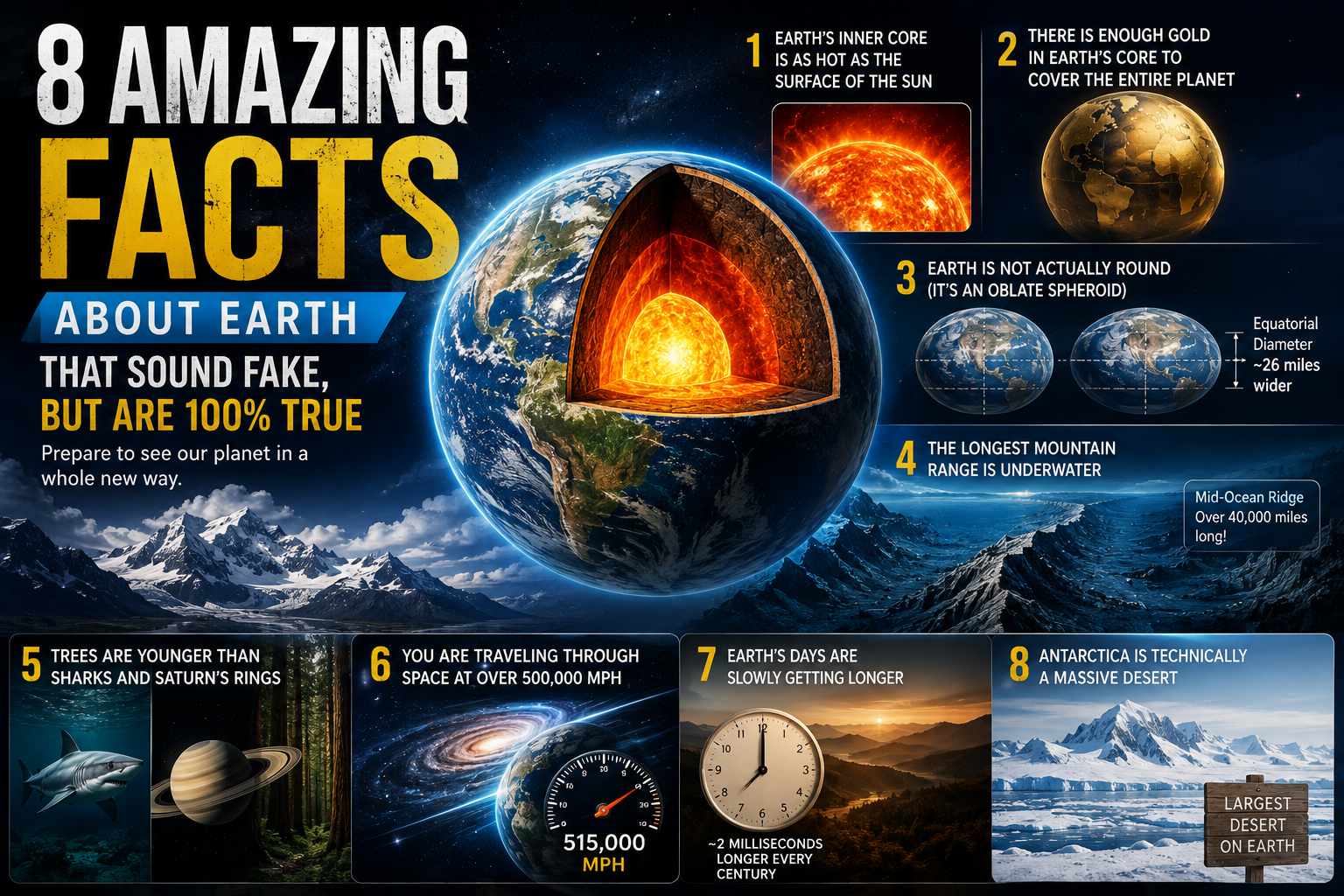
1. Earth's Inner Core Is As Hot As the Surface of the Sun

When we think about extreme heat in our solar system, our minds immediately fly straight to the Sun—a colossal ball of burning plasma sitting 93 million miles away. Yet, you don't have to travel millions of miles into space to experience stellar temperatures; you just need to dig straight down.

Deep at the center of our planet sits Earth’s inner core—a solid ball of compressed iron and nickel roughly the size of Pluto. Driven by intense gravitational pressure and leftover heat from planetary formation, temperatures inside the inner core reach an astounding 10,800 degrees Fahrenheit (6,000 degrees Celsius). That is roughly as hot as the blazing surface of the Sun! It is a wild reality: you are walking around on a thin, cooled crust floating above a miniature star.

2. There Is Enough Gold in Earth’s Core to Cover the Entire Planet

Throughout human history, people have waged wars, crossed treacherous oceans, and spent lifetimes panning through freezing rivers in search of rare, glittering gold. We treat gold as one of the scarcest, most precious commodities on Earth.

Technically speaking, it is scarce on the surface—but that is only because nearly all of it sank. When Earth was first forming over 4.5 billion years ago, molten iron and heavy metals sank straight down toward the center of the planet. Geologists estimate that 99% of Earth's total gold supply is trapped deep within the metallic core. If you could magically extract all that gold and bring it to the surface, there is so much of it that it would completely coat the entire globe in a layer roughly 1.5 feet thick!

3. Earth Is Not Actually Round (It’s an Oblate Spheroid)

Every globe you saw in elementary school and every textbook diagram depicts Earth as a smooth, geometrically perfect blue sphere. Space agencies publish stunning photographs that reinforce this round illusion.

In reality, Earth is not a sphere at all. Because our planet spins continuously on its axis at roughly 1,000 miles per hour at the equator, centrifugal force causes the planet to bulge outward around the middle. Earth is officially classified as an "oblate spheroid." If you measured Earth from pole to pole versus across the equator, the equatorial diameter is about 26 miles wider. It is slightly squished, like a giant spinning water balloon.

4. The Longest Mountain Range Is Underwater

When people think of epic mountain chains, they picture the snow-capped Himalayas, the jagged Andes, or the rocky peaks of North America. However, the true king of mountain ranges is completely invisible to casual beachgoers.

The Mid-Ocean Ridge is a colossal underwater volcanic mountain chain that twists and winds across the globe for more than 40,000 miles, wrapping around the planet like the seam on a baseball. Because tectonic plates are constantly pulling apart and allowing magma to rise from the mantle, this continuous underwater mountain system is over ten times longer than the longest mountain range found on dry land.

5. Trees Are Younger Than Sharks and Saturn’s Rings

It is easy to look at ancient forests filled with towering redwoods and ancient sequoias and assume trees are among the most ancient fixtures of planetary life. However, evolutionary timelines hold some shocking surprises.

Sharks swam in Earth's oceans over 400 million years ago, meaning they predate land trees by roughly 50 to 100 million years. Furthermore, astronomical data and Cassini probe measurements suggest that Saturn’s iconic icy rings may be less than 100 to 200 million years old, meaning sharks were hunting in our oceans before Saturn even put on its jewelry.

6. You Are Traveling Through Space at Over 500,000 MPH Right Now

If you are sitting completely still on your couch reading this article, you probably feel like you are at absolute rest. Your coffee cup isn't sliding off the table, and gravity is keeping you firmly planted.

In astronomical terms, you are a high-speed interstellar traveler. While Earth spins on its axis at 1,000 mph, it also races around the Sun at an average speed of 67,000 mph. But that's not all: our entire solar system is orbiting the center of the Milky Way galaxy at a blistering speed of roughly 515,000 mph. In the time it took you to read this paragraph, you have traveled thousands of miles across the cosmos without moving a single muscle.

7. Earth’s Days Are Slowly Getting Longer

If you frequently feel like 24 hours in a day is not nearly enough time to get everything done, science confirms that your frustration is mathematically valid. Days really are getting longer.

Due to the gravitational tidal friction exerted by the Moon on Earth’s oceans and crust, our planet's rotation is gradually decelerating. Every single century, Earth's day lengthens by approximately 2 milliseconds. While that sounds negligible, over millions of years, it means ancient dinosaurs experienced significantly shorter days and a year had far more total days than it does today.

8. Antarctica Is Technically a Massive Desert

When we picture deserts, our minds automatically conjure up images of scorching sand dunes, camels, blistering sunshine, and dehydrated explorers wandering across the Sahara. We think heat is a mandatory requirement for a desert.

In meteorological terms, a desert is defined strictly by its level of precipitation—specifically, any region that receives less than 10 inches of annual rainfall. Because Antarctica is so intensely cold that moisture cannot easily linger in the atmosphere, the frozen continent receives almost zero annual precipitation. Despite being buried under miles of thick ice, Antarctica is classified as the largest desert on Earth.

Conclusion: Our Bizarre, Beautiful Home

These eight facts remind us that Earth is not a simple, static rock spinning quietly in the dark. It is a violent, dynamic, golden-hearted, fast-moving cosmic anomaly.

The next time you walk outside, take a moment to look around. Remember that you are standing on a bulging, spinning oblate spheroid racing half a million miles per hour through the stars, floating above a sun-hot metallic core. Earth isn't just our home; it is the greatest mystery show in the universe.

Quick Summary

From a core as hot as the Sun and gold buried deep inside the earth to trees older than mountains and a planet that isn’t actually round, discover mind-blowing facts about Earth.

Quick Facts

Category: Science
Published: August 3, 2026
Updated: October 8, 2026
Reading time: 6 min
48 views
Updated Oct 8, 2026 6 min read

Related Articles

View all
The Science of Influence: Psychological Tricks That Actually Work Science
Article Science

The Science of Influence: Psychological Tricks That Actually Work

We often think of psychology as something confined to therapy rooms or academic research, but it is actually the invisible framework of our daily interactions. By understanding how the human brain processes information, social cues, and emotions, you can navigate conversations, build deeper connections, and influence outcomes more effectively. Here are scientifically-backed psychological "hacks" that can make your life run more smoothly.

Joyce, James 8 min 53
The World’s Most Enduring Mysteries: What Still Puzzles Us in 2026 Science
Article Science

The World’s Most Enduring Mysteries: What Still Puzzles Us in 2026

Despite the rapid advancements of 2026, from forensic genealogy to AI-assisted data analysis, many of the greatest questions in history, science, and the unexplained remain unanswered. While some cold cases are finally closing, others continue to defy logic, challenging our understanding of the universe and our own past.

Bisma 7 min 47

Popular

View all

Mixed Content

Science
Article Science

The Post-Automation Economy: Architecting Human Skill Premiums in the Age of Autonomy

The rapid proliferation of agentic workflows and large action models is structurally inverting the traditional corporate skill pyramid. While routine analytical processes and information retrieval tasks are being automated into low-cost utility, uncommoditizable human traits—emotional intelligence, strategic ambiguity management, and ethical governance—are commanding an unprecedented value premium. Succeeding in the post-automation enterprise requires re-engineering workforce development to focu

Mutwassim 3 min 72
The Decline of Friction: Inside the FinTech Revolution in Cross-Border Settlement and Digital Identity Science
Article Science

The Decline of Friction: Inside the FinTech Revolution in Cross-Border Settlement and Digital Identity

The traditional plumbing of global finance—characterized by multi-day delays, hidden fees, and fragmented identity silo—is undergoing a profound transformation. A new generation of FinTech architectures, combining distributed ledger technology (DLT), synchronized liquidity pools, and decentralized digital passports, is enabling cross-border instant payments with near-zero friction.

Mutwassim 1 min 44
The City as a Switch: Architecting IoT Logistics for the Post-Congestion Urban Era Science
Article Science

The City as a Switch: Architecting IoT Logistics for the Post-Congestion Urban Era

The traditional model of urban delivery—reliant on high-emission diesel vans navigating static street grids—is creating unsustainable levels of congestion and pollution in global metros. To reclaim urban space, cities are transitioning to IoT-orchestrated logistics. This data-driven framework utilizes autonomous delivery swarms, automated micro-fulfillment centers, and dynamic digital kerb-side management to route goods with the efficiency of internet packets, transforming static streets into fl

Mutwassim 4 min 71
Beyond the Coffee Shop: How Cross-Border Employment and Sovereign Visas Are Institutionalizing Remote Work Science
Article Science

Beyond the Coffee Shop: How Cross-Border Employment and Sovereign Visas Are Institutionalizing Remote Work

Remote work is transitioning from an informal perk into an institutionalized pillar of international commerce. Over 60 nations have launched dedicated digital nomad visa regimes, while multi-jurisdictional compliance platforms and Employer of Record (EOR) frameworks dismantle traditional geographic barriers. As knowledge workers disperse globally, enterprises and municipal governments are formalizing policies around tax residency, permanent establishment risk, and asynchronous operational workfl

Mutwassim 3 min 71
The Death of Syntax: Inside the Shift to Intent-Driven Software Engineering Science
Article Science

The Death of Syntax: Inside the Shift to Intent-Driven Software Engineering

The day-to-day discipline of software engineering is undergoing its most radical abstraction leap since the transition from assembly language to high-level compilers. Generative code synthesis and deterministic reasoning engines are automating boilerplate syntax, turning software developers into systems architects. Survival in this new paradigm demands mastering intent formalization, specification design, and continuous verification.

Mutwassim 3 min 71
The Post-Visual Threat: Architecting Zero-Trust Defense Against Weaponized Deepfakes Science
Article Science

The Post-Visual Threat: Architecting Zero-Trust Defense Against Weaponized Deepfakes

The rapid weaponization of real-time voice cloning and synthetic video generation has transformed social engineering from opportunistic phishing into targeted executive identity emulation. High-profile incidents involving multi-million-dollar wire transfers authorized via synthetic video calls prove that sight and sound can no longer authenticate authorization. Securing modern enterprises requires an uncompromising zero-trust identity layer capable of neutralizing synthetic deception.

Mutwassim 3 min 137
Beyond the Battery: How Electric Mobility Is Forcing a Overhaul of the Global Power Grid Science
Article Science

Beyond the Battery: How Electric Mobility Is Forcing a Overhaul of the Global Power Grid

The global transition toward electric vehicles is no longer constrained primarily by battery chemistry or vehicle range. Instead, the real bottleneck has shifted directly to the electrical grid. As commercial fleets and passenger cars electrify at scale, utilities and city planners are racing to deploy vehicle-to-grid (V2G) bidirectional systems, AI-driven dynamic load balancers, and decentralized microgrid storage to avoid grid failure.

Mutwassim 3 min 58
Cloud 3.0: The Shift Toward Sovereign Data Architectures and Edge Computing Science
Article Science

Cloud 3.0: The Shift Toward Sovereign Data Architectures and Edge Computing

The architectural assumption that enterprise compute and storage should reside in a handful of centralized hyperscaler data centers is fracturing. Driven by strict cross-border data sovereignty regulations and the demand for millisecond-latency AI inference, global IT leaders are pivoting to Cloud 3.0—a model centered on distributed, locally governed, and hybrid sovereign architectures.

Mutwassim 3 min 61