





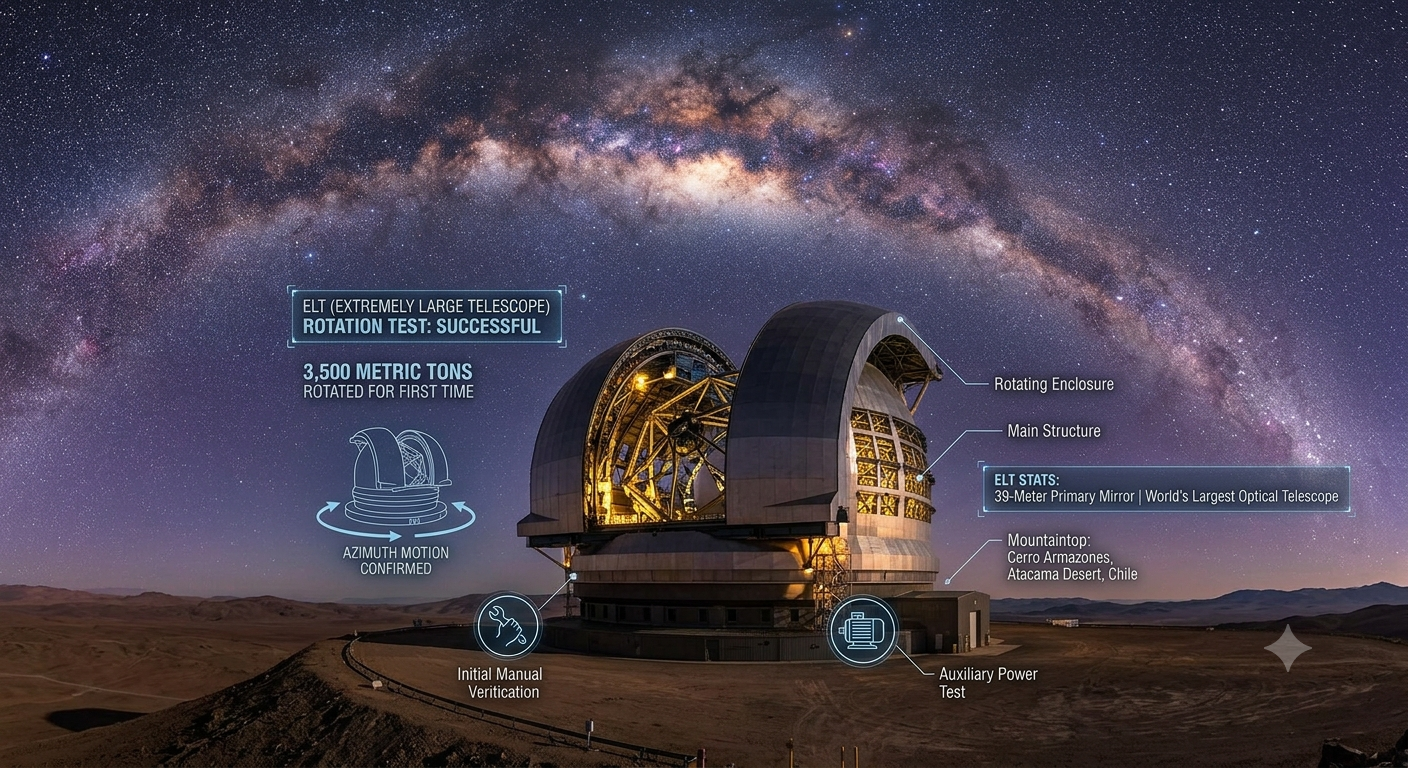
High above the breathtaking Atacama Desert in northern Chile, one of humanity’s most ambitious scientific projects has reached a major milestone. The European Southern Observatory (ESO) has successfully completed the first full rotation test of the Extremely Large Telescope (ELT), confirming that its enormous moving structure operates with exceptional precision. While it may seem like a simple mechanical test, this achievement represents years of engineering excellence and brings the telescope one step closer to transforming our understanding of the universe.
Located on the summit of Cerro Armazones, the ELT is being built to become the largest optical and near-infrared telescope ever constructed. Once completed, it will provide astronomers with an unprecedented view of the cosmos, allowing them to observe distant galaxies, study the atmospheres of planets beyond our solar system, and investigate some of the universe’s greatest mysteries. The successful rotation test proves that the telescope’s massive steel framework can move smoothly and accurately despite its extraordinary size and weight.
The Massive Engineering Challenge
Constructing the ELT is one of the most complex engineering projects ever undertaken. Every component must perform with extraordinary precision because even the slightest movement error could affect the quality of astronomical observations.
The telescope’s rotating structure currently weighs around 3,500 metric tons (7.7 million pounds), making it one of the heaviest precision instruments ever built. During the initial testing phase, engineers carefully rotated the enormous structure by hand over short distances to verify the alignment of the hydrostatic bearing system. Once the mechanical balance was confirmed, powerful electric motors successfully completed a full 360-degree rotation with remarkable stability and accuracy.
The project is still far from complete. After the installation of its giant mirrors, advanced scientific instruments, and supporting systems, the total weight of the telescope will exceed 4,600 metric tons (10 million pounds). Despite this enormous mass, the telescope must still move with millimeter-level precision to accurately track distant celestial objects across the night sky.
A Telescope Unlike Any Before
The ELT is designed to redefine modern astronomy through its revolutionary optical system. At the heart of the observatory will be a 39-meter primary mirror, assembled from 798 precisely manufactured hexagonal mirror segments. Together, these segments will function as a single giant mirror capable of collecting far more light than any existing optical telescope.
This enormous collecting power will enable astronomers to observe incredibly faint and distant objects with unprecedented clarity. The ELT is expected to gather approximately 15 times more light than today’s largest optical telescopes while producing images up to 16 times sharper than those captured by the Hubble Space Telescope.
Its advanced adaptive optics system will continuously correct for atmospheric distortions, allowing scientists to obtain exceptionally detailed images directly from Earth without many of the limitations that affect traditional ground-based observatories.
Unlocking the Secrets of the Universe
Once operational, the Extremely Large Telescope will help answer scientific questions that have challenged astronomers for decades.
One of its primary missions will be the search for Earth-like exoplanets capable of supporting life. By analyzing the chemical composition of distant planetary atmospheres, scientists hope to identify important biosignatures such as oxygen, water vapor, methane, and carbon dioxide—potential indicators of biological activity beyond Earth.
The ELT will also allow researchers to look farther back in time than ever before by observing galaxies that formed shortly after the Big Bang. These observations could reveal how the first stars, galaxies, and cosmic structures emerged, providing valuable insight into the early evolution of the universe.
In addition, astronomers will use the telescope to study the mysterious forces of dark matter and dark energy, which together make up approximately 95% of the universe yet remain largely unexplained. Its extraordinary sensitivity will help scientists test fundamental theories of gravity and improve our understanding of how the universe continues to expand.
The Road Ahead
Although the successful rotation test marks a major engineering victory, significant work still lies ahead. Over the coming years, engineers will carefully install the telescope’s massive mirror segments, adaptive optics systems, scientific instruments, cooling technologies, and high-performance control systems. Every component must undergo extensive testing before the observatory is ready for scientific operations.
Once construction is complete and the telescope achieves its long-awaited “first light,” it will become one of the most powerful scientific instruments ever created. Researchers from around the world will use the ELT to conduct groundbreaking observations that could reshape our understanding of planets, stars, galaxies, black holes, and the origins of the universe itself.
The successful rotation of the Extremely Large Telescope is far more than an engineering milestone—it is a symbol of international scientific collaboration and humanity’s enduring desire to explore the unknown. As this extraordinary observatory moves closer to completion, it promises to open an entirely new window into the cosmos and inspire discoveries that will influence astronomy for generations to come.