



Galaxy Z Fold 8 vs Pixel Fold 3: The Ultimate Foldable Showdown

Samsung and Google battle for foldable supremacy. We put the Galaxy Z Fold 8 and Pixel Fold 3 head-to-head across design, software, battery life, and cameras.

Galaxy Z Fold 8 vs Pixel Fold 3: The Ultimate Foldable Showdown

The foldable smartphone landscape has officially graduated from a futuristic novelty experiment into a fiercely contested mainstream battleground. What once started as a category plagued by thick hinges, questionable durability, and awkward aspect ratios is now home to some of the most sophisticated, ultra-thin engineering marvels in consumer electronics. At the vanguard of this revolution stand two tech titans: Samsung and Google.

With the release of the Samsung Galaxy Z Fold 8 and the generation-defining Google Pixel Fold 3, buyers face one of the toughest choices in mobile tech. Do you opt for Samsung’s finely-tuned hardware dominance and multi-window productivity, or Google’s intuitive AI integration, stock software experience, and natural cover screen proportions? Let’s dive deep into the ultimate foldable showdown to see which device reigns supreme.

1. Design, Build, and Ergonomics

For years, the physical footprint of foldable devices defined their usability. Carrying around a heavy, brick-like phone in your pocket was an acceptable compromise for early adopters, but today's users demand standard candy-bar comfort when closed.

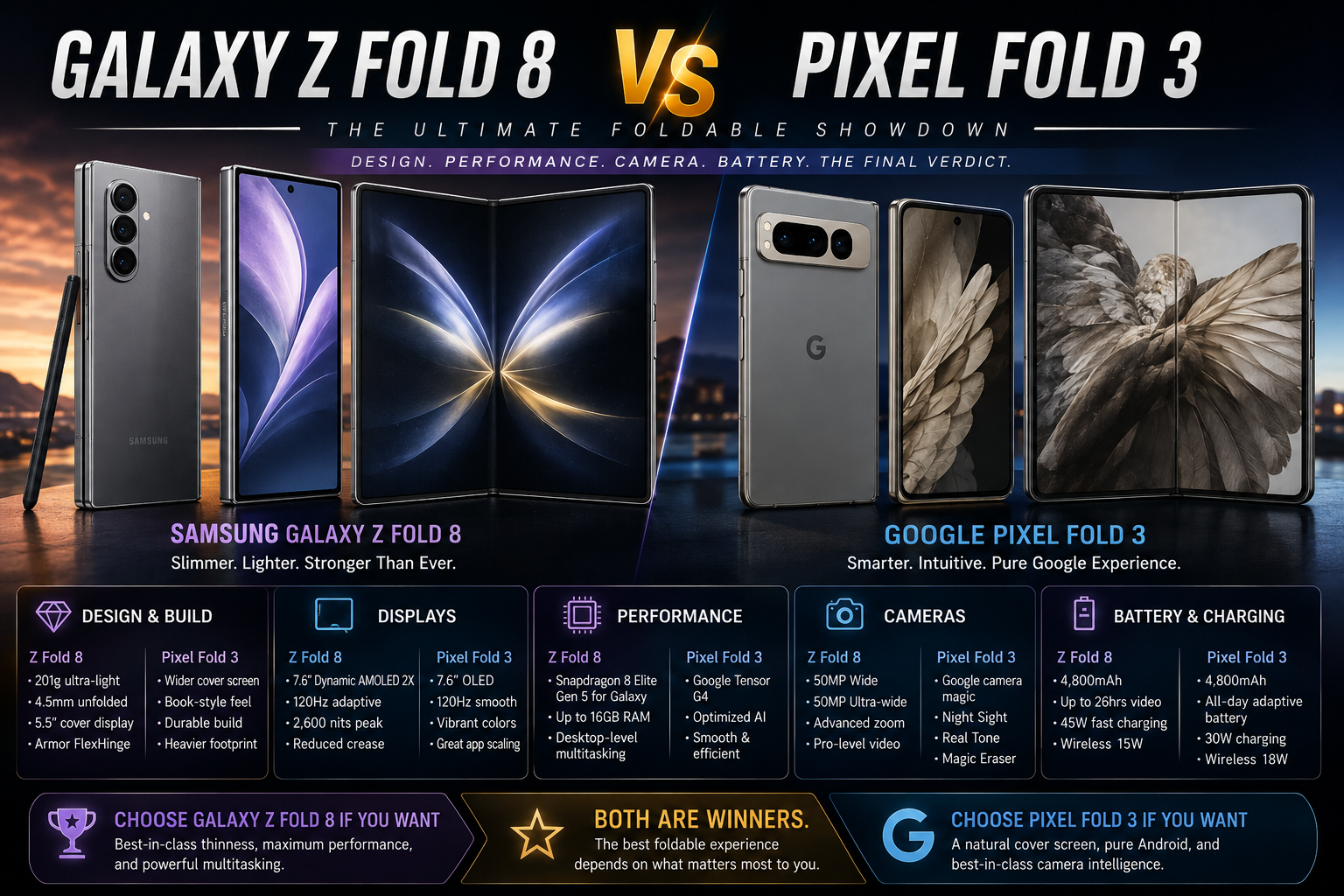
Samsung has made staggering strides with the Galaxy Z Fold 8. Dropping down to an astonishing 201 grams and featuring an ultra-slim 4.5mm unfolded profile, it feels almost indistinguishable from a standard flagship slab phone when closed. Samsung refined its Armor FlexHinge, narrowing the inner bezel gap and expanding the cover screen to a much more comfortable 5.5-inch panel with a standard-feeling aspect ratio.

On the other side, the Pixel Fold 3 leans heavily into Google’s distinct design ethos. Continuing the passport-style wide outer screen format that fans adore, the Pixel Fold 3 offers a shorter, wider cover display that makes typing on the go feel completely natural without forcing you to open the inner screen for simple text replies. However, it still carries a slightly heavier footprint than Samsung's featherlight champion, prioritizing a solid, book-like hand-feel that many users find deeply ergonomic.

2. Displays and Visual Immersion

Unfolding a foldable phone should feel like opening a portal to a miniature tablet. Both competitors deliver breathtaking OLED panels, but their approach to crease management and peak brightness differs.

The Galaxy Z Fold 8 features a gorgeous 7.6-inch main interior AMOLED display boasting a 120Hz refresh rate and a blinding peak brightness of 2,600 nits. Samsung has applied a dual layer of titanium reinforcement beneath the display layer, significantly minimizing the central crease and making touch interaction feel seamless. Outdoor visibility under harsh direct sunlight is simply stellar.

Google’s Pixel Fold 3 counters with its own immersive inner canvas. Google's software excels at handling aspect ratio scaling for stubborn apps that refuse to cooperate with square-ish tablet formats. While the crease is still faintly noticeable under direct glare, the color accuracy, skin tone calibration via Google’s advanced display pipelines, and media consumption experience make watching cinematic content an absolute joy.

3. Performance and Hardware Horsepower

Under the hood, these two devices represent fundamentally different philosophies regarding mobile computing power and efficiency.

Samsung equips the Galaxy Z Fold 8 with the custom-tuned Snapdragon 8 Elite Gen 5 for Galaxy processor, paired with up to 16GB of RAM. This powerhouse configuration handles heavy mobile gaming, split-screen multitasking with three active apps, and demanding Galaxy AI computational tasks without dropping a single frame. App launches are instantaneous, and thermal management has been vastly improved over previous generations.

The Pixel Fold 3 relies on Google’s proprietary custom silicon architecture. While it may occasionally trail Qualcomm in raw synthetic benchmark numbers, Google optimizes its hardware-software integration masterfully. Animations glide smoothly, background machine learning tasks run locally with high efficiency, and everyday fluid navigation feels deeply intuitive. If you prioritize raw gaming muscle, Samsung takes the win; if you prioritize fluid, integrated daily execution, Google holds its ground.

4. Camera Capabilities

Mobile photography is often the ultimate tiebreaker for smartphone buyers. Samsung brings heavy artillery to the Z Fold 8, featuring a versatile dual 50MP wide and 50MP ultra-wide camera system alongside advanced zoom capabilities. The larger inner screen also acts as a massive, functional viewfinder, making framing group shots or creative angles effortless.

Google, however, has built a legendary reputation on computational photography. The Pixel Fold 3 leverages Google’s industry-leading camera processing software, Magic Eraser tools, Real Tone skin mapping, and exceptional low-light Night Sight performance. Photos captured on the Pixel carry that signature contrast-rich, true-to-life look that effortlessly rivals the best non-folding flagship cameras on the market.

5. Battery Life and Endurance

Powering two separate screens used to be an insurmountable hurdle for foldables, leading to embarrassing battery drain. Fortunately, both manufacturers have turned a corner.

The Galaxy Z Fold 8 packs a robust 4,800 mAh battery optimized to handle up to 26 hours of continuous video playback, supported by faster 45W wired charging. The Pixel Fold 3 matches this dedication to longevity with smart battery-drain management that learns your daily usage habits, easily pushing through a full demanding workday of mixed 5G and Wi-Fi use.

Conclusion: Which Foldable Should You Buy?

Choosing between the Samsung Galaxy Z Fold 8 and the Google Pixel Fold 3 ultimately comes down to what you value most in your daily mobile experience.

Choose the Galaxy Z Fold 8 if you want the absolute pinnacle of lightweight hardware engineering, record-breaking thinness, blistering Snapdragon performance, and robust multitasking power tools.

Choose the Pixel Fold 3 if you prefer a wider, more natural cover screen for quick typing, cleaner stock Android software integration, and Google's peerless computational photography suite.

No matter which device you choose, the future of mobile technology has never looked more flexible.

Quick Summary

Samsung and Google battle for foldable supremacy. We put the Galaxy Z Fold 8 and Pixel Fold 3 head-to-head across design, software, battery life, and cameras.

Key Takeaways

  • Samsung and Google battle for foldable supremacy.
  • We put the Galaxy Z Fold 8 and Pixel Fold 3 head-to-head across design, software, battery life, and cameras.

Quick Facts

Category: Technology
Published: August 3, 2026
Updated: October 8, 2026
Reading time: 5 min
69 views
Updated Oct 8, 2026 5 min read

Related Articles

View all
The 2026 Smartphone Divide: iPhone vs. Android Technology
Article Technology

The 2026 Smartphone Divide: iPhone vs. Android

As we move through 2026, the long-standing rivalry between iOS and Android has evolved. While both platforms are more capable and secure than ever, they serve fundamentally different philosophies: Apple’s curated ecosystem versus Android’s open-source flexibility.

Orwell, George 9 min 293

Mixed Content

Technology
Article Technology

The Post-Automation Economy: Architecting Human Skill Premiums in the Age of Autonomy

The rapid proliferation of agentic workflows and large action models is structurally inverting the traditional corporate skill pyramid. While routine analytical processes and information retrieval tasks are being automated into low-cost utility, uncommoditizable human traits—emotional intelligence, strategic ambiguity management, and ethical governance—are commanding an unprecedented value premium. Succeeding in the post-automation enterprise requires re-engineering workforce development to focu

Mutwassim 3 min 72
The Decline of Friction: Inside the FinTech Revolution in Cross-Border Settlement and Digital Identity Technology
Article Technology

The Decline of Friction: Inside the FinTech Revolution in Cross-Border Settlement and Digital Identity

The traditional plumbing of global finance—characterized by multi-day delays, hidden fees, and fragmented identity silo—is undergoing a profound transformation. A new generation of FinTech architectures, combining distributed ledger technology (DLT), synchronized liquidity pools, and decentralized digital passports, is enabling cross-border instant payments with near-zero friction.

Mutwassim 1 min 44
The City as a Switch: Architecting IoT Logistics for the Post-Congestion Urban Era Technology
Article Technology

The City as a Switch: Architecting IoT Logistics for the Post-Congestion Urban Era

The traditional model of urban delivery—reliant on high-emission diesel vans navigating static street grids—is creating unsustainable levels of congestion and pollution in global metros. To reclaim urban space, cities are transitioning to IoT-orchestrated logistics. This data-driven framework utilizes autonomous delivery swarms, automated micro-fulfillment centers, and dynamic digital kerb-side management to route goods with the efficiency of internet packets, transforming static streets into fl

Mutwassim 4 min 71
Beyond the Coffee Shop: How Cross-Border Employment and Sovereign Visas Are Institutionalizing Remote Work Technology
Article Technology

Beyond the Coffee Shop: How Cross-Border Employment and Sovereign Visas Are Institutionalizing Remote Work

Remote work is transitioning from an informal perk into an institutionalized pillar of international commerce. Over 60 nations have launched dedicated digital nomad visa regimes, while multi-jurisdictional compliance platforms and Employer of Record (EOR) frameworks dismantle traditional geographic barriers. As knowledge workers disperse globally, enterprises and municipal governments are formalizing policies around tax residency, permanent establishment risk, and asynchronous operational workfl

Mutwassim 3 min 71
The Death of Syntax: Inside the Shift to Intent-Driven Software Engineering Technology
Article Technology

The Death of Syntax: Inside the Shift to Intent-Driven Software Engineering

The day-to-day discipline of software engineering is undergoing its most radical abstraction leap since the transition from assembly language to high-level compilers. Generative code synthesis and deterministic reasoning engines are automating boilerplate syntax, turning software developers into systems architects. Survival in this new paradigm demands mastering intent formalization, specification design, and continuous verification.

Mutwassim 3 min 71
The Post-Visual Threat: Architecting Zero-Trust Defense Against Weaponized Deepfakes Technology
Article Technology

The Post-Visual Threat: Architecting Zero-Trust Defense Against Weaponized Deepfakes

The rapid weaponization of real-time voice cloning and synthetic video generation has transformed social engineering from opportunistic phishing into targeted executive identity emulation. High-profile incidents involving multi-million-dollar wire transfers authorized via synthetic video calls prove that sight and sound can no longer authenticate authorization. Securing modern enterprises requires an uncompromising zero-trust identity layer capable of neutralizing synthetic deception.

Mutwassim 3 min 137
Beyond the Battery: How Electric Mobility Is Forcing a Overhaul of the Global Power Grid Technology
Article Technology

Beyond the Battery: How Electric Mobility Is Forcing a Overhaul of the Global Power Grid

The global transition toward electric vehicles is no longer constrained primarily by battery chemistry or vehicle range. Instead, the real bottleneck has shifted directly to the electrical grid. As commercial fleets and passenger cars electrify at scale, utilities and city planners are racing to deploy vehicle-to-grid (V2G) bidirectional systems, AI-driven dynamic load balancers, and decentralized microgrid storage to avoid grid failure.

Mutwassim 3 min 58
Cloud 3.0: The Shift Toward Sovereign Data Architectures and Edge Computing Technology
Article Technology

Cloud 3.0: The Shift Toward Sovereign Data Architectures and Edge Computing

The architectural assumption that enterprise compute and storage should reside in a handful of centralized hyperscaler data centers is fracturing. Driven by strict cross-border data sovereignty regulations and the demand for millisecond-latency AI inference, global IT leaders are pivoting to Cloud 3.0—a model centered on distributed, locally governed, and hybrid sovereign architectures.

Mutwassim 3 min 61