





For the past decade, the explosive narrative of artificial intelligence has been defined by massive, centralized server farms. Whenever you asked a voice assistant a complex question, generated an image, or requested a translation, your device acted as a simple middleman. It packaged your raw data, shot it across hundreds or thousands of miles through fiber-optic cables to a football-field-sized cloud data center, waited for a bank of power-hungry GPUs to crunch the numbers, and bounced the result back to your screen.
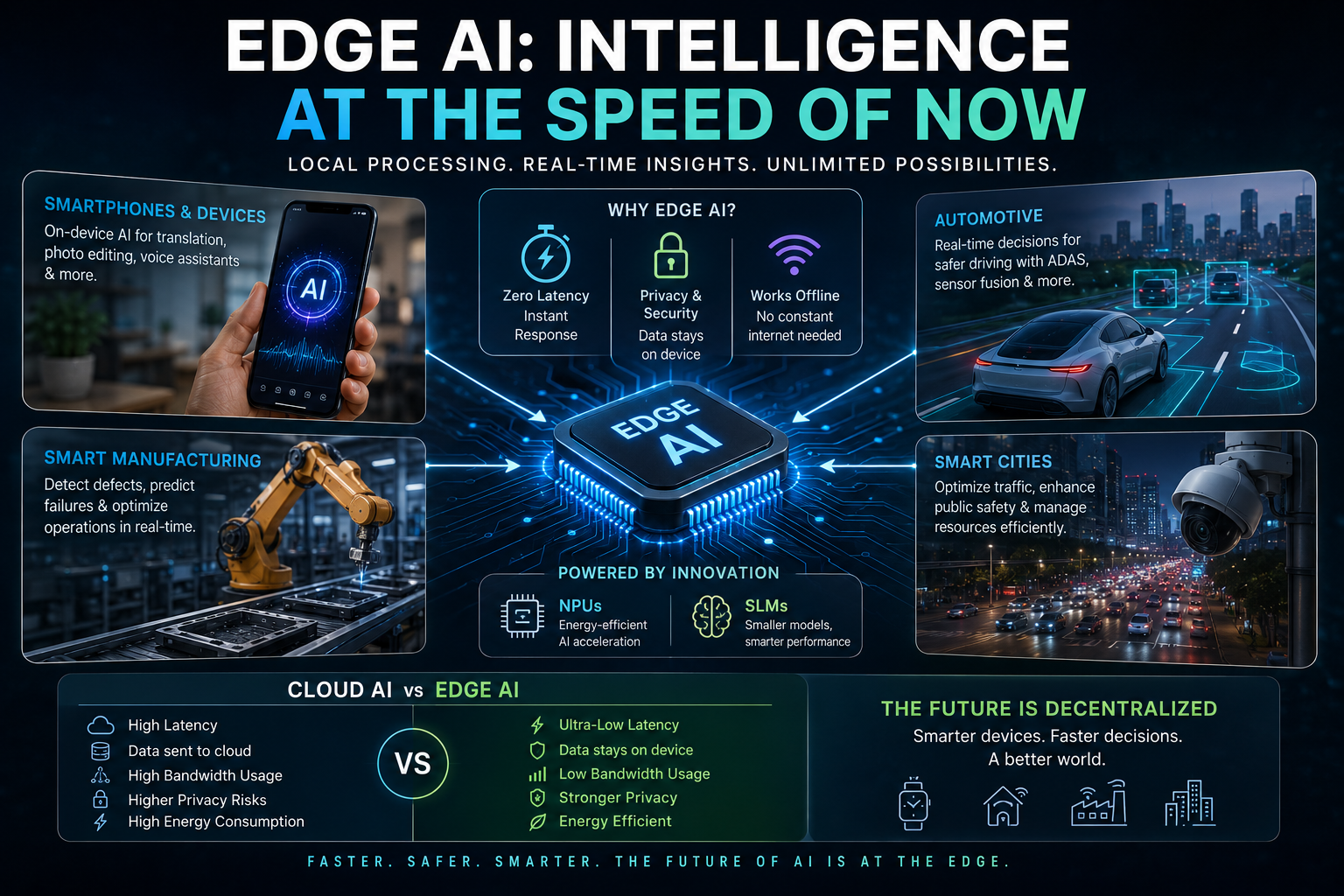
While this cloud-centric model birthed the modern AI boom, it comes with unavoidable bottlenecks: frustrating latency, high bandwidth costs, persistent privacy risks, and astronomical energy consumption. Enter Edge AI. By shifting machine learning inference directly onto local hardware—smartphones, wearables, smart home appliances, cars, and industrial machinery—the tech industry is radically decentralizing intelligence. Here is a comprehensive look at what Edge AI is and why every new device is racing to adopt it.
1. Defining Edge AI: Moving Brains Out of the Cloud
To understand Edge AI, you first need to understand the "edge" of a network. In traditional computing architecture, the edge refers to the physical location where data is actually gathered—the sensor on a factory floor, the camera lens on a traffic light, or the microphone inside your wireless earbuds.
Traditionally, these endpoints were "dumb" collectors; they gathered raw data and shipped it elsewhere to be interpreted. Edge AI integrates advanced machine learning models directly onto these local devices. Instead of sending raw video footage from a security camera to a remote cloud server for analysis, an edge-AI-enabled camera processes the video locally on a specialized microchip, instantly recognizing threats or anomalies on the spot without ever uploading private streams to an external server.
2. The Core Driver: Why the Tech World is Pivoting to the Edge
The rapid migration toward local, on-device processing is not a cosmetic trend; it is driven by hard operational necessities that cloud computing simply cannot solve on its own.
A. Zero Latency and Instantaneous Response
In safety-critical scenarios, milliseconds matter. If an autonomous vehicle's collision-avoidance system has to beam sensor data to a cloud server and wait for a response before slamming on the brakes, the delay—however small—can result in disaster. Edge AI processes data instantly at the point of origin, allowing for real-time reflexes essential for robotics, autonomous transit, and medical monitoring.
B. Uncompromising Data Privacy and Security
When your personal voice commands, health metrics, and private home video feeds stay strictly on your device, the attack surface for hackers shrinks dramatically. Edge AI processes sensitive information locally, meaning confidential data never has to transit vulnerable public networks or sit on third-party cloud servers where it could potentially be intercepted or exploited.
C. Liberation from Bandwidth and Connectivity Limits
Streaming high-definition video and continuous telemetry data from millions of deployed Internet of Things (IoT) devices consumes staggering amounts of network bandwidth. Edge AI filters data locally, transmitting only relevant, lightweight insights rather than raw continuous streams. This keeps systems fully operational even in remote or offline environments where internet connectivity is spotty or nonexistent.
3. The Hardware Revolution: NPUs and Small Language Models (SLMs)
Edge AI wouldn't be possible without a simultaneous transformation in silicon engineering and model architecture.
On the hardware front, traditional Central Processing Units (CPUs) and even standard Graphics Processing Units (GPUs) are often too power-hungry for compact gadgets. This has led to the ubiquitous rise of Neural Processing Units (NPUs)—specialized coprocessors engineered from the ground up to execute machine learning algorithms with incredible energy efficiency.
Simultaneously, the software side has shifted away from monolithic, trillion-parameter Large Language Models (LLMs) toward highly optimized Small Language Models (SLMs) and quantized neural networks. These compact models pack targeted, high-level intelligence into just a few gigabytes of memory, allowing sophisticated reasoning capabilities to run smoothly inside everyday consumer devices without melting your battery.
4. Edge AI Across Industries: Where Is It Being Deployed?
The footprint of Edge AI spans nearly every vertical sector of the modern global economy:
- Consumer Electronics: Smartphones and AI PCs now feature dedicated on-device neural chips that handle real-time language translation, generative photo editing, and personalized assistant workflows locally without draining cellular data.
- Automotive: Modern connected vehicles use local edge computing for advanced driver-assistance systems (ADAS), cabin monitoring, and real-time sensor fusion to guarantee split-second driving safety.
- Smart Manufacturing & Industry: Factories utilize edge-enabled computer vision and predictive maintenance sensors to catch assembly line defects and predict mechanical failure before equipment breaks down.
- Smart Cities: Urban infrastructure leverages intelligent edge cameras to optimize traffic flow, monitor public safety, and manage municipal resources dynamically.
Conclusion: The Local Future of Intelligent Computing
Edge AI represents a maturing of artificial intelligence from a centralized utility into a ubiquitous, invisible fabric embedded in the physical world around us. By bringing high-speed processing directly to the device level, we are building a technology ecosystem that is faster, safer, more private, and entirely independent of fragile cloud connections.
The future of intelligence is no longer sitting thousands of miles away in a remote server rack—it lives right in the palm of your hand, inside your car, and embedded in the walls of your smart home.