





What Is Edge AI and Why Every New Device Is Adopting It

Say goodbye to cloud latency. Discover why smartphones, appliances, and industrial machines are integrating on-device Edge AI for instant, private processing.

What Is Edge AI and Why Every New Device Is Adopting It

For the past decade, the explosive narrative of artificial intelligence has been defined by massive, centralized server farms. Whenever you asked a voice assistant a complex question, generated an image, or requested a translation, your device acted as a simple middleman. It packaged your raw data, shot it across hundreds or thousands of miles through fiber-optic cables to a football-field-sized cloud data center, waited for a bank of power-hungry GPUs to crunch the numbers, and bounced the result back to your screen.

While this cloud-centric model birthed the modern AI boom, it comes with unavoidable bottlenecks: frustrating latency, high bandwidth costs, persistent privacy risks, and astronomical energy consumption. Enter Edge AI. By shifting machine learning inference directly onto local hardware—smartphones, wearables, smart home appliances, cars, and industrial machinery—the tech industry is radically decentralizing intelligence. Here is a comprehensive look at what Edge AI is and why every new device is racing to adopt it.

1. Defining Edge AI: Moving Brains Out of the Cloud

To understand Edge AI, you first need to understand the "edge" of a network. In traditional computing architecture, the edge refers to the physical location where data is actually gathered—the sensor on a factory floor, the camera lens on a traffic light, or the microphone inside your wireless earbuds.

Traditionally, these endpoints were "dumb" collectors; they gathered raw data and shipped it elsewhere to be interpreted. Edge AI integrates advanced machine learning models directly onto these local devices. Instead of sending raw video footage from a security camera to a remote cloud server for analysis, an edge-AI-enabled camera processes the video locally on a specialized microchip, instantly recognizing threats or anomalies on the spot without ever uploading private streams to an external server.

2. The Core Driver: Why the Tech World is Pivoting to the Edge

The rapid migration toward local, on-device processing is not a cosmetic trend; it is driven by hard operational necessities that cloud computing simply cannot solve on its own.

A. Zero Latency and Instantaneous Response

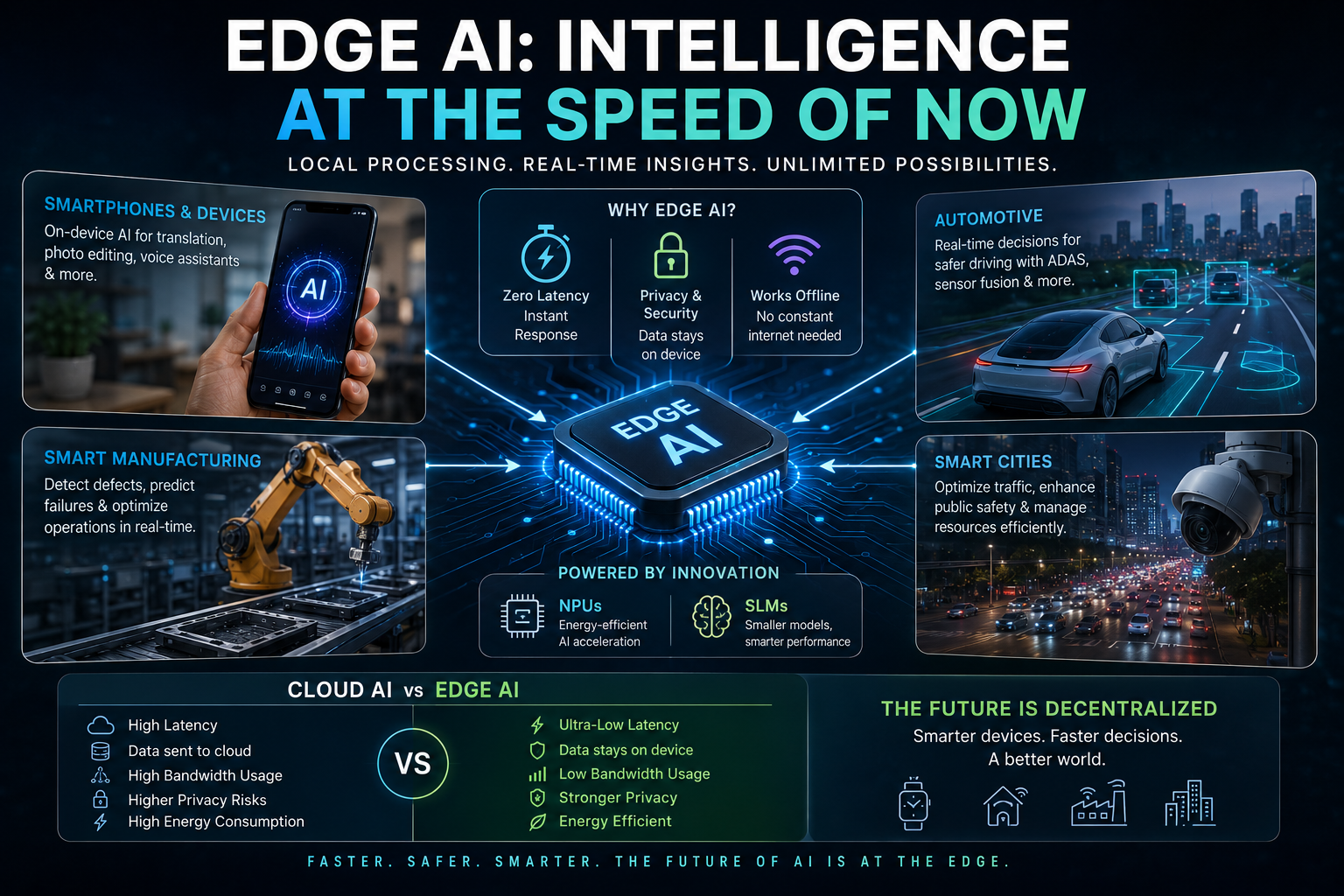
In safety-critical scenarios, milliseconds matter. If an autonomous vehicle's collision-avoidance system has to beam sensor data to a cloud server and wait for a response before slamming on the brakes, the delay—however small—can result in disaster. Edge AI processes data instantly at the point of origin, allowing for real-time reflexes essential for robotics, autonomous transit, and medical monitoring.

B. Uncompromising Data Privacy and Security

When your personal voice commands, health metrics, and private home video feeds stay strictly on your device, the attack surface for hackers shrinks dramatically. Edge AI processes sensitive information locally, meaning confidential data never has to transit vulnerable public networks or sit on third-party cloud servers where it could potentially be intercepted or exploited.

C. Liberation from Bandwidth and Connectivity Limits

Streaming high-definition video and continuous telemetry data from millions of deployed Internet of Things (IoT) devices consumes staggering amounts of network bandwidth. Edge AI filters data locally, transmitting only relevant, lightweight insights rather than raw continuous streams. This keeps systems fully operational even in remote or offline environments where internet connectivity is spotty or nonexistent.

3. The Hardware Revolution: NPUs and Small Language Models (SLMs)

Edge AI wouldn't be possible without a simultaneous transformation in silicon engineering and model architecture.

On the hardware front, traditional Central Processing Units (CPUs) and even standard Graphics Processing Units (GPUs) are often too power-hungry for compact gadgets. This has led to the ubiquitous rise of Neural Processing Units (NPUs)—specialized coprocessors engineered from the ground up to execute machine learning algorithms with incredible energy efficiency.

Simultaneously, the software side has shifted away from monolithic, trillion-parameter Large Language Models (LLMs) toward highly optimized Small Language Models (SLMs) and quantized neural networks. These compact models pack targeted, high-level intelligence into just a few gigabytes of memory, allowing sophisticated reasoning capabilities to run smoothly inside everyday consumer devices without melting your battery.

4. Edge AI Across Industries: Where Is It Being Deployed?

The footprint of Edge AI spans nearly every vertical sector of the modern global economy:

  • Consumer Electronics: Smartphones and AI PCs now feature dedicated on-device neural chips that handle real-time language translation, generative photo editing, and personalized assistant workflows locally without draining cellular data.
  • Automotive: Modern connected vehicles use local edge computing for advanced driver-assistance systems (ADAS), cabin monitoring, and real-time sensor fusion to guarantee split-second driving safety.
  • Smart Manufacturing & Industry: Factories utilize edge-enabled computer vision and predictive maintenance sensors to catch assembly line defects and predict mechanical failure before equipment breaks down.
  • Smart Cities: Urban infrastructure leverages intelligent edge cameras to optimize traffic flow, monitor public safety, and manage municipal resources dynamically.

Conclusion: The Local Future of Intelligent Computing

Edge AI represents a maturing of artificial intelligence from a centralized utility into a ubiquitous, invisible fabric embedded in the physical world around us. By bringing high-speed processing directly to the device level, we are building a technology ecosystem that is faster, safer, more private, and entirely independent of fragile cloud connections.

The future of intelligence is no longer sitting thousands of miles away in a remote server rack—it lives right in the palm of your hand, inside your car, and embedded in the walls of your smart home.

Quick Summary

Say goodbye to cloud latency. Discover why smartphones, appliances, and industrial machines are integrating on-device Edge AI for instant, private processing.

Key Takeaways

  • Consumer Electronics: Smartphones and AI PCs now feature dedicated on-device neural chips that handle real-time language translation, generative photo editing, and personalized assistant workflows locally without draining cellular data.
  • Automotive: Modern connected vehicles use local edge computing for advanced driver-assistance systems (ADAS), cabin monitoring, and real-time sensor fusion to guarantee split-second driving safety.
  • Smart Manufacturing & Industry: Factories utilize edge-enabled computer vision and predictive maintenance sensors to catch assembly line defects and predict mechanical failure before equipment breaks down.
  • Smart Cities: Urban infrastructure leverages intelligent edge cameras to optimize traffic flow, monitor public safety, and manage municipal resources dynamically.

Quick Facts

Category: Technology
Published: August 5, 2026
Updated: October 8, 2026
Reading time: 5 min
61 views
Updated Oct 8, 2026 5 min read

Related Articles

View all
The 2026 Smartphone Divide: iPhone vs. Android Technology
Article Technology

The 2026 Smartphone Divide: iPhone vs. Android

As we move through 2026, the long-standing rivalry between iOS and Android has evolved. While both platforms are more capable and secure than ever, they serve fundamentally different philosophies: Apple’s curated ecosystem versus Android’s open-source flexibility.

Orwell, George 9 min 293

Mixed Content

Technology
Article Technology

The Post-Automation Economy: Architecting Human Skill Premiums in the Age of Autonomy

The rapid proliferation of agentic workflows and large action models is structurally inverting the traditional corporate skill pyramid. While routine analytical processes and information retrieval tasks are being automated into low-cost utility, uncommoditizable human traits—emotional intelligence, strategic ambiguity management, and ethical governance—are commanding an unprecedented value premium. Succeeding in the post-automation enterprise requires re-engineering workforce development to focu

Mutwassim 3 min 72
The Decline of Friction: Inside the FinTech Revolution in Cross-Border Settlement and Digital Identity Technology
Article Technology

The Decline of Friction: Inside the FinTech Revolution in Cross-Border Settlement and Digital Identity

The traditional plumbing of global finance—characterized by multi-day delays, hidden fees, and fragmented identity silo—is undergoing a profound transformation. A new generation of FinTech architectures, combining distributed ledger technology (DLT), synchronized liquidity pools, and decentralized digital passports, is enabling cross-border instant payments with near-zero friction.

Mutwassim 1 min 44
The City as a Switch: Architecting IoT Logistics for the Post-Congestion Urban Era Technology
Article Technology

The City as a Switch: Architecting IoT Logistics for the Post-Congestion Urban Era

The traditional model of urban delivery—reliant on high-emission diesel vans navigating static street grids—is creating unsustainable levels of congestion and pollution in global metros. To reclaim urban space, cities are transitioning to IoT-orchestrated logistics. This data-driven framework utilizes autonomous delivery swarms, automated micro-fulfillment centers, and dynamic digital kerb-side management to route goods with the efficiency of internet packets, transforming static streets into fl

Mutwassim 4 min 71
Beyond the Coffee Shop: How Cross-Border Employment and Sovereign Visas Are Institutionalizing Remote Work Technology
Article Technology

Beyond the Coffee Shop: How Cross-Border Employment and Sovereign Visas Are Institutionalizing Remote Work

Remote work is transitioning from an informal perk into an institutionalized pillar of international commerce. Over 60 nations have launched dedicated digital nomad visa regimes, while multi-jurisdictional compliance platforms and Employer of Record (EOR) frameworks dismantle traditional geographic barriers. As knowledge workers disperse globally, enterprises and municipal governments are formalizing policies around tax residency, permanent establishment risk, and asynchronous operational workfl

Mutwassim 3 min 71
The Death of Syntax: Inside the Shift to Intent-Driven Software Engineering Technology
Article Technology

The Death of Syntax: Inside the Shift to Intent-Driven Software Engineering

The day-to-day discipline of software engineering is undergoing its most radical abstraction leap since the transition from assembly language to high-level compilers. Generative code synthesis and deterministic reasoning engines are automating boilerplate syntax, turning software developers into systems architects. Survival in this new paradigm demands mastering intent formalization, specification design, and continuous verification.

Mutwassim 3 min 71
The Post-Visual Threat: Architecting Zero-Trust Defense Against Weaponized Deepfakes Technology
Article Technology

The Post-Visual Threat: Architecting Zero-Trust Defense Against Weaponized Deepfakes

The rapid weaponization of real-time voice cloning and synthetic video generation has transformed social engineering from opportunistic phishing into targeted executive identity emulation. High-profile incidents involving multi-million-dollar wire transfers authorized via synthetic video calls prove that sight and sound can no longer authenticate authorization. Securing modern enterprises requires an uncompromising zero-trust identity layer capable of neutralizing synthetic deception.

Mutwassim 3 min 137
Beyond the Battery: How Electric Mobility Is Forcing a Overhaul of the Global Power Grid Technology
Article Technology

Beyond the Battery: How Electric Mobility Is Forcing a Overhaul of the Global Power Grid

The global transition toward electric vehicles is no longer constrained primarily by battery chemistry or vehicle range. Instead, the real bottleneck has shifted directly to the electrical grid. As commercial fleets and passenger cars electrify at scale, utilities and city planners are racing to deploy vehicle-to-grid (V2G) bidirectional systems, AI-driven dynamic load balancers, and decentralized microgrid storage to avoid grid failure.

Mutwassim 3 min 58
Cloud 3.0: The Shift Toward Sovereign Data Architectures and Edge Computing Technology
Article Technology

Cloud 3.0: The Shift Toward Sovereign Data Architectures and Edge Computing

The architectural assumption that enterprise compute and storage should reside in a handful of centralized hyperscaler data centers is fracturing. Driven by strict cross-border data sovereignty regulations and the demand for millisecond-latency AI inference, global IT leaders are pivoting to Cloud 3.0—a model centered on distributed, locally governed, and hybrid sovereign architectures.

Mutwassim 3 min 61