





We live in a remarkably unprecedented era. For the first time in human history, nearly every waking moment can be filled with instantaneous, high-stakes stimulation. From the infinite scroll of algorithmic feeds and the endless dopamine hits of notification pings to the 24/7 availability of on-demand entertainment and hyper-palatable foods, our brains are constantly bathed in a flood of chemical reinforcement. We are, quite literally, over-stimulated.
In response to this modern saturation, a trend has exploded across Silicon Valley, productivity circles, and wellness blogs: the "Dopamine Detox." The concept, popularized by YouTubers and self-help gurus, suggests that by abstaining from all pleasurable activities—no technology, no food, no reading, sometimes even no talking—for 24 to 48 hours, you can "reset" your brain chemistry, cure burnout, and reclaim your lost motivation.
But does it hold up to scientific scrutiny? Can you actually "fast" from a neurotransmitter? The short answer is: No, you cannot fast from dopamine itself. It is vital for survival. The long answer, however, is that the underlying principle—taking a strategic break from hyper-stimulating modern environments—is rooted in solid neuroscience. To understand what actually works, we must first understand how dopamine really functions.
The Neurobiology of Stimulation: Why We Need a Reset
Dopamine is not simply the "pleasure molecule" as it is often reductively labeled in popular media. It is primarily the neurotransmitter of desire, craving, and prediction error. It is released not just when you receive a reward, but when your brain anticipates a potential reward. It compels you to take action.
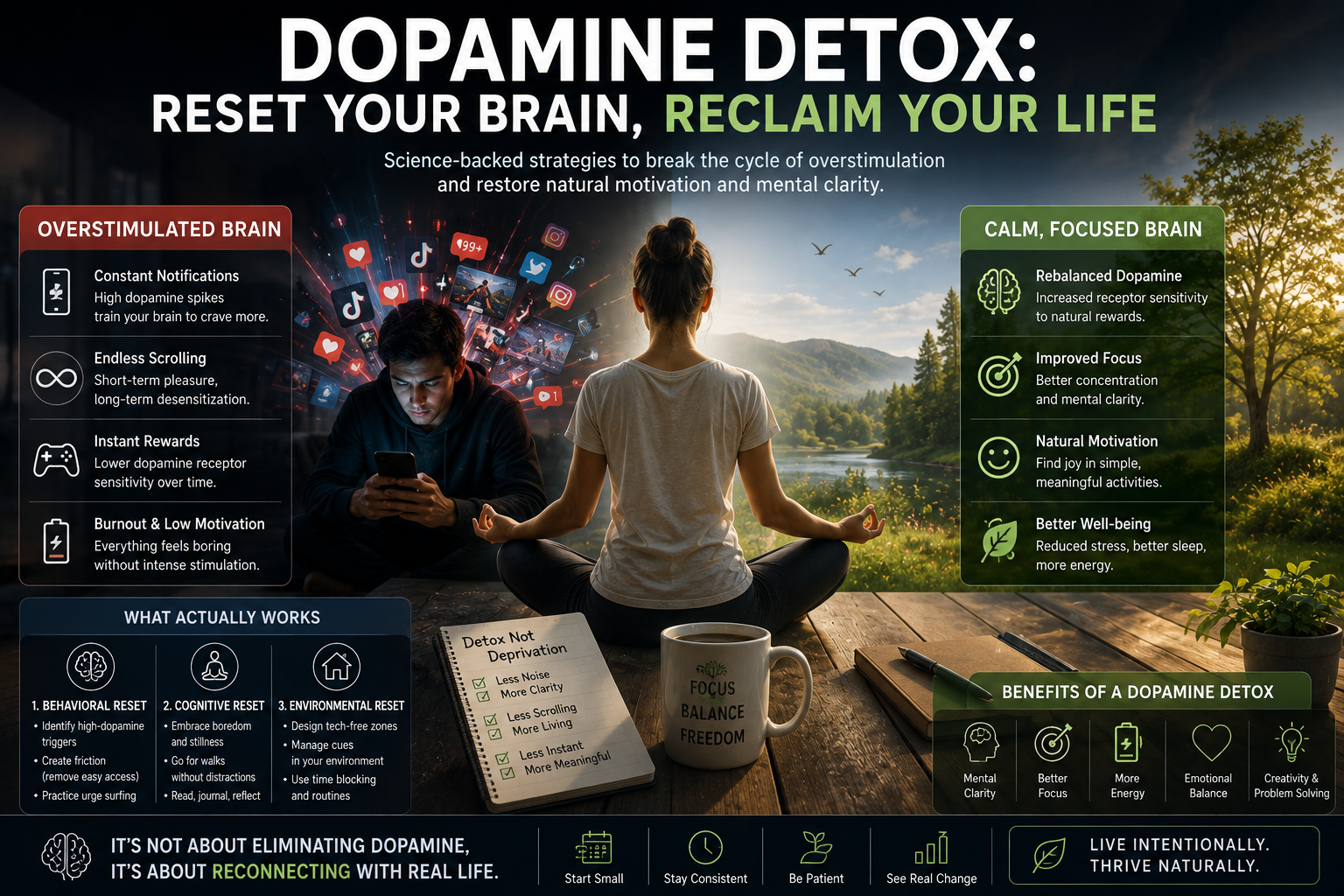
The fundamental issue addressed by the dopamine detox movement is neural adaptation, specifically downregulation. When your brain is consistently exposed to unnaturally high levels of stimulation—like the variable rewards of social media or the intensity of fast-paced video games—it adapts to maintain homeostasis. It does this by reducing the sensitivity and number of available dopamine receptors (D2 receptors specifically) in the brain's reward pathway, the striatum.
Think of it like turning down the volume on a blaring speaker. To feel the same level of excitement or motivation you once did, you now require a much stronger stimulus. This process leads to tolerance, cravings, and a diminished baseline level of satisfaction in everyday activities—the feeling that everything is boring unless it's immediately engaging.
A "dopamine detox," therefore, is not about eliminating dopamine. It is a misnomer. It is actually a stimulus detox. By removing the artificial, high-salience triggers of modern life, you allow your overtaxed reward system time to recover sensitivity. You are letting your brain's dopamine receptors "upregulate," meaning they become more sensitive again to normal, lower levels of stimulation.
The Myth of the Monastic Fast: What Doesn't Work
The extreme version of the dopamine detox—often attributed to Dr. Cameron Sepah, who originally proposed a clinically-based "Dopamine Fast" to help tech workers manage impulsive behaviors—has been misinterpreted by popular culture.
Dr. Sepah’s original protocol was based on Cognitive Behavioral Therapy (CBT), not total sensory deprivation. It was designed to help people manage behavioral addictions (like compulsive internet use or gaming) by scheduling periods of abstinence from *specific problematic behaviors*, rather than engaging in a monastic fast where you stare at a wall in silence.
Total abstinence from *everything* for 24 hours is often counterproductive and based on a misunderstanding of biology:
- It’s impossible: Your brain releases dopamine continuously just to keep you alive—moving, breathing, and thinking. You cannot stop it.
- It creates rebound effects: Forcing yourself into severe boredom can paradoxically increase the salience of the very things you are trying to avoid. You may experience intense cravings and end up bingeing harder once the fast is over.
- It's unnecessary: You do not need to eliminate all external input to allow receptor sensitivity to recover. You just need to significantly lower the signal-to-noise ratio.
The Science-Backed Protocol: What Actually Works
If the extreme fast is a myth, what does the science suggest for resetting your motivation and focus? The goal is not to live a life without stimulation, but to recalibrate your relationship with it so you are not constantly driven by impulsive craving.
Here is a practical, science-informed approach to effectively lowering your baseline stimulation levels.
1. The Behavioral Reset: Strategic Stimulus Reduction
Instead of fasting from reality, apply the principles of stimulus control used in addiction treatment. The goal is to make problematic stimuli less accessible and less visible.
- Identify Your High-Dopamine Triggers: What is the primary source of your over-stimulation? Is it the infinite scroll of TikTok, competitive video games, or compulsive news checking?
- Implement Friction: Make it difficult to engage with these triggers. Delete the apps from your phone for a set period. Use website blockers on your computer. Put your gaming console in another room. The easier it is to access a stimulus, the more likely you are to consume it impulsively.
- Schedule "Urge Surfing": When you feel a strong craving to check your device, recognize it as a physical sensation in your body. Instead of immediately reacting, practice "urge surfing"—observe the urge without acting on it, realizing that like a wave, it will eventually crest and subside. This strengthens your prefrontal cortex's ability to override impulsive actions.
- Engage in Low-Stimulus Activities: During your detox period, focus on activities that provide a slow, steady drip of dopamine rather than a sudden flood. Go for a walk *without* headphones. Do some light stretching. Read a physical book or journal. Stare out a window. Cook a simple meal from scratch.
- Let Your Mind Wander: When we are bored, our brains activate the "Default Mode Network" (DMN). This network is crucial for creativity, self-reflection, long-term planning, and consolidating memories. When you are constantly stimulated, the DMN is suppressed. Deliberate boredom allows your brain to connect disparate ideas and generate new insights.
- Design Your Environment for Focus: Keep your workspace clear of distractions. Designate specific "tech-free zones" in your home, like the dining table or the bedroom. By removing the visual cues of high-dopamine temptations, you reduce the cognitive load required to maintain focus.
- Utilize Time Blocking: Allocate specific times for checking emails and social media rather than letting them interrupt your workflow. This puts you back in control of your dopamine release rather than being at the mercy of incoming notifications.
2. The Cognitive Reset: Embracing Deliberate Boredom
Our brains are wired to constantly seek novelty and solve problems. In the modern world, we have outsourced this drive to devices. To recover our creative capacity, we need to re-learn how to be bored.
3. The Environmental Reset: Managing Cues
Behavioral psychology teaches us that cues in our environment trigger habitual responses. If your phone is sitting next to you on the couch, the cue is constantly activating your craving circuitry.
Conclusion: Recalibrating for a Sustainable Future
The true value of a "dopamine detox" lies not in a magical biological reset over a weekend, but in the long-term behavioral changes it initiates. It serves as a circuit breaker, interrupting the automatic loops of craving and consumption that define much of modern life.
By strategically reducing the overwhelming noise of hyper-stimulation, we give our neural architecture the space to heal and regain sensitivity to the subtler, more sustainable rewards of real-world engagement—deep work, genuine connection, and the quiet satisfaction of boredom. It is less a fast and more a recalibration: an opportunity to become the master of your motivation rather than its servant.