






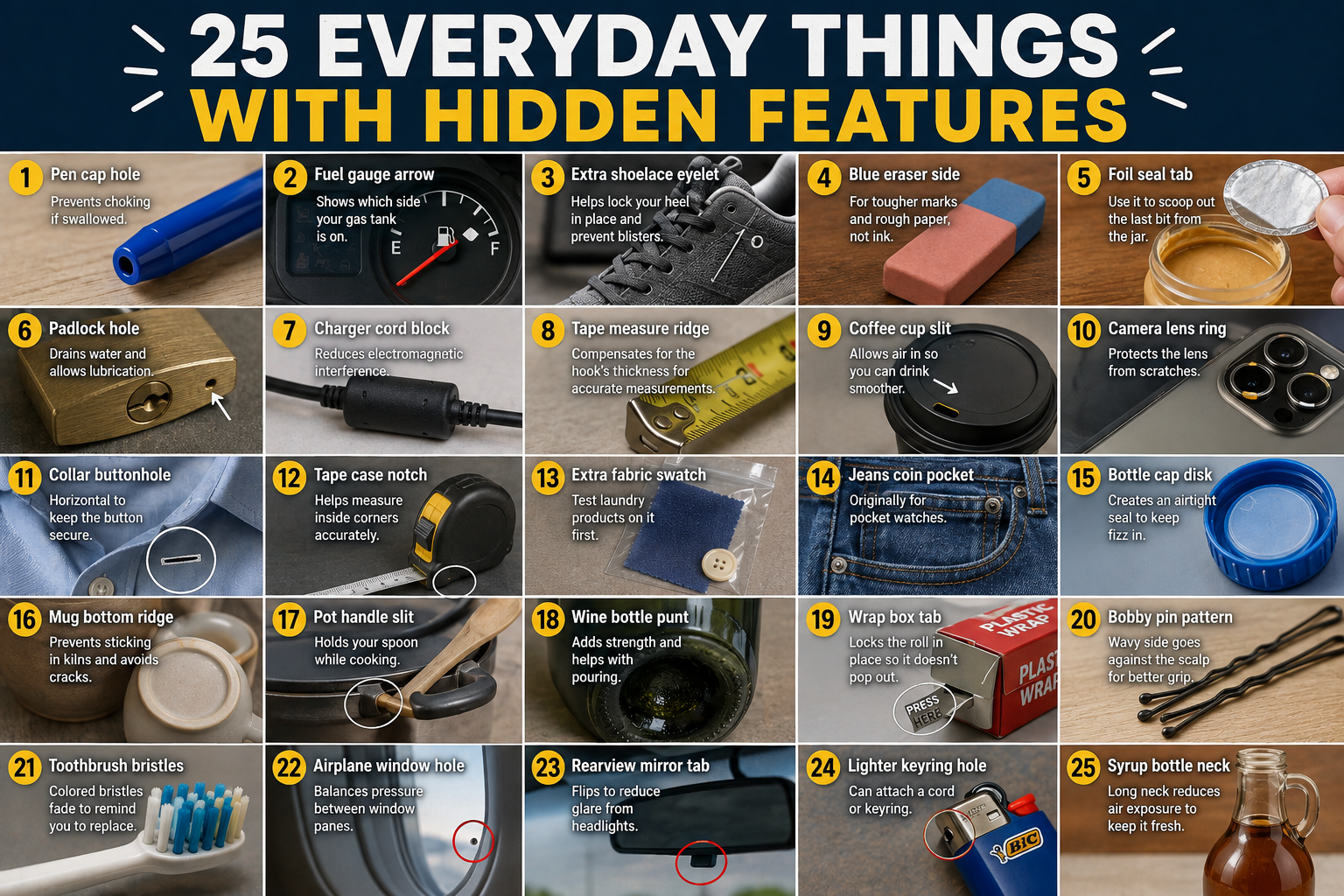
We live our lives surrounded by manufactured objects. From the moment we wake up and brush our teeth to the moment we lock our front doors at night, we interact with dozens of tools, gadgets, containers, and garments. Because these items are so deeply ingrained in our daily routines, we rarely stop to examine them closely.
Yet, industrial designers and engineers often pack everyday items with brilliant, clever features designed to solve minor annoyances or prevent safety hazards—features that sit right out in the open, completely unnoticed by the average person. Here are 25 everyday things you didn’t know had hidden features.
1. The Hole in Your Ballpoint Pen Cap
Have you ever wondered why almost every classic ballpoint pen cap has a small hole right at the top tip? Most people assume it helps equalize pressure so the ink doesn't leak. In reality, it is a life-saving safety feature. Children and adults frequently chew on pen caps, and accidental ingestion can lead to choking. If a cap gets lodged in someone's windpipe, that tiny hole maintains partial airflow, preventing complete suffocation until medical help arrives.
2. The Little Arrow on Your Car’s Fuel Gauge
If you have ever rented a car or driven an unfamiliar vehicle, you have likely experienced the awkward moment of pulling up to a gas station pump and forgetting which side the fuel tank door is on. Next time, check your dashboard's fuel gauge icon: right next to the gas pump symbol is a tiny triangular arrow. That arrow points directly to the side of the car where your gas cap is located.
3. The Extra Shoelace Eyelet at the Top of Sneakers
Athletic running shoes almost always feature an extra, seemingly isolated eyelet near the very top of the lacing system. Most people leave it empty. However, threading your laces through this loop to create a "heel lock" or "runner's knot" locks your ankle firmly in place, preventing your foot from sliding forward and rubbing against the shoe to cause painful blisters during long runs.
4. The Blue Section of Erasers Was Never for Ink
For generations, students carried dual-colored rubber erasers featuring a pink side and a rough blue side. Urban legend dictated that the blue side was meant to erase ink pens. In reality, the blue side was engineered for dense, heavy paper stock and thick graphite marks. Using it on cheap notebook paper usually results in tearing a massive hole right through the page.
5. The Foil Seal Tab Under Peanut Butter Lids
When you peel back the foil safety seal on a new jar of peanut butter or mayonnaise, you probably throw it straight in the trash. However, the stiff cardboard or foil circle inside the lid can actually be inverted and used as a temporary, mess-free scraper or spreader when you want to scoop out the last remnants from the bottom of the jar.
6. The Small Hole on the Bottom of Padlocks
If you look closely at the bottom base of a standard brass padlock next to the shackle opening, you will notice a tiny microscopic hole. This is not a manufacturing defect. It is a drainage and lubrication port. If moisture gets trapped inside the lock during rain or snow, the hole allows water to escape so the internal mechanisms don't rust solid. It is also the port where technicians inject lubricating oil.
7. The Cylindrical Block on Laptop Charger Cords
That heavy plastic cylinder molded near the end of your laptop charging cable is called a ferrite bead. It is packed with a chunk of magnetic iron oxide. Its purpose is to suppress high-frequency electromagnetic interference (EMI), keeping radio waves from leaking out of your cord and preventing outside electrical signals from disrupting your computer's clean power delivery.
8. The Tiny Metal Ridge on Tape Measures
Have you ever noticed that the metal hook at the very end of a tape measure is intentionally loose and wobbly? Far from being a broken manufacturing flaw, that wiggle room is mathematically calibrated. The gap accounts for the exact thickness of the metal hook itself—giving you the exact same precision measurement whether you hook the end over a board or press it flat against a wall.
9. The Diagonal Slit on Takeout Coffee Cup Lids
Plastic coffee cup lids often feature a small raised indentation or a secondary slot opposite the primary sip hole. While some people use it to jam wooden stir sticks in to cool the coffee down, it is primarily engineered as an air-vent channel. It allows air to flow back into the cup as you drink, preventing the liquid from glugging and splashing out unexpectedly.
10. The Golden Ring on iPhone Camera Lenses
Many smartphones feature metallic rings or protective rims surrounding their camera lenses. These aren't just decorative accents; they act as physical buffer zones. They slightly elevate the glass surface off flat tables when you lay your phone down, preventing abrasive dust particles from scratching your camera optics.
11. The Horizontal Buttonhole on the Top Shirt Collar
Most shirt buttonholes run vertically up and down the garment. However, look at the very top collar buttonhole on a classic dress shirt: it is horizontal. Because the collar experiences the highest degree of tension and movement when you turn your head, a horizontal hole keeps the button securely locked in place, preventing it from popping open unexpectedly.
12. The Little Triangle Notch on Measuring Tape Cases
Look closely at the plastic casing of your tape measure; many professional units feature a small printed arrow or notch on the bottom edge. When you need to measure an inside corner where the tape case won't sit flat, you can place the base of the tape flush against the wall and read the measurement on the case, adding the printed length of the casing to get an exact total.
13. The Extra Fabric Swatch That Comes With New Clothes
When you buy a new jacket or pair of trousers, they often come packaged with a tiny plastic bag containing a spare button and a small square swatch of fabric. While many people assume it's meant to patch a tear, clothing manufacturers include it so you can test your household laundry detergent, bleach, or iron temperature on the exact fabric blend before ruining your new garment.
14. The Small Pocket Inside Your Jeans Pocket
That tiny, seemingly useless mini-pocket sewn inside the right front pocket of classic denim jeans dates back to the late 1800s. It was originally designed by Levi Strauss as a secure watch pocket for cowboys and miners to store their fragile pocket watches on silver chains. Today, it serves as a convenient coin or guitar pick holder.
15. The Plastic Disk Under Plastic Bottle Caps
If you pop open a plastic soda or carbonated water bottle cap and peer inside, you will see a thin circular plastic liner ring. Without this liner, the plastic cap wouldn't create an airtight seal against the bottle neck, and carbon dioxide gas would slowly leak out, leaving your favorite soda completely flat within hours.
16. The Ridge on the Bottom of Coffee Mugs
Flip over your favorite ceramic coffee mug. Notice the unglazed circular ring on the bottom base? That ring isn't just left unfinished for texture. During the kiln-firing process, it keeps the glazed ceramic mug from sticking permanently to the kiln shelf. Additionally, it prevents the mug from sitting completely flat on cold countertops, which would otherwise crack the ceramic due to rapid thermal shock.
17. The Slit on the Handle of a Cooking Pot
Many metal and plastic cooking pot handles feature a neat little hole or rectangular slot at the very end. While it is obviously useful for hanging the pot on a kitchen rack, it doubles as a convenient resting slot for your stirring spoon while cooking, letting messy sauce drips slide right back down into the pot.
18. The Indentation on the Bottom of Wine Bottles
That deep thumb-sized indentation at the base of wine bottles—known as the "punt"—is a remnant of traditional hand-blown glass history. Glassblowers pushed the bottom inward to ensure the base sat completely flat without a protruding glass blow-pipe scar. Today, it also adds structural stability against high internal pressures in sparkling wine bottles and gives sommeliers a secure grip when pouring.
19. The Plastic Wrap Box Cutting Tab
Look at the side cardboard flaps of a box of aluminum foil or plastic wrap. Many brands feature small perforated punch-out tabs labeled "Press Here." If you push these tabs inward, they lock the cardboard cardboard roll core securely in place, preventing the entire roll from flying out of the box when you yank a sheet of wrap.
20. The Zig-Zag Pattern on Bobby Pins
If you have ever used a bobby pin, you have likely noticed that one side is completely flat while the other side features a wavy, zig-zag texture. Most people wear them with the wavy side facing upward. In reality, the textured side should face inward toward your scalp. The ridges grip hair strands securely, keeping the pin from sliding out of place.
21. The Colored Bristles on Toothbrushes
Have you noticed that many manual toothbrushes feature a cluster of colored bristles right in the middle? This isn't just a fun aesthetic design choice. It is a visual wear indicator. As you brush over months, the colored bristles slowly fade to white, signaling that the bristles have frayed and it's time to replace your toothbrush.
22. The Tiny Hole in Airplane Windows
If you look closely at the window panes next to your seat on a commercial airliner, you will see a tiny microscopic hole in the inner pane. This "bleed hole" is vital for cabin pressure regulation. It allows air pressure to balance between the passenger cabin and the space between the outer and inner window panes, ensuring the thick outer pane handles the primary structural load.
23. The Plastic Tab on the Back of Rearview Mirrors
Look at the bottom edge of your car's rearview mirror; there is a small physical tab or toggle switch. Flipping this tab at night tilts the mirror angle slightly upward, casting a dim double-reflection that prevents the blinding glare of high-beam headlights trailing behind you from damaging your night vision.
24. The Keyring Hole on Bic Lighters
While disposable lighters aren't explicitly designed for keychains, the metal hood encasing the flint wheel features a small structural gap that fits thin cords perfectly. For decades, campers and outdoor enthusiasts have threaded twine through this gap to secure lighters around their necks.
25. The Extra Long Neck on Honey and Syrup Bottles
Have you ever wondered why glass bottles for maple syrup or olive oil feature such elongated, narrow necks? Beyond giving them an elegant aesthetic, the long neck creates an airflow barrier that prevents oxygen from rushing into the main body of the liquid, preserving freshness and preventing rapid spoilage.
Conclusion: Look Closer at the World
These 25 examples prove that thoughtful design hides in plain sight. Every object we touch was crafted by someone trying to solve a problem, streamline a task, or keep us safe.
The next time you pick up a pen, drive your car, or grab a roll of plastic wrap, take a second to look closer. You might just discover another hidden feature waiting to make your day a little easier.