



The foldable smartphone landscape has officially graduated from a futuristic novelty experiment into a fiercely contested mainstream battleground. What once started as a category plagued by thick hinges, questionable durability, and awkward aspect ratios is now home to some of the most sophisticated, ultra-thin engineering marvels in consumer electronics. At the vanguard of this revolution stand two tech titans: Samsung and Google.
With the release of the Samsung Galaxy Z Fold 8 and the generation-defining Google Pixel Fold 3, buyers face one of the toughest choices in mobile tech. Do you opt for Samsung’s finely-tuned hardware dominance and multi-window productivity, or Google’s intuitive AI integration, stock software experience, and natural cover screen proportions? Let’s dive deep into the ultimate foldable showdown to see which device reigns supreme.
1. Design, Build, and Ergonomics
For years, the physical footprint of foldable devices defined their usability. Carrying around a heavy, brick-like phone in your pocket was an acceptable compromise for early adopters, but today's users demand standard candy-bar comfort when closed.
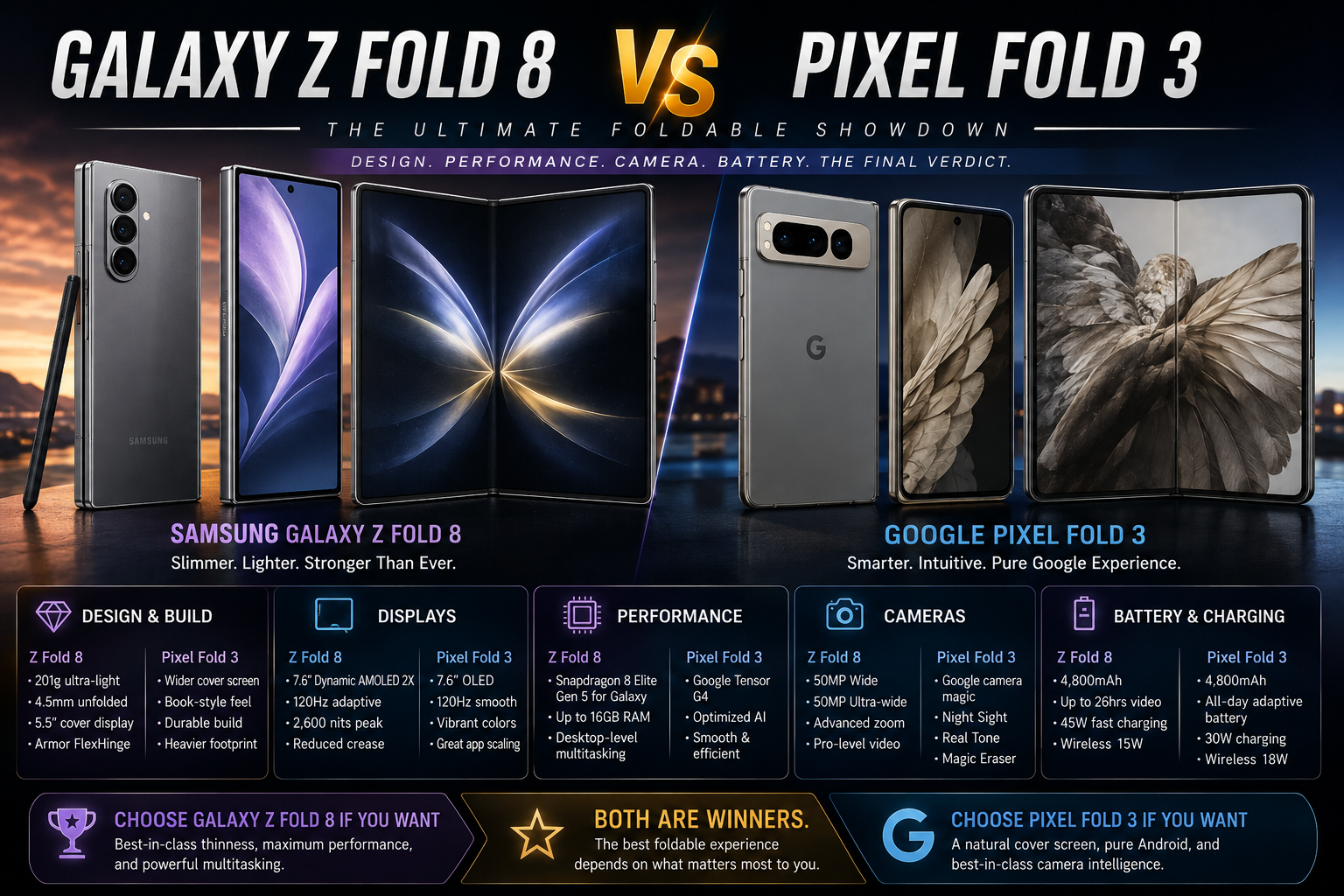
Samsung has made staggering strides with the Galaxy Z Fold 8. Dropping down to an astonishing 201 grams and featuring an ultra-slim 4.5mm unfolded profile, it feels almost indistinguishable from a standard flagship slab phone when closed. Samsung refined its Armor FlexHinge, narrowing the inner bezel gap and expanding the cover screen to a much more comfortable 5.5-inch panel with a standard-feeling aspect ratio.
On the other side, the Pixel Fold 3 leans heavily into Google’s distinct design ethos. Continuing the passport-style wide outer screen format that fans adore, the Pixel Fold 3 offers a shorter, wider cover display that makes typing on the go feel completely natural without forcing you to open the inner screen for simple text replies. However, it still carries a slightly heavier footprint than Samsung's featherlight champion, prioritizing a solid, book-like hand-feel that many users find deeply ergonomic.
2. Displays and Visual Immersion
Unfolding a foldable phone should feel like opening a portal to a miniature tablet. Both competitors deliver breathtaking OLED panels, but their approach to crease management and peak brightness differs.
The Galaxy Z Fold 8 features a gorgeous 7.6-inch main interior AMOLED display boasting a 120Hz refresh rate and a blinding peak brightness of 2,600 nits. Samsung has applied a dual layer of titanium reinforcement beneath the display layer, significantly minimizing the central crease and making touch interaction feel seamless. Outdoor visibility under harsh direct sunlight is simply stellar.
Google’s Pixel Fold 3 counters with its own immersive inner canvas. Google's software excels at handling aspect ratio scaling for stubborn apps that refuse to cooperate with square-ish tablet formats. While the crease is still faintly noticeable under direct glare, the color accuracy, skin tone calibration via Google’s advanced display pipelines, and media consumption experience make watching cinematic content an absolute joy.
3. Performance and Hardware Horsepower
Under the hood, these two devices represent fundamentally different philosophies regarding mobile computing power and efficiency.
Samsung equips the Galaxy Z Fold 8 with the custom-tuned Snapdragon 8 Elite Gen 5 for Galaxy processor, paired with up to 16GB of RAM. This powerhouse configuration handles heavy mobile gaming, split-screen multitasking with three active apps, and demanding Galaxy AI computational tasks without dropping a single frame. App launches are instantaneous, and thermal management has been vastly improved over previous generations.
The Pixel Fold 3 relies on Google’s proprietary custom silicon architecture. While it may occasionally trail Qualcomm in raw synthetic benchmark numbers, Google optimizes its hardware-software integration masterfully. Animations glide smoothly, background machine learning tasks run locally with high efficiency, and everyday fluid navigation feels deeply intuitive. If you prioritize raw gaming muscle, Samsung takes the win; if you prioritize fluid, integrated daily execution, Google holds its ground.
4. Camera Capabilities
Mobile photography is often the ultimate tiebreaker for smartphone buyers. Samsung brings heavy artillery to the Z Fold 8, featuring a versatile dual 50MP wide and 50MP ultra-wide camera system alongside advanced zoom capabilities. The larger inner screen also acts as a massive, functional viewfinder, making framing group shots or creative angles effortless.
Google, however, has built a legendary reputation on computational photography. The Pixel Fold 3 leverages Google’s industry-leading camera processing software, Magic Eraser tools, Real Tone skin mapping, and exceptional low-light Night Sight performance. Photos captured on the Pixel carry that signature contrast-rich, true-to-life look that effortlessly rivals the best non-folding flagship cameras on the market.
5. Battery Life and Endurance
Powering two separate screens used to be an insurmountable hurdle for foldables, leading to embarrassing battery drain. Fortunately, both manufacturers have turned a corner.
The Galaxy Z Fold 8 packs a robust 4,800 mAh battery optimized to handle up to 26 hours of continuous video playback, supported by faster 45W wired charging. The Pixel Fold 3 matches this dedication to longevity with smart battery-drain management that learns your daily usage habits, easily pushing through a full demanding workday of mixed 5G and Wi-Fi use.
Conclusion: Which Foldable Should You Buy?
Choosing between the Samsung Galaxy Z Fold 8 and the Google Pixel Fold 3 ultimately comes down to what you value most in your daily mobile experience.
Choose the Galaxy Z Fold 8 if you want the absolute pinnacle of lightweight hardware engineering, record-breaking thinness, blistering Snapdragon performance, and robust multitasking power tools.
Choose the Pixel Fold 3 if you prefer a wider, more natural cover screen for quick typing, cleaner stock Android software integration, and Google's peerless computational photography suite.
No matter which device you choose, the future of mobile technology has never looked more flexible.