





We spend our entire lives walking, running, building, and living on planet Earth. Because it is our home, we tend to take its existence for granted. We look out our windows, see familiar trees, pavement, blue skies, and oceans, and assume we understand the mechanics of the world beneath our feet. Yet, beneath our mundane daily routines lies a planet so wild, violent, bizarre, and counterintuitive that it sounds like pure science fiction.
If you were told these facts by a stranger on the street, you would assume they were making things up. However, every single one of these mind-boggling phenomena is backed by rigorous scientific reality. Here are some of the most amazing facts about Earth that sound completely fake, but are 100% true.
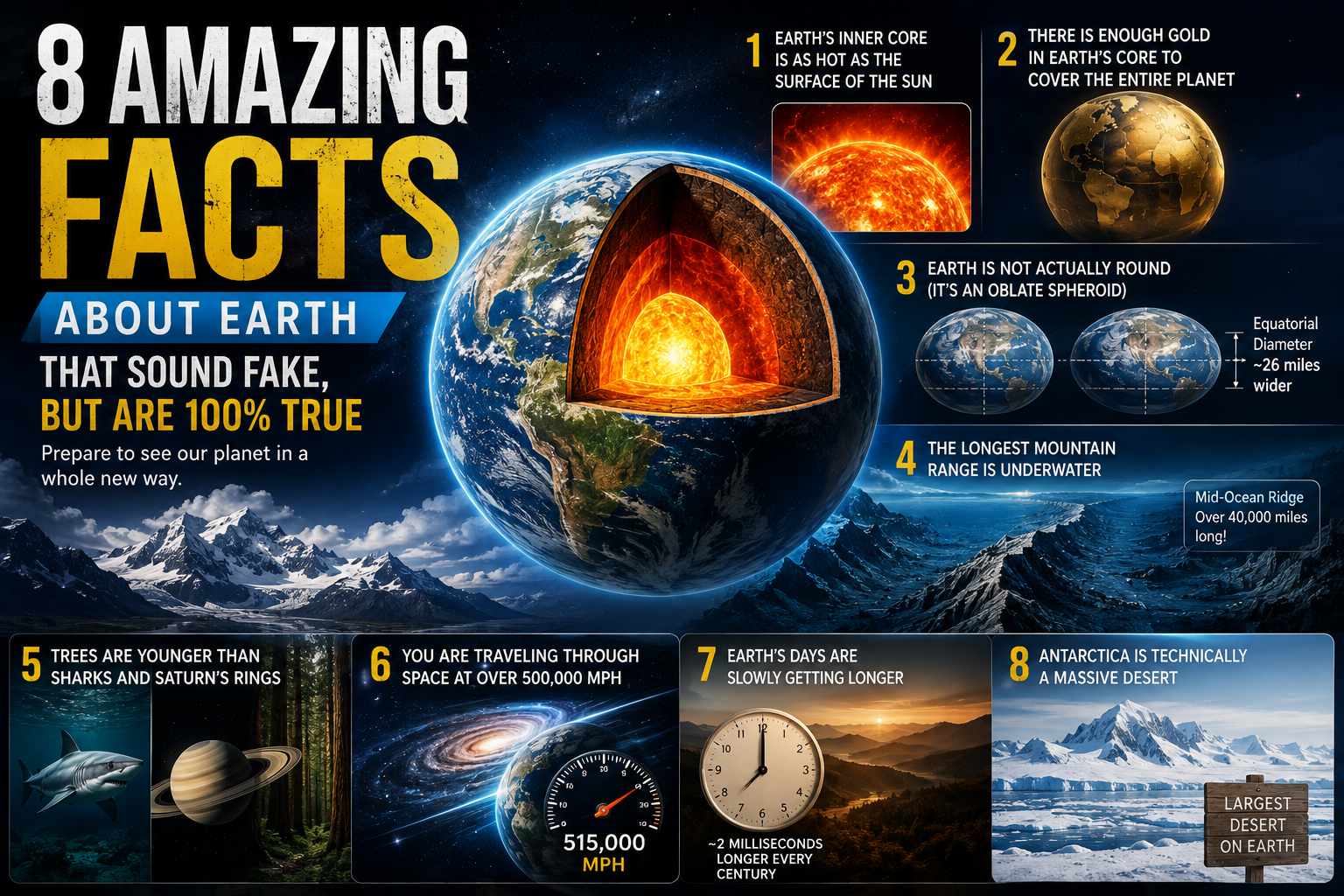
1. Earth's Inner Core Is As Hot As the Surface of the Sun
When we think about extreme heat in our solar system, our minds immediately fly straight to the Sun—a colossal ball of burning plasma sitting 93 million miles away. Yet, you don't have to travel millions of miles into space to experience stellar temperatures; you just need to dig straight down.
Deep at the center of our planet sits Earth’s inner core—a solid ball of compressed iron and nickel roughly the size of Pluto. Driven by intense gravitational pressure and leftover heat from planetary formation, temperatures inside the inner core reach an astounding 10,800 degrees Fahrenheit (6,000 degrees Celsius). That is roughly as hot as the blazing surface of the Sun! It is a wild reality: you are walking around on a thin, cooled crust floating above a miniature star.
2. There Is Enough Gold in Earth’s Core to Cover the Entire Planet
Throughout human history, people have waged wars, crossed treacherous oceans, and spent lifetimes panning through freezing rivers in search of rare, glittering gold. We treat gold as one of the scarcest, most precious commodities on Earth.
Technically speaking, it is scarce on the surface—but that is only because nearly all of it sank. When Earth was first forming over 4.5 billion years ago, molten iron and heavy metals sank straight down toward the center of the planet. Geologists estimate that 99% of Earth's total gold supply is trapped deep within the metallic core. If you could magically extract all that gold and bring it to the surface, there is so much of it that it would completely coat the entire globe in a layer roughly 1.5 feet thick!
3. Earth Is Not Actually Round (It’s an Oblate Spheroid)
Every globe you saw in elementary school and every textbook diagram depicts Earth as a smooth, geometrically perfect blue sphere. Space agencies publish stunning photographs that reinforce this round illusion.
In reality, Earth is not a sphere at all. Because our planet spins continuously on its axis at roughly 1,000 miles per hour at the equator, centrifugal force causes the planet to bulge outward around the middle. Earth is officially classified as an "oblate spheroid." If you measured Earth from pole to pole versus across the equator, the equatorial diameter is about 26 miles wider. It is slightly squished, like a giant spinning water balloon.
4. The Longest Mountain Range Is Underwater
When people think of epic mountain chains, they picture the snow-capped Himalayas, the jagged Andes, or the rocky peaks of North America. However, the true king of mountain ranges is completely invisible to casual beachgoers.
The Mid-Ocean Ridge is a colossal underwater volcanic mountain chain that twists and winds across the globe for more than 40,000 miles, wrapping around the planet like the seam on a baseball. Because tectonic plates are constantly pulling apart and allowing magma to rise from the mantle, this continuous underwater mountain system is over ten times longer than the longest mountain range found on dry land.
5. Trees Are Younger Than Sharks and Saturn’s Rings
It is easy to look at ancient forests filled with towering redwoods and ancient sequoias and assume trees are among the most ancient fixtures of planetary life. However, evolutionary timelines hold some shocking surprises.
Sharks swam in Earth's oceans over 400 million years ago, meaning they predate land trees by roughly 50 to 100 million years. Furthermore, astronomical data and Cassini probe measurements suggest that Saturn’s iconic icy rings may be less than 100 to 200 million years old, meaning sharks were hunting in our oceans before Saturn even put on its jewelry.
6. You Are Traveling Through Space at Over 500,000 MPH Right Now
If you are sitting completely still on your couch reading this article, you probably feel like you are at absolute rest. Your coffee cup isn't sliding off the table, and gravity is keeping you firmly planted.
In astronomical terms, you are a high-speed interstellar traveler. While Earth spins on its axis at 1,000 mph, it also races around the Sun at an average speed of 67,000 mph. But that's not all: our entire solar system is orbiting the center of the Milky Way galaxy at a blistering speed of roughly 515,000 mph. In the time it took you to read this paragraph, you have traveled thousands of miles across the cosmos without moving a single muscle.
7. Earth’s Days Are Slowly Getting Longer
If you frequently feel like 24 hours in a day is not nearly enough time to get everything done, science confirms that your frustration is mathematically valid. Days really are getting longer.
Due to the gravitational tidal friction exerted by the Moon on Earth’s oceans and crust, our planet's rotation is gradually decelerating. Every single century, Earth's day lengthens by approximately 2 milliseconds. While that sounds negligible, over millions of years, it means ancient dinosaurs experienced significantly shorter days and a year had far more total days than it does today.
8. Antarctica Is Technically a Massive Desert
When we picture deserts, our minds automatically conjure up images of scorching sand dunes, camels, blistering sunshine, and dehydrated explorers wandering across the Sahara. We think heat is a mandatory requirement for a desert.
In meteorological terms, a desert is defined strictly by its level of precipitation—specifically, any region that receives less than 10 inches of annual rainfall. Because Antarctica is so intensely cold that moisture cannot easily linger in the atmosphere, the frozen continent receives almost zero annual precipitation. Despite being buried under miles of thick ice, Antarctica is classified as the largest desert on Earth.
Conclusion: Our Bizarre, Beautiful Home
These eight facts remind us that Earth is not a simple, static rock spinning quietly in the dark. It is a violent, dynamic, golden-hearted, fast-moving cosmic anomaly.
The next time you walk outside, take a moment to look around. Remember that you are standing on a bulging, spinning oblate spheroid racing half a million miles per hour through the stars, floating above a sun-hot metallic core. Earth isn't just our home; it is the greatest mystery show in the universe.