





The Architecture of Work Is Being Rewritten
The architecture of human labor is undergoing one of its most significant structural transformations since the Industrial Revolution.
For generations, the definition of work was closely tied to a physical location: a central office, a fixed schedule, and a long-term employment relationship with a single organization.
That model is rapidly changing.
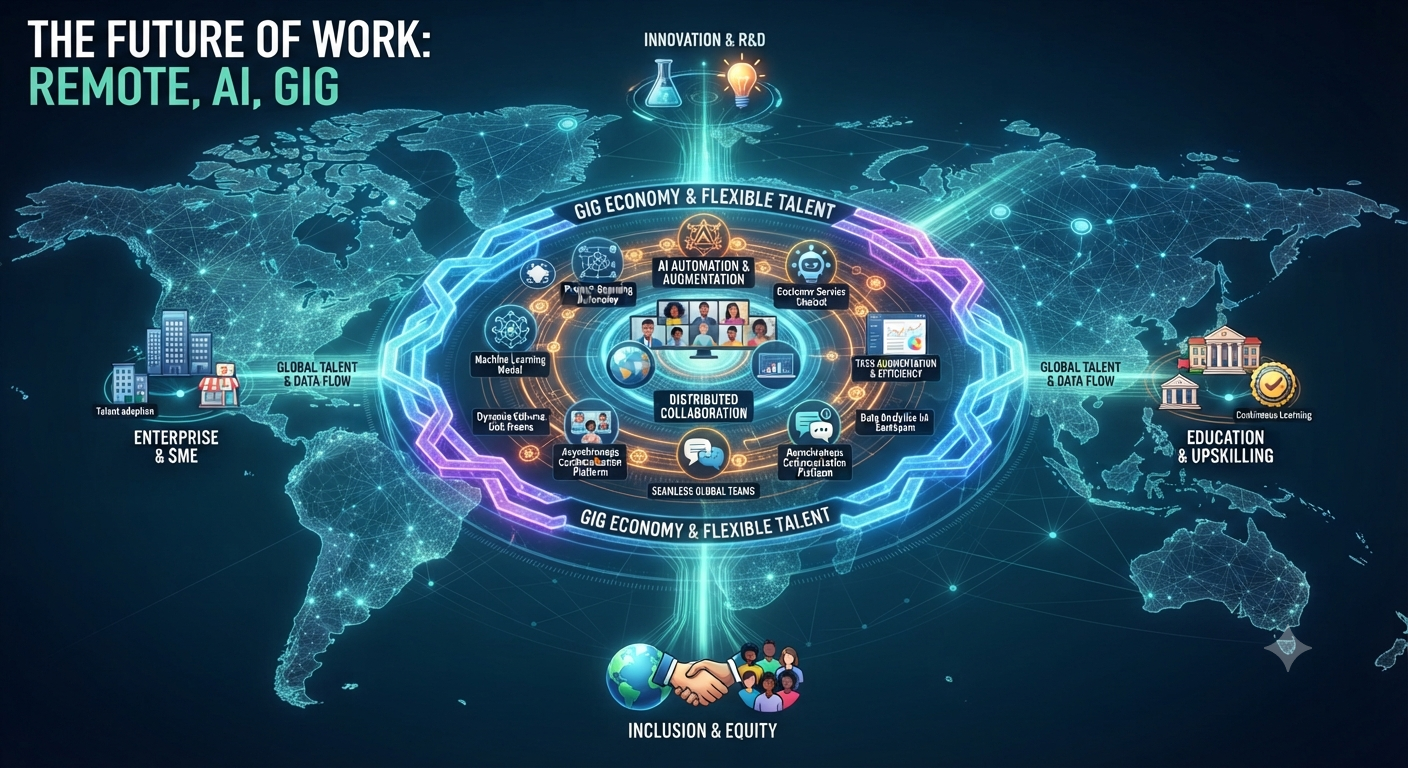
Today, the modern workplace is becoming more distributed, flexible, and technology-driven. Remote teams can collaborate across continents, artificial intelligence can automate increasingly complex tasks, and independent professionals can build careers around projects rather than traditional corporate ladders.
As businesses adapt to changing employee expectations and accelerating technological disruption, the fundamental concepts of productivity, career development, and organizational loyalty are being redefined.
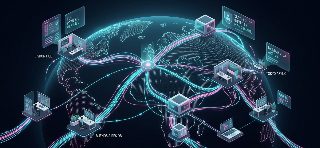
Distributed Collaboration and the Decline of Geography
The expansion of remote and hybrid work has demonstrated that physical proximity is no longer the only path to effective collaboration.
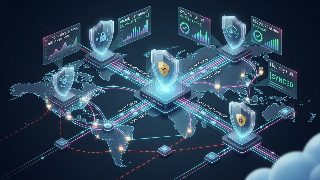
Cloud computing, video conferencing, project management platforms, and asynchronous communication tools have created digital workplaces capable of connecting employees regardless of geographic location.
This shift has opened new opportunities for organizations and workers alike.
Companies can access talent from a much larger global pool, allowing them to build diverse teams with specialized expertise from different regions and cultures.
Employees, meanwhile, have gained greater flexibility over where and, in many cases, when they work.
For many professionals, the elimination of daily commuting has created more opportunities to balance professional responsibilities with personal life.
However, distributed work also introduces new challenges, including communication gaps, isolation, time-zone differences, and the difficulty of maintaining a strong organizational culture across geographically dispersed teams.
The future of remote work will therefore depend not only on technology, but also on how effectively organizations design communication systems and maintain meaningful human connections.
Artificial Intelligence and the Augmentation of Work
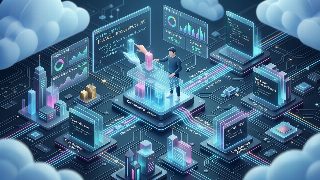
While remote technology is changing where work happens, artificial intelligence is transforming how work gets done.
Generative AI and automation tools are increasingly being integrated into everyday professional workflows.
Instead of completely replacing entire professions, many AI systems are initially being used to augment human capabilities.
They can help draft documents, summarize information, analyze large datasets, generate software code, automate routine administrative tasks, and support customer service operations.
This creates a new model of human-machine collaboration.
The professional of the future may not compete directly with AI but instead learn how to use it as a powerful digital co-pilot.
The Growing Importance of Upskilling
As automation takes over repetitive and predictable activities, the value of uniquely human capabilities is becoming more apparent.
Workers are increasingly expected to develop skills such as:
Strategic thinking.
Complex problem-solving.
Creative reasoning.
Emotional intelligence.
Adaptability.
Communication and collaboration.
Technical knowledge remains important, but the ability to continuously learn and adapt may become one of the most valuable professional advantages in an economy defined by rapid technological change.
This creates a growing need for continuous professional development.
The traditional idea of completing education early in life and relying on those qualifications for an entire career is becoming less realistic.
Instead, workers may need to repeatedly update their skills as technologies, industries, and job requirements evolve.
AI as a Productivity Multiplier
One of the most significant effects of AI adoption is its potential to increase individual productivity.
A professional who once spent hours performing repetitive research, formatting documents, or analyzing routine information can increasingly delegate portions of that work to AI-powered tools.
This can compress project timelines and allow individuals to focus more of their attention on high-value activities.
However, productivity gains are not automatic.
Organizations must develop responsible AI policies, provide adequate training, and ensure that automated systems are used appropriately.
The greatest benefits are likely to emerge when AI handles repetitive tasks while humans remain responsible for judgment, creativity, accountability, and strategic decisions.
The Rise of the Gig Economy
Alongside remote employment and AI automation, the gig economy is reshaping the traditional relationship between workers and organizations.
Freelancers, independent contractors, consultants, and specialized creators are increasingly able to offer their services to clients around the world.
Digital platforms have made it easier for professionals to build careers around individual projects rather than relying exclusively on a single long-term employer.
This model offers significant flexibility.
A skilled professional can potentially work with multiple organizations, specialize in a specific niche, and choose projects based on personal interests or career goals.
For businesses, the gig economy provides access to specialized expertise without requiring every skill to exist within the permanent workforce.
Yet this flexibility also raises important questions.
Independent workers may face challenges related to income stability, healthcare, retirement savings, paid leave, and legal protections.
As the gig economy expands, policymakers and businesses will need to reconsider how traditional employment benefits can adapt to more fluid career structures.
The End of the Linear Career Path
The conventional career path once followed a relatively predictable pattern:
Education, employment, promotion, and eventual retirement.
That model is becoming increasingly flexible.
Modern careers may involve multiple industries, frequent reskilling, freelance projects, entrepreneurial ventures, and periods of transition between different forms of employment.
Professionals may move between corporate positions, independent consulting, remote contracts, and startup ventures throughout their working lives.
This fluidity can create new opportunities, but it also places greater responsibility on individuals to manage their own professional development.
Career resilience will increasingly depend on maintaining adaptable skills, building professional networks, and continuously learning.
The Challenge of Organizational Culture
As work becomes more distributed and automated, organizations face a new challenge: preserving human connection.
A company can have world-class digital infrastructure and still struggle with employee engagement if workers feel disconnected from colleagues or excluded from decision-making.
Leaders must therefore rethink how culture is created.
Instead of relying entirely on physical offices, organizations are increasingly experimenting with intentional communication, virtual collaboration, in-person gatherings, mentorship programs, and asynchronous workflows.
The goal is not simply to replicate the traditional office online.
It is to build a new model of organizational culture that takes advantage of digital flexibility while preserving trust, collaboration, and belonging.
Redefining Professional Life
The future of work is not necessarily about eliminating human labor.
It is about removing some of the rigid constraints that have historically defined it.
Remote infrastructure can reduce geographic limitations.
Artificial intelligence can reduce repetitive workloads.
The gig economy can create greater professional flexibility.
Continuous learning can help workers adapt to rapidly changing industries.
Together, these forces are creating a more dynamic labor market—but also one that requires greater adaptability from both employers and employees.
Conclusion
The workplace of the future will be defined by flexibility, technology, and continuous adaptation.
The traditional office is becoming one option among many. AI is evolving into a collaborative productivity tool, while independent work is becoming a more established part of the global economy.
Yet technology alone will not determine whether this transition succeeds.
Organizations must invest in people, build responsible AI systems, protect worker well-being, and create fair frameworks for increasingly flexible employment models.
For workers, the most valuable advantage may be the ability to keep learning and evolving.
The future of work is not about humans versus machines. It is about creating a system in which technology removes unnecessary friction while people focus on creativity, judgment, connection, and meaningful problem-solving.
The most resilient professionals and organizations will be those that learn to adapt continuously—turning technological disruption from a source of uncertainty into an opportunity for growth.