





Humanity has mapped nearly every corner of the globe, charted the deep ocean trenches, and launched probes far into the cold vacuum of deep space. Yet, despite our technological advancement and satellite imagery, planet Earth continues to hold breathtaking secrets. There are regions scattered across our world that completely defy logic, break the rules of color and gravity, and look less like geography and more like digital fantasy concepts or fragments from a dream.
When you look at photographs of these extraordinary locations, your brain instantly suspects Photoshop filters, CGI manipulation, or science fiction concept art. Yet, they are 100% real, untouched by editing, and waiting to be explored. Here is a journey through some of the most surreal places on Earth that simply do not feel real.
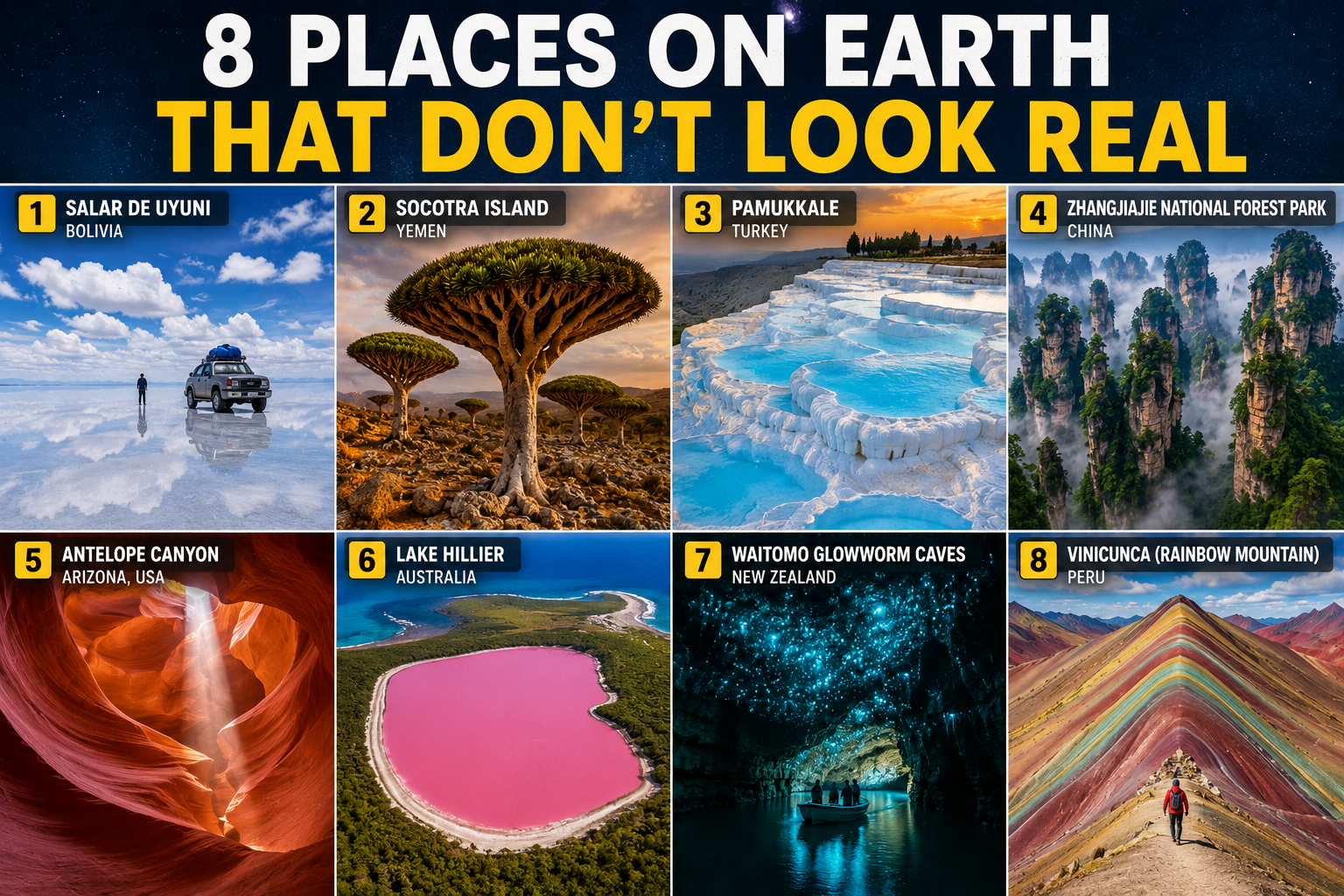
1. Salar de Uyuni, Bolivia: The World’s Largest Natural Mirror
Nestled high amidst the Andes mountains in southwest Bolivia lies Salar de Uyuni, stretching across more than 4,000 square miles. It is the largest salt flat on Earth, formed by the gradual evaporation of prehistoric ancient lakes. While it looks like a barren, cracked white desert during the dry season, it undergoes a mind-bending transformation during the rainy months.
A thin sheet of water covers the vast salt crust, turning the entire landscape into a colossal, flawless mirror. The reflection is so crisp and perfect that the horizon line disappears entirely. Standing or driving across the flats creates the eerie, magical illusion that you are floating through outer space or walking directly across the sky.
2. Socotra Island, Yemen: The Alien Botanical Garden
Isolated from the mainland of Africa for millions of years, the remote island of Socotra in the Arabian Sea feels like an entirely separate planet. Its evolutionary path diverged so completely that a third of its plant life cannot be found anywhere else on the face of the Earth.
The crown jewels of the island are the bizarre Dragon’s Blood Trees. Growing in dense plateaus, these trees look like giant, dark green flying saucers perched on thick trunks. When their bark is cut, they bleed a thick, crimson-red resin that ancient civilizations prized for medicine and magic. Combined with bizarre bottle trees and cucumber trees, walking through Socotra feels like stepping onto an alien science-fiction set.
3. Pamukkale, Turkey: The Frozen Cotton Castle
Located in southwestern Turkey, Pamukkale (which translates to "Cotton Castle" in Turkish) looks like a cascading mountainside carved entirely out of pure white snow and glacial ice. In reality, it is a geological marvel born from hot thermal springs.
For thousands of years, mineral-rich thermal waters flowing down the slope have deposited calcium carbonate, hardening into dazzling, brilliant white travertine terraces and stepped wading pools. Visitors can step barefoot into the warm, bright turquoise thermal waters while looking out over the green valley below. It presents a striking optical illusion: a warm, tropical spa environment masquerading as a freezing alpine glacier.
4. Zhangjiajie National Forest Park, China: The Floating Avatar Mountains
If you thought the soaring, mist-shrouded floating mountains in James Cameron’s blockbuster film Avatar were purely products of digital imagination, you haven't seen Zhangjiajie in Hunan, China.
Thousands of massive, sheer sandstone pillars rise dramatically out of dense subtropical forests, piercing straight up through low-hanging clouds. Over millions of years, physical erosion by water and ice carved these towering columns into vertical monoliths. When morning fog rolls through the valleys, the peaks appear completely detached from the earth, suspended in mid-air among the clouds like ancient monuments.
5. Antelope Canyon, Arizona, USA: The Fluid Sandstone Waves
Hidden deep within the Navajo Nation in Arizona, Antelope Canyon is a slot canyon carved by millions of years of rushing flash floods and wind erosion. When viewed from the outside, it looks like a simple crack in the desert floor. Step inside, however, and you enter a subterranean art gallery.
The sandstone walls have been sculpted into smooth, undulating, wave-like ribbons that curve like liquid chocolate. When high midday sunbeams pierce through the narrow cracks above, light shafts illuminate the canyon walls, casting glowing shades of fiery red, deep orange, and shimmering gold that shift as the hours pass.
6. Lake Hillier, Australia: The Bubblegum-Pink Lake
Australia is home to several natural wonders, but Middle Island off the coast of Western Australia holds a bizarre secret: Lake Hillier, a body of water with a striking, permanent bubblegum-pink color that contrasts sharply with the deep blue ocean right beside it.
Unlike other pink lakes whose colors shift seasonally depending on sunlight and evaporation, Lake Hillier stays bright pink all year round. Even when scientists scoop the vibrant pink water into a glass vial, the water remains vividly pink. Research suggests the phenomenon is driven by a unique combination of salt-loving microalgae and pink-hued halophilic bacteria thriving in the extreme salinity.
7. Waitomo Glowworm Caves, New Zealand: An Underground Galaxy
Deep beneath the rolling green hills of New Zealand’s North Island lies a subterranean labyrinth of ancient limestone caves. During the day, the dry caves feature impressive stalactites and stalagmites. But when you board a small boat and drift silently into the pitch-black underground waterways, the magic happens.
Thousands of tiny bioluminescent glowworms (*Arachnocampa luminosa*) cling to the cavern ceilings, casting a soft, electric-blue luminescence. Looking up feels identical to staring out at a clear night sky filled with millions of distant stars inside a cavernous underground universe.
8. Vinicunca (Rainbow Mountain), Peru: The Melted Crayon Slopes
Tucked deep in the Peruvian Andes sits Vinicunca, a mountain ridge draped in striking, horizontal stripes of turquoise, maroon, mustard yellow, and emerald green. Sitting at an altitude of over 5,000 meters, the mountain looks like someone took oversized pastel crayons and painted the slopes.
For centuries, these vibrant colors were completely hidden beneath a heavy year-round layer of glacial ice. However, due to recent climate shifts and glacial retreat, the mineral-rich sedimentary layers—formed over millions of years of weathering and iron oxidation—were exposed to the world, creating one of the most colorful geological formations on Earth.
Conclusion: The World Is Stranger Than Fiction
These eight locations remind us that reality is infinitely more creative, colorful, and bizarre than any human imagination could ever invent. They challenge our perceptions of what nature is capable of and inspire a profound sense of awe.
Whether you dream of walking across a cosmic sky mirror in Bolivia, drifting under an underground galaxy in New Zealand, or marveling at alien trees on a forgotten island, our planet is packed with wonder. Step outside your comfort zone, explore the map, and discover the places on Earth that prove magic is entirely real.