




Introduction
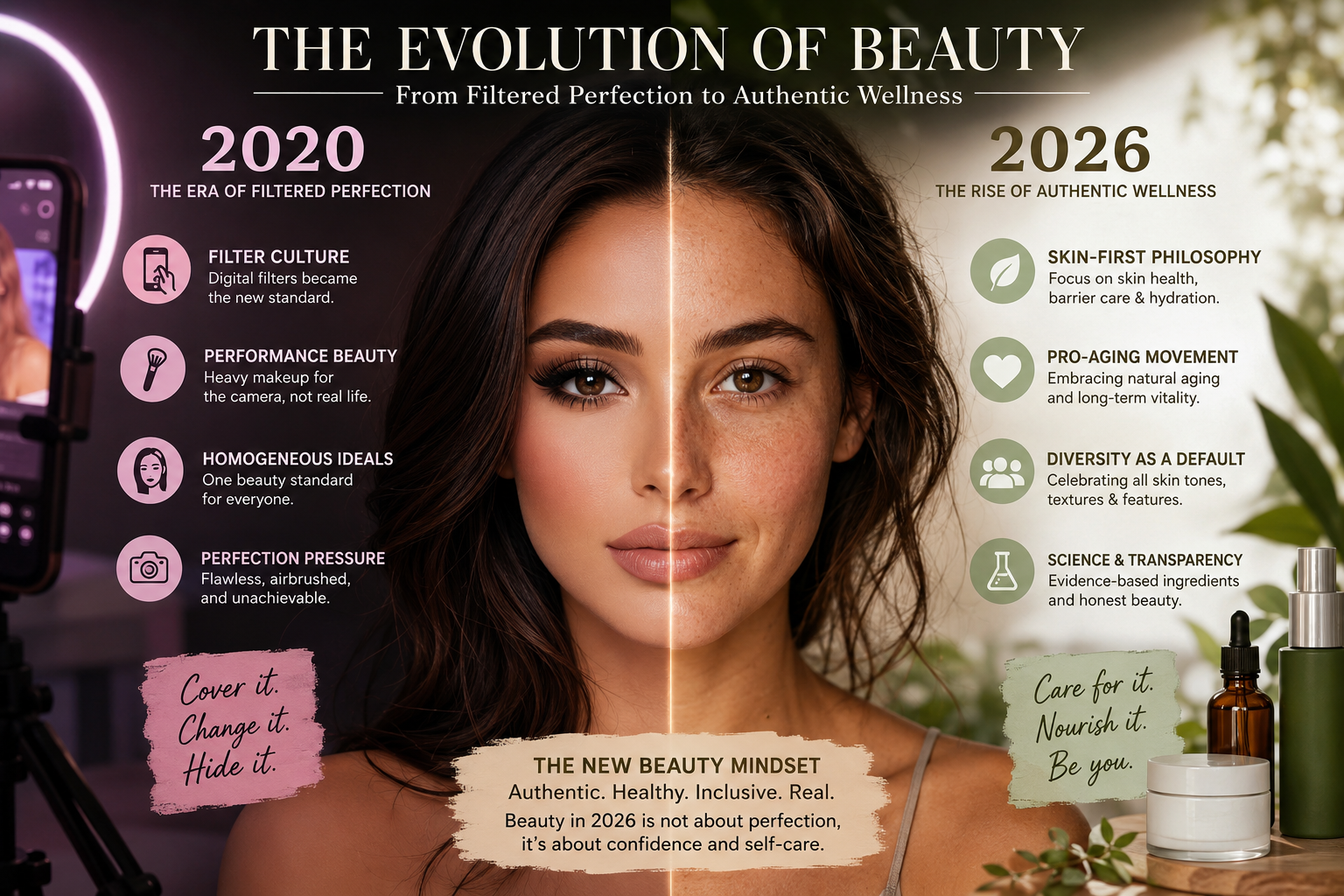
The beauty industry has undergone one of its most significant transformations in recent years. If you compare the beauty landscape of 2020 with the reality of 2026, the difference is remarkable. Six years ago, beauty was largely defined by flawless Instagram aesthetics, heavy digital editing, and unrealistic standards that encouraged people to chase perfection. Today, the industry has shifted toward authenticity, skin health, inclusivity, and scientific innovation.
Consumers are no longer searching for products that simply conceal imperfections. Instead, they want skincare and cosmetics that improve long-term skin health while celebrating individuality. This change has been driven by growing awareness of mental well-being, increased transparency from beauty brands, advances in dermatological science, and a widespread rejection of unrealistic beauty standards created by filters and AI-generated imagery.
Modern beauty in 2026 is no longer about looking perfect—it is about looking healthy, confident, and uniquely yourself.
The Beauty Industry of 2020: The Era of Filtered Perfection
Between 2020 and 2022, social media platforms heavily influenced global beauty standards. Instagram, TikTok, and Snapchat filters created an environment where flawless skin, perfectly sculpted facial features, and unrealistic proportions became the ideal.
Millions of users edited their photos before posting online, making digital perfection appear normal. As a result, many people compared themselves to unrealistic versions of beauty that did not exist in real life.
Beauty products during this period were primarily designed to create dramatic transformations rather than enhance natural features. Heavy contouring, full-coverage foundations, oversized lashes, and overlined lips dominated tutorials and advertisements.
The industry rewarded perfection instead of authenticity.
The Filter Mandate
One of the defining characteristics of early-2020s beauty was the widespread use of digital filters.
Photo editing applications automatically smoothed skin, removed pores, brightened eyes, reshaped noses, enlarged lips, and enhanced facial symmetry. Over time, these edited appearances became normalized, creating unrealistic expectations among consumers.
Many individuals felt pressured to resemble their filtered selfies in real life. This phenomenon contributed to increased dissatisfaction with natural appearances and fueled demand for cosmetic procedures and aesthetic treatments.
The “filter face” became one of the most recognizable beauty trends of the era.
Beauty as Performance Instead of Self-Care
During the early 2020s, beauty routines focused primarily on appearance rather than health.
Makeup was often treated as a performance designed for photographs and videos instead of everyday life. Heavy foundations, baking techniques, dramatic contouring, and bold transformations were considered essential for achieving the perfect online image.
Skincare often played a secondary role to cosmetics. Many consumers prioritized covering skin concerns instead of understanding their underlying causes.
The emphasis remained on instant visual results rather than long-term skin wellness.
The Rise of Homogeneous Beauty Standards
Social media algorithms promoted similar faces across the world.
Regardless of cultural background, many beauty influencers adopted nearly identical makeup techniques, facial aesthetics, and editing styles. This created what many experts described as the “same-face phenomenon.”
Unique facial features and cultural characteristics gradually became less visible as global beauty trends encouraged everyone to follow the same ideal.
Individuality was often sacrificed in pursuit of online popularity.
The Shift Toward Authentic Wellness
By 2025 and continuing into 2026, consumer attitudes began changing dramatically.
People grew tired of unrealistic beauty standards and overly edited content. Instead of striving for perfection, consumers started embracing authenticity, self-confidence, and overall well-being.
The beauty industry responded by developing products that support healthy skin rather than simply masking imperfections.
Authenticity became more valuable than perfection.
Consumers now appreciate natural skin texture, freckles, fine lines, and individual facial characteristics as symbols of genuine beauty.
The Skin-First Philosophy
One of the biggest beauty trends in 2026 is the shift toward skin-first routines.
Rather than relying on heavy makeup to conceal imperfections, consumers invest in skincare products that strengthen the skin barrier, improve hydration, balance the microbiome, and promote long-term skin health.
Daily skincare routines now prioritize gentle cleansing, moisturizing, sun protection, antioxidant treatments, peptides, ceramides, and scientifically proven active ingredients.
Healthy skin has become the foundation of modern beauty.
Instead of asking, “How can I hide this?” consumers now ask, “How can I improve my skin naturally?”
From Anti-Aging to Pro-Aging
The language of beauty has also evolved significantly.
For decades, anti-aging dominated beauty marketing, often portraying aging as something to fear or prevent.
In 2026, the conversation has shifted toward pro-aging and healthy longevity.
Rather than promising eternal youth, brands emphasize maintaining healthy skin throughout every stage of life.
The concept of healthspan has become increasingly important. Consumers recognize that beauty reflects overall health, lifestyle, nutrition, sleep quality, stress management, and emotional well-being.
Wrinkles and fine lines are no longer viewed as flaws but as natural signs of a life well lived.
Diversity Has Become the New Standard
Perhaps the most meaningful transformation in modern beauty is the celebration of diversity.
Instead of promoting one universal beauty ideal, brands now recognize that beauty exists across countless skin tones, facial features, hair textures, ages, and cultural backgrounds.
Consumers expect inclusive foundation shades, personalized skincare solutions, and products developed specifically for different ethnic and biological needs.
Representation is no longer treated as a marketing campaign—it has become a permanent expectation.
This inclusive approach allows people to embrace their natural identities rather than trying to fit into a single global standard.
The Growing Importance of Personalized Beauty
Advances in technology have made personalized beauty more accessible than ever.
Artificial intelligence, digital skin analysis, genetic insights, and personalized consultations allow consumers to receive customized skincare recommendations based on their unique skin type, lifestyle, environmental conditions, and individual concerns.
Rather than following generic routines, consumers now build skincare regimens tailored specifically to their needs.
Personalization improves both customer satisfaction and long-term skincare results.
The AI Backlash: Why Authenticity Became More Valuable
Ironically, the rapid advancement of artificial intelligence has increased the value of authenticity.
AI can now generate photorealistic faces, flawless models, and perfectly edited beauty campaigns within seconds.
As these synthetic images became more common, audiences began craving genuine human experiences.
Real skin texture, natural smiles, subtle imperfections, and unedited photography became symbols of honesty and trust.
Consumers increasingly support creators who openly share authentic moments instead of presenting unrealistic perfection.
In today’s digital landscape, authenticity has become a competitive advantage.
The Rise of Skintellectualism
Another defining trend of 2026 is the emergence of “skintellectualism.”
Consumers have become significantly more educated about skincare ingredients, formulations, and scientific research.
Instead of purchasing products based solely on celebrity endorsements or attractive packaging, buyers carefully evaluate ingredient lists, clinical studies, dermatological testing, and scientific evidence.
Popular ingredients such as niacinamide, ceramides, peptides, retinoids, azelaic acid, vitamin C, and hyaluronic acid are now widely understood by everyday consumers.
Education has become an essential part of the beauty industry.
Transparency and Evidence-Based Beauty
Modern consumers demand transparency from beauty brands.
They want to know where ingredients come from, how products are manufactured, whether formulations are supported by clinical research, and how products impact both human health and the environment.
Brands that openly communicate scientific evidence, sustainability practices, and ingredient sourcing earn greater customer trust.
Marketing claims alone are no longer sufficient.
Consumers expect measurable proof that products deliver real results.
Sustainability and Ethical Beauty
Beauty has expanded beyond personal appearance to include environmental responsibility.
Consumers increasingly choose brands that use recyclable packaging, ethically sourced ingredients, cruelty-free testing practices, and environmentally friendly manufacturing methods.
Sustainability is no longer viewed as an optional feature—it has become an essential expectation.
Companies that prioritize ethical production build stronger relationships with environmentally conscious consumers.
Social Media’s New Role in Beauty
Although social media continues to influence beauty trends, its role has evolved.
Instead of promoting unattainable perfection, many creators now focus on realistic skincare journeys, ingredient education, product transparency, and honest reviews.
Unfiltered content has become more relatable and trustworthy.
Consumers value creators who openly discuss acne, pigmentation, aging, sensitivity, and real-life skincare challenges.
Authenticity generates stronger engagement than perfection.
The Future of Beauty
Looking ahead, beauty will continue moving toward personalization, scientific innovation, and holistic wellness.
Artificial intelligence will support personalized skincare recommendations, while biotechnology will create increasingly advanced formulations designed to improve skin health at the cellular level.
However, despite technological progress, one principle is expected to remain constant: beauty will continue celebrating individuality rather than conformity.
Future innovations will focus on enhancing natural beauty instead of replacing it.
Conclusion
The transformation of the beauty industry between 2020 and 2026 represents far more than a change in makeup trends. It reflects a broader cultural shift toward authenticity, health, inclusivity, and scientific understanding.
The era of heavily filtered perfection has given way to a beauty philosophy that values healthy skin, evidence-based skincare, cultural diversity, and genuine self-expression. Consumers now seek products that nourish rather than conceal, educate rather than exaggerate, and celebrate individuality instead of enforcing unrealistic ideals.
As technology continues to reshape the industry, authenticity has become beauty’s greatest luxury. The future belongs to brands and creators who combine innovation with honesty, science with transparency, and personalization with genuine human connection.
In 2026, beauty is no longer defined by perfection—it is defined by confidence, wellness, and the courage to embrace what makes every individual unique.