




The Sun Awakens: How Powerful Solar Storms Are Testing Earth's Technology and Lighting Up the Sky
Introduction
Our Sun is far more than a distant source of warmth and light. It is a dynamic, constantly changing star whose magnetic activity can have profound effects across the solar system. While most solar events pass unnoticed on Earth, particularly powerful eruptions can interact with our planet's magnetic field, creating what scientists call space weather. These events can influence satellites, communications, navigation systems, aviation, and even electrical infrastructure.
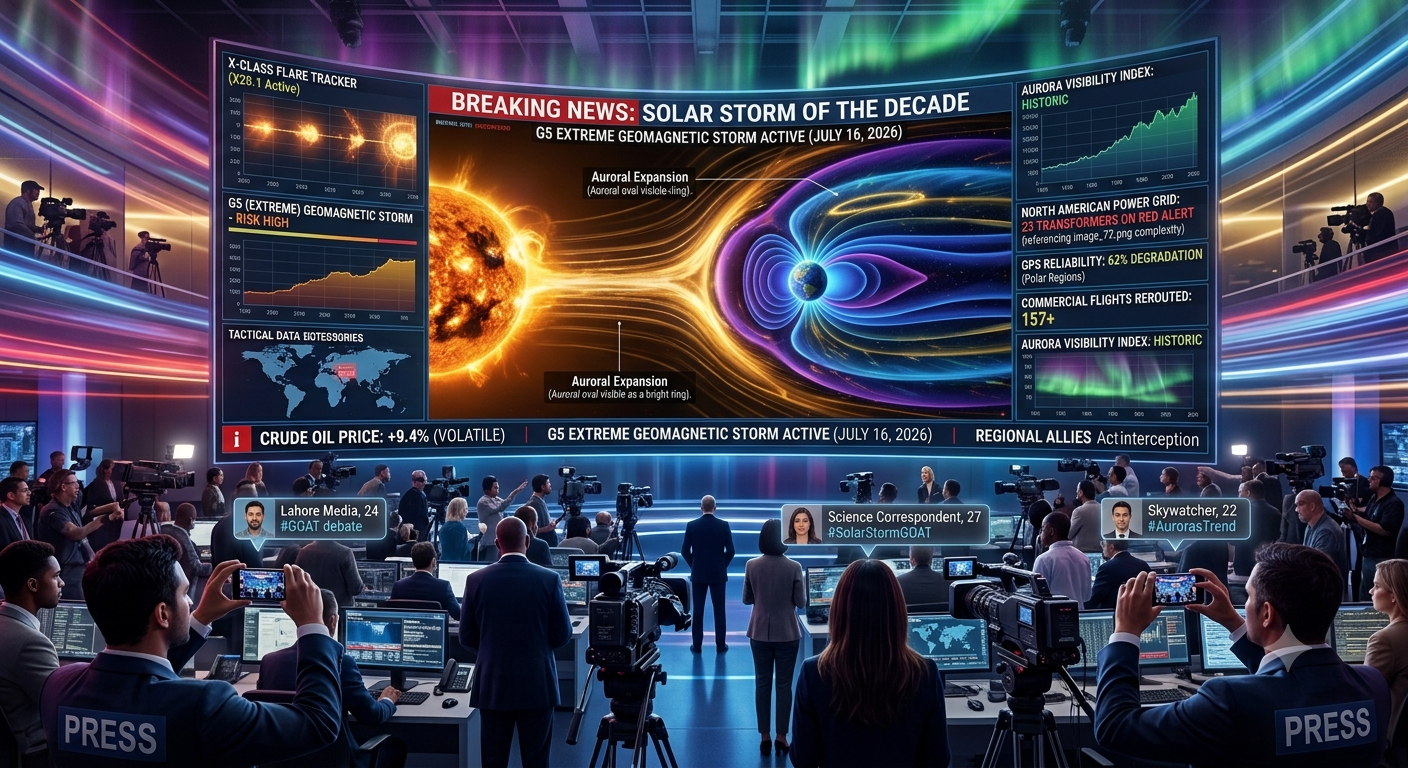
Recent solar activity has once again placed space weather in the global spotlight. A series of powerful X-class solar flares erupted from an exceptionally active sunspot region, launching massive clouds of charged particles known as coronal mass ejections (CMEs) toward Earth. These eruptions prompted space weather agencies to monitor the possibility of severe to extreme geomagnetic storm conditions, with warnings that the incoming solar material could temporarily disrupt technological systems while producing spectacular auroral displays. Recent strong solar flares and geomagnetic activity have been closely tracked by NASA and NOAA's Space Weather Prediction Center.
Although modern technology has made society more resilient to solar activity than in previous decades, our increasing dependence on satellites, power grids, and wireless communications also means that intense space weather events receive greater attention than ever before.
Understanding Space Weather
Unlike weather on Earth, space weather originates from activity on the Sun.
The Sun constantly emits charged particles known as the solar wind, but periods of heightened magnetic activity can produce much larger eruptions capable of reaching Earth.
The most significant forms of solar activity include:
- Solar flares
- Coronal mass ejections (CMEs)
- Solar energetic particle events
When these eruptions are directed toward Earth, they can disturb our planet's magnetic field and upper atmosphere, triggering geomagnetic storms.
Most solar storms produce only minor effects. However, particularly energetic events have the potential to influence both natural phenomena and modern technological systems.
X-Class Solar Flares: The Sun's Most Powerful Eruptions
Solar flares occur when magnetic energy stored around sunspots is suddenly released.
These eruptions emit enormous amounts of electromagnetic radiation across multiple wavelengths, including X-rays and ultraviolet radiation.
Scientists classify solar flares according to their intensity:
- A-Class: Very weak
- B-Class: Weak
- C-Class: Small
- M-Class: Moderate
- X-Class: Most powerful
X-class flares represent the strongest category and are capable of causing temporary radio blackouts, affecting satellite operations, and contributing to major geomagnetic storms when accompanied by Earth-directed coronal mass ejections. NASA notes that X-class flares are the most intense category and can affect radio communications, navigation systems, spacecraft, and power infrastructure.
Coronal Mass Ejections: Massive Clouds of Solar Plasma
While solar flares release radiation almost immediately, coronal mass ejections involve the ejection of enormous clouds of magnetized plasma into space.
These clouds consist primarily of:
- Electrically charged particles
- Magnetic fields
- Superheated plasma
When a CME is directed toward Earth, it typically takes one to several days to arrive, depending on its speed.
Upon reaching Earth, the CME interacts with the planet's magnetosphere—the protective magnetic bubble surrounding our world.
If the magnetic orientation of the incoming plasma aligns in a way that strongly couples with Earth's magnetic field, geomagnetic storm conditions can intensify significantly.
Geomagnetic Storms Explained
Earth's magnetic field acts as a protective shield against charged particles from space.
During powerful solar storms, however, large amounts of solar energy disturb this magnetic field.
Scientists classify geomagnetic storms using the NOAA G-scale:
- G1: Minor
- G2: Moderate
- G3: Strong
- G4: Severe
- G5: Extreme
Higher categories generally indicate greater potential for impacts on technological systems, though actual effects vary depending on the characteristics of each event. NOAA regularly uses this scale to describe observed and forecast geomagnetic storm intensity.
Potential Effects on Power Grids
One of the most closely monitored aspects of severe geomagnetic storms involves electrical infrastructure.
Rapid changes in Earth's magnetic field can induce electrical currents in long-distance transmission lines.
These geomagnetically induced currents may:
- Increase stress on transformers.
- Affect voltage regulation.
- Require operators to adjust grid operations.
- Increase the risk of localized equipment issues during particularly severe events.
Modern electrical utilities have developed monitoring systems and operational procedures designed to reduce these risks. Grid operators can temporarily modify network configurations, increase monitoring, and prepare maintenance teams while the storm is in progress.
Although widespread power failures are uncommon, severe geomagnetic storms remain an important consideration for electrical infrastructure planning.
GPS and Communication Systems
Modern navigation relies heavily on satellites orbiting Earth.
Geomagnetic storms disturb the ionosphere—the electrically charged layer of the upper atmosphere through which many radio signals travel.
These disturbances can temporarily reduce the accuracy of:
- GPS navigation
- Satellite positioning
- High-frequency radio communications
- Aviation communication systems
Aircraft operating on long-distance polar routes are particularly sensitive because they often depend on high-frequency radio communications, which can be affected during periods of intense solar activity. In some cases, airlines may adjust routes to maintain reliable communications and operational safety.
Satellites Under Pressure
Solar storms influence satellites in several ways.
One important effect involves the expansion of Earth's upper atmosphere.
As solar energy heats the atmosphere, it becomes less dense at higher altitudes but expands outward. This increased atmospheric drag slows satellites operating in low Earth orbit.
Satellite operators may need to perform orbital adjustments to maintain accurate positioning.
Additional concerns include:
- Increased radiation exposure.
- Temporary communication interruptions.
- Sensor interference.
- Greater demands on onboard navigation systems.
These challenges highlight the importance of continuous monitoring by satellite operators during active periods of space weather.
The Spectacular Side of Solar Storms
Despite the technological challenges, powerful geomagnetic storms also produce one of nature's most breathtaking spectacles: the aurora.
Known as the Aurora Borealis in the Northern Hemisphere and the Aurora Australis in the Southern Hemisphere, these colorful displays occur when charged solar particles collide with atoms in Earth's upper atmosphere.
The collisions produce brilliant curtains of light that may appear:
- Green
- Red
- Purple
- Pink
- White
During especially strong geomagnetic storms, auroras can extend far beyond their usual polar locations, becoming visible in regions where they are rarely observed.
For many skywatchers, these rare events provide an extraordinary opportunity to witness one of Earth's most beautiful natural phenomena.
Why Auroras Become Visible Farther South
Normally, Earth's magnetic field directs charged particles toward the polar regions.
During severe geomagnetic storms, however, the auroral oval expands significantly.
This expansion allows people living much farther from the poles to observe auroral displays that would otherwise remain confined to higher latitudes.
Exactly how far the auroras become visible depends on several factors, including:
- Storm intensity.
- Atmospheric conditions.
- Cloud cover.
- Local light pollution.
- The orientation of the incoming solar magnetic field.
Modern Technology Is Better Prepared
Historically, major solar storms caused significant disruptions because electrical infrastructure lacked today's monitoring capabilities.
Today, governments, scientific organizations, and private companies continuously monitor solar activity using dedicated satellites and ground-based observatories.
These monitoring systems provide valuable advance warning, allowing operators to prepare before the most intense effects arrive.
Preventive measures may include:
- Increasing grid monitoring.
- Adjusting satellite operations.
- Protecting sensitive equipment.
- Planning alternate communication methods.
- Issuing aviation advisories.
While severe space weather cannot be prevented, preparation significantly reduces potential impacts.
What Scientists Expect
Solar activity follows an approximately 11-year cycle, alternating between quieter and more active periods.
During active phases, the likelihood of powerful flares and coronal mass ejections increases.
Scientists closely monitor active sunspot regions because they can produce multiple eruptions over several days as the Sun rotates.
Forecasts continue to evolve as new observations become available, and the exact impacts of any given event depend on the characteristics of the incoming solar plasma and how it interacts with Earth's magnetic field.
Practical Advice for the Public
For most people, severe geomagnetic storms pose little direct danger.
However, experts often recommend a few simple precautions during periods of heightened space weather:
- Keep mobile phones and essential devices charged.
- Stay informed through official weather and utility updates.
- Be prepared for the possibility of temporary communication or navigation disruptions.
- If aurora viewing is possible in your area, choose a dark location away from city lights while following local weather conditions.
These measures are precautionary and help ensure preparedness without causing unnecessary concern.
Conclusion
Powerful solar storms serve as a reminder that Earth's technological society remains connected to the dynamic activity of our nearest star. X-class solar flares and Earth-directed coronal mass ejections can temporarily affect satellites, navigation systems, communications, and power infrastructure, prompting scientists and engineers worldwide to closely monitor evolving space weather conditions. At the same time, these events also produce some of nature's most extraordinary spectacles, allowing millions of people to witness brilliant auroras far beyond their usual polar homes.
As solar activity continues through its active phase, advances in scientific observation, forecasting, and infrastructure resilience help reduce the risks associated with severe geomagnetic storms. While researchers remain vigilant in monitoring the Sun's changing behavior, these events also offer an opportunity to better understand the powerful forces that connect our planet to the wider solar system and to appreciate both the challenges and the beauty of living beneath an active star.