






Modern civilization is powered by an invisible technology that most people rarely notice but rely on every single day—the semiconductor. From smartphones, laptops, and gaming consoles to electric vehicles, medical equipment, industrial robots, satellites, and advanced artificial intelligence systems, semiconductor chips serve as the computational foundation of the modern world. Every digital interaction, online transaction, cloud service, and intelligent device depends on billions of tiny transistors embedded within these remarkable pieces of silicon.
Over the past several decades, semiconductors have evolved from simple electronic components into one of the world's most valuable strategic resources. The rapid growth of artificial intelligence, 5G communications, cloud computing, autonomous vehicles, and smart manufacturing has dramatically increased global demand for more powerful, energy-efficient, and compact chips. Today, access to advanced semiconductor technology influences not only economic growth but also scientific innovation, military capability, and national security.
Despite their importance, the global semiconductor supply chain remains one of the most sophisticated and fragile manufacturing ecosystems ever created. Designing and manufacturing a modern microchip requires thousands of specialized processes, hundreds of suppliers, and years of research and development. As geopolitical competition intensifies and technology becomes increasingly central to global economies, semiconductors have transformed from commercial products into strategic assets that nations are determined to protect.
The world is now entering an era often described as "Silicon Sovereignty," where countries are investing billions of dollars to secure domestic semiconductor production and reduce dependence on foreign manufacturing.
Why Semiconductors Matter More Than Ever
Semiconductors are often referred to as the "brains" of electronic devices because they control how digital systems process information. Every smartphone call, online payment, medical diagnosis, navigation system, or AI-generated response depends on billions of microscopic transistors working together at extraordinary speeds.
The emergence of artificial intelligence has accelerated semiconductor demand even further. Training advanced AI models requires enormous computing power delivered by specialized Graphics Processing Units (GPUs) and AI accelerators capable of performing trillions of calculations every second. Cloud service providers, research institutions, and technology companies are investing heavily in these advanced processors, making semiconductors one of the most sought-after technologies in the world.
At the same time, industries such as automotive manufacturing are becoming increasingly dependent on chips. Modern vehicles now contain hundreds or even thousands of semiconductor components responsible for engine management, safety systems, infotainment, battery management, and autonomous driving technologies.
Without reliable semiconductor production, entire industries can slow down or even come to a standstill.
The Fragility of a Highly Concentrated Supply Chain
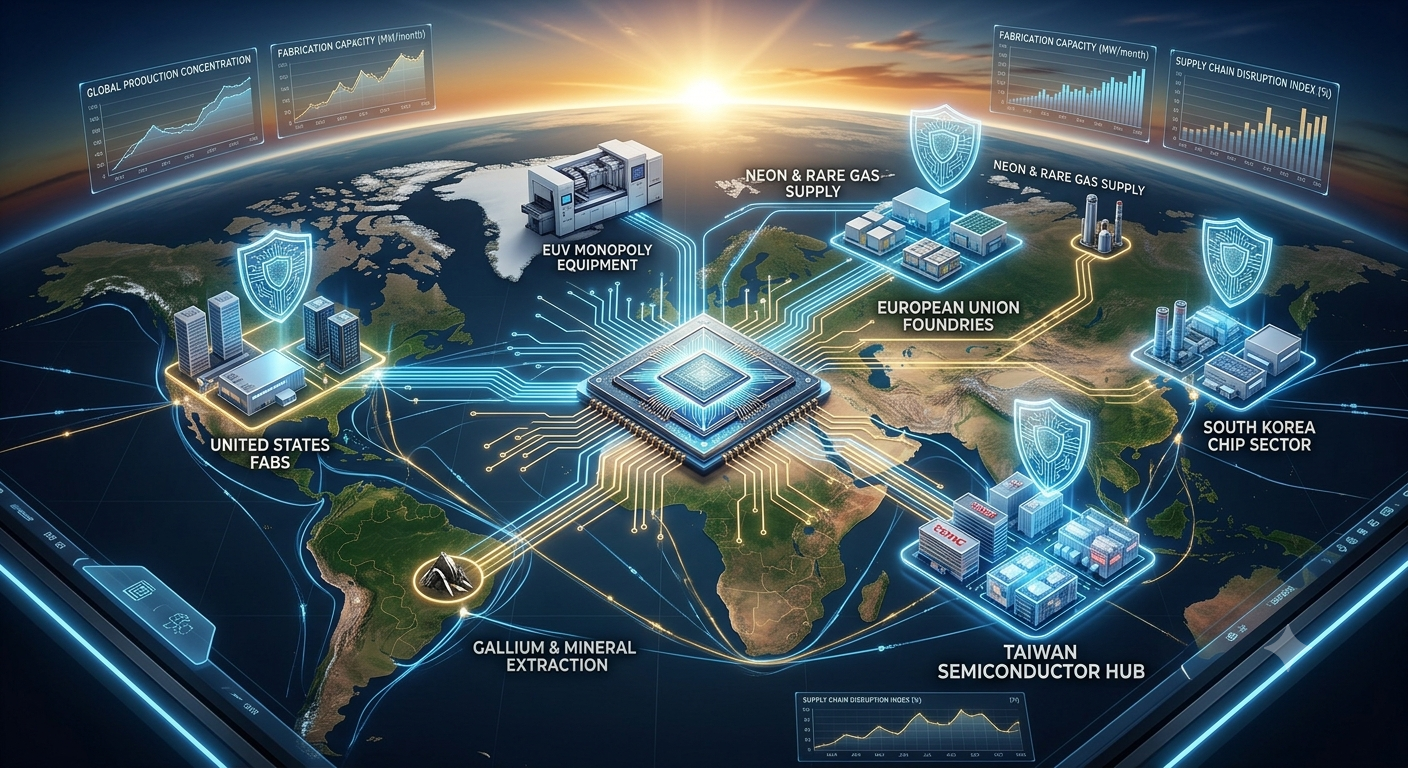
One of the semiconductor industry's greatest challenges is its extraordinary geographic concentration. Although chip design often takes place in the United States, Europe, and other innovation hubs, the manufacturing of the world's most advanced semiconductors is heavily concentrated in East Asia.
Taiwan and South Korea host the majority of global production capacity for cutting-edge semiconductor fabrication. These facilities manufacture many of the advanced chips used in smartphones, cloud computing infrastructure, artificial intelligence systems, and defense technologies.
This concentration creates significant vulnerabilities for the global economy. A major geopolitical conflict, natural disaster, cyberattack, or disruption to transportation infrastructure could interrupt semiconductor production for months. Such disruptions would ripple across industries including automotive manufacturing, consumer electronics, telecommunications, healthcare, aerospace, and defense.
Recent supply chain disruptions demonstrated how quickly semiconductor shortages can affect global production. Automobile manufacturers temporarily halted assembly lines, electronics companies delayed product launches, and businesses worldwide experienced shortages of essential electronic components.
These events highlighted how dependent the global economy has become on a relatively small number of highly specialized manufacturing facilities.
Building Domestic Semiconductor Ecosystems
Recognizing these vulnerabilities, governments across the world have launched ambitious initiatives to strengthen domestic semiconductor manufacturing.
Government Investment and Industrial Expansion
Countries are providing unprecedented levels of financial support to encourage semiconductor companies to build new fabrication plants, commonly known as "fabs." These facilities require billions of dollars in investment and represent some of the most technologically advanced manufacturing environments ever constructed.
New fabrication plants are being developed across North America, Europe, and Asia to diversify global production capacity and reduce dependence on a limited number of manufacturing locations.
These investments are expected to strengthen economic resilience while creating thousands of highly skilled jobs in engineering, manufacturing, research, and advanced technology.
Securing Critical Raw Materials
Building semiconductor factories is only part of the challenge.
Modern chip manufacturing depends on an extensive supply chain of highly purified raw materials, specialty chemicals, industrial gases, silicon wafers, rare earth elements, and advanced manufacturing equipment.
Materials such as gallium, germanium, neon gas, cobalt, and rare earth minerals play essential roles in semiconductor production. Governments are increasingly working to secure long-term supplies through domestic mining projects, international partnerships, and diversified trade agreements to reduce exposure to export restrictions or geopolitical tensions.
Advanced Manufacturing Equipment
Perhaps the most sophisticated aspect of semiconductor production involves lithography—the process used to print microscopic circuits onto silicon wafers.
The latest generation of semiconductor manufacturing relies on Extreme Ultraviolet (EUV) lithography, an incredibly complex technology capable of producing features measured in just a few nanometers.
Because only a very small number of companies possess the expertise to manufacture this equipment, advanced lithography systems have become strategically important assets. Export controls, technology partnerships, and international regulations surrounding these machines now play a major role in global technology policy.
The Growing Influence of Artificial Intelligence
Artificial intelligence has fundamentally changed the semiconductor industry.
Training large language models, scientific simulations, autonomous vehicles, robotics, and cloud computing platforms requires specialized processors capable of handling enormous computational workloads.
This growing demand has encouraged manufacturers to design chips specifically optimized for AI applications, high-performance computing, and machine learning. As AI adoption continues to expand across industries, semiconductor manufacturers are racing to develop faster, smaller, and more energy-efficient processors capable of supporting increasingly sophisticated applications.
The relationship between AI and semiconductors has become mutually dependent. Artificial intelligence requires advanced chips to function effectively, while semiconductor companies increasingly use AI to improve chip design, manufacturing efficiency, and quality control.
Challenges Facing the Industry
Although global investment in semiconductor manufacturing is growing rapidly, rebuilding domestic production capacity is an enormous undertaking.
Constructing a state-of-the-art fabrication plant requires years of planning, highly specialized engineering expertise, advanced cleanroom facilities, and billions of dollars in capital investment.
The industry also faces workforce shortages, as manufacturers require highly trained engineers, materials scientists, software developers, and semiconductor specialists capable of operating sophisticated production systems.
In addition, semiconductor manufacturing consumes significant amounts of electricity and ultra-pure water, making reliable infrastructure and sustainable resource management increasingly important considerations for future expansion.
Looking Toward the Future
The semiconductor industry is entering one of the most significant periods of transformation in its history.
Future innovations such as 2-nanometer manufacturing processes, chiplet architectures, three-dimensional chip stacking, quantum processors, advanced packaging technologies, and AI-designed circuits promise to deliver unprecedented improvements in computing performance and energy efficiency.
At the same time, governments and businesses will continue investing in resilient supply chains, domestic manufacturing capabilities, and international partnerships to reduce strategic risks associated with concentrated production.
Conclusion
Semiconductors have become the foundation of the modern digital economy, enabling virtually every technological innovation that defines contemporary life. As demand continues to grow across artificial intelligence, cloud computing, healthcare, transportation, telecommunications, and advanced manufacturing, ensuring secure access to semiconductor technology has become a global strategic priority.
The future of technological leadership will depend not only on designing more powerful chips but also on building resilient supply chains, investing in advanced manufacturing, securing critical raw materials, and developing the highly skilled workforce required to sustain innovation.
In the emerging era of Silicon Sovereignty, nations and organizations that successfully strengthen their semiconductor ecosystems will be better positioned to drive economic growth, technological advancement, and long-term digital resilience. As the world becomes increasingly connected, semiconductors will remain one of the most critical components shaping the future of industry, innovation, and global competitiveness