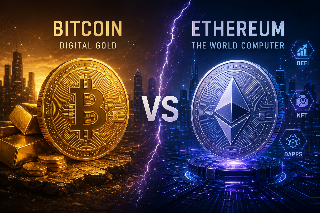




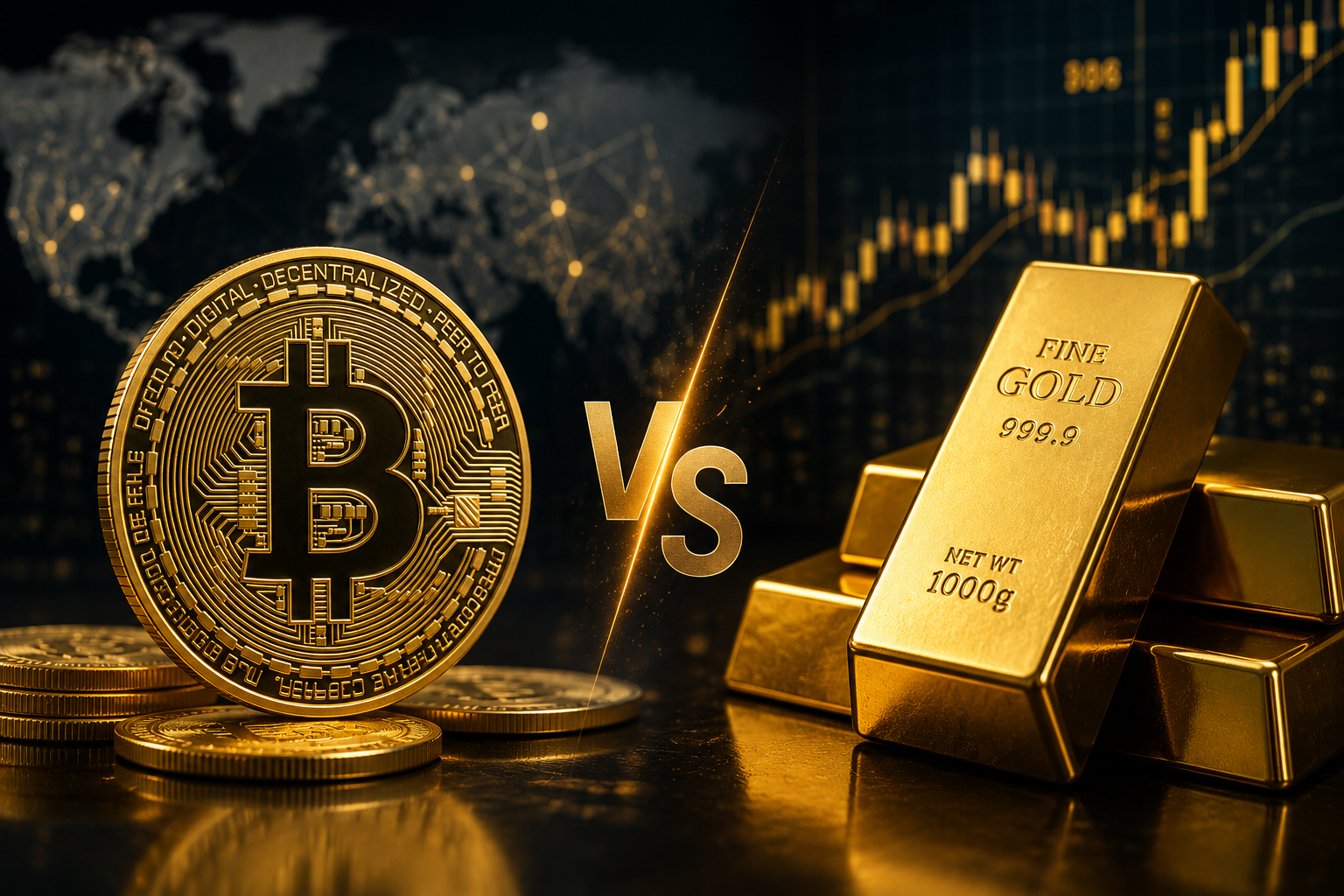
For centuries, physical gold has been the ultimate safe-haven asset—a universal store of value trusted by civilizations worldwide. However, over the last decade, a new contender has emerged, challenging this long-held dominance: Bitcoin (BTC). Often dubbed "Digital Gold," Bitcoin shares many characteristics with the precious metal, but it also brings significant modern advantages. The debate between Bitcoin vs. Gold is one of the most critical conversations in modern finance.
Is Bitcoin the New Gold?
The comparison is not coincidental. Bitcoin was explicitly designed with properties intended to mimic gold. Both assets are scarce, durable, fungible, and independent of any government or central bank. Because of these shared traits, many investors are beginning to treat Bitcoin as a digital equivalent to the physical metal.
The Duel for Dominance: Digital vs. Physical Store of Value.
Key Similarities: The "Hard Money" Case
Both Bitcoin and Gold are considered "hard money," meaning their supply cannot be arbitrarily increased by a central authority, making them resistant to inflation.
- Scarcity: Gold is scarce by nature of its geology. Bitcoin is scarce by nature of its mathematics (capped at 21 million BTC).
- Durability: Neither asset corrodes or degrades over time.
- Fungibility: One ounce of gold is worth the same as another. One bitcoin is worth the same as another.
- Decentralization: No single entity controls the global price or supply of either asset.
Key Differences: Where Bitcoin Outshines Gold
While gold has a 5,000-year head start, Bitcoin offers technological advantages that are crucial for the digital age.
| Feature | Bitcoin (BTC) | Gold |
|---|---|---|
| Portability | Extremely High: Can send billions of dollars worth anywhere in the world instantly via a smartphone. | Very Low: Physically heavy, difficult, and expensive to transport and secure in large quantities. |
| Divisibility | High: Can be divided into tiny fractions (satoshis). | Low: Difficult to use small amounts for everyday transactions. |
| Verifiability | Instant & Trustless: Verified instantly on the public blockchain. | Requires Trust/Equipment: Requires acid tests, X-rays, or trusted assayers to verify authenticity. |
Conclusion: The Future of Wealth
Gold remains a foundational asset, especially for central banks and ultra-conservative investors who value its millennia of proven trust. However, Bitcoin is rapidly gaining traction as a superior store of value for a younger, tech-savvy generation.
"While gold may always hold a place in the physical vault, Bitcoin is increasingly becoming the preferred asset for the digital vault."
As economic uncertainty persists, holding a diversified portfolio that includes both "Digital Gold" and Physical Gold may prove to be the most robust strategy for preserving wealth.