




Introduction
Saving money has become more important than ever in 2026. Rising living costs, subscription-based services, inflation, and impulse online shopping have made it increasingly difficult for many people to build healthy financial habits. At the same time, technology has created countless opportunities to automate savings, reduce unnecessary expenses, and even earn extra income without working traditional part-time jobs.
The good news is that successful money management doesn’t require earning a massive salary. Financial stability is often built through consistent habits, smart planning, and making better decisions with the money you already have. Small changes—such as eliminating forgotten subscriptions, waiting before making purchases, or using smart technology to reduce utility bills—can save hundreds or even thousands of dollars each year.
Beyond saving money, many people are also looking for reliable ways to increase their income. The best side hustles in 2026 are no longer based solely on exchanging time for money. Instead, they focus on creating digital products, offering specialized expertise, and building online assets that continue generating income long after the initial work is complete.
In this guide, you’ll discover practical strategies to reduce monthly expenses, build better financial habits, and explore scalable side hustles that can strengthen your financial future.
Why Saving Money Matters More Than Ever
Financial security provides more than just extra cash in your bank account. It creates peace of mind, reduces stress, and prepares you for unexpected emergencies.
Whether your goal is purchasing a home, traveling, starting a business, paying off debt, or building an emergency fund, consistent saving is the foundation of long-term financial success.
Modern technology has made saving easier than ever before. Banking apps, budgeting software, automated transfers, cashback rewards, and AI-powered financial assistants now help people manage money with minimal effort.
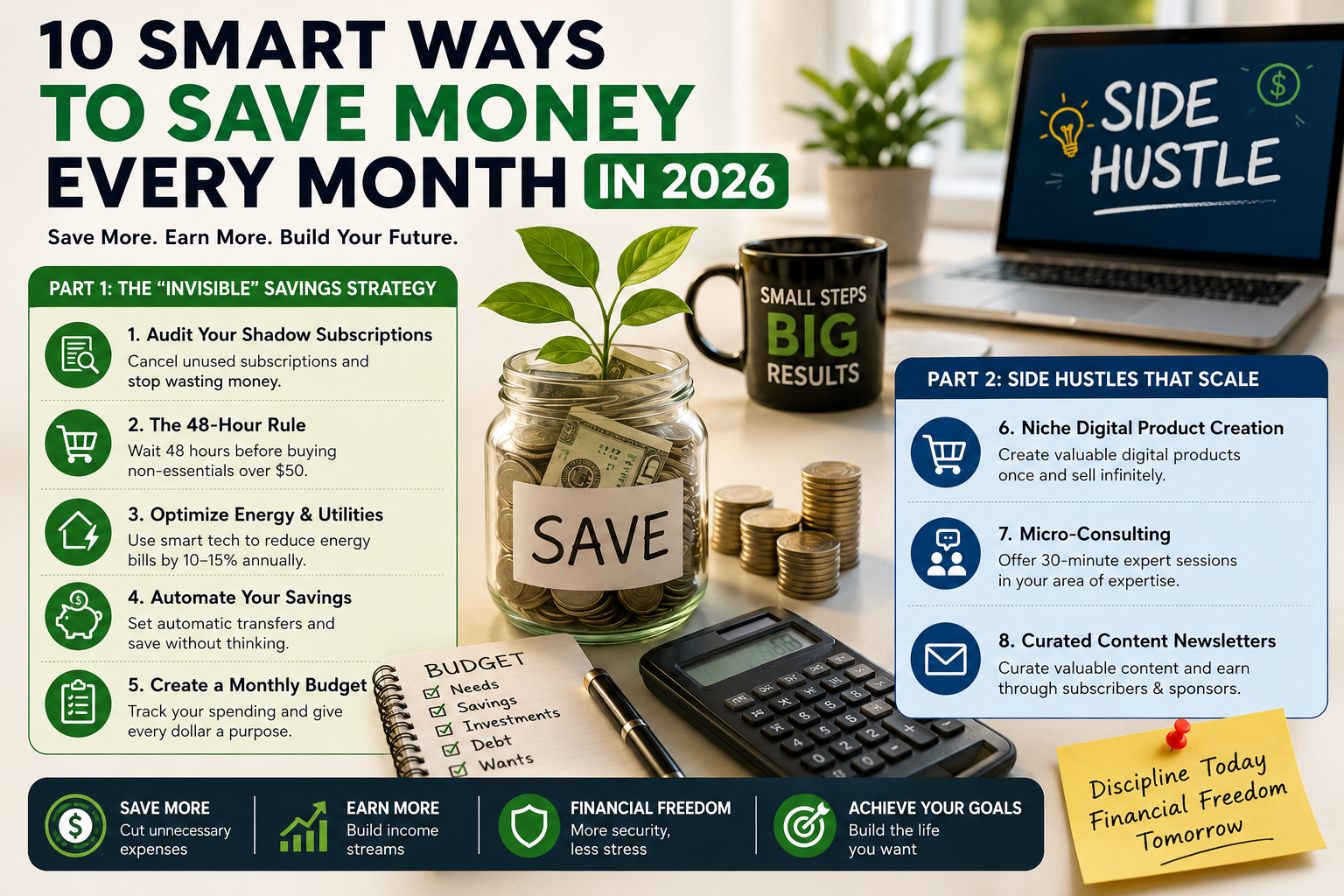
Part 1: The “Invisible” Savings Strategy
One of the biggest secrets of successful savers is that they don’t rely on willpower alone. Instead, they build systems that automatically save money without requiring daily decisions.
The less effort required, the more likely you are to stick with good financial habits.
1. Audit Your “Shadow” Subscriptions
Subscription services have become a normal part of everyday life. Streaming platforms, fitness apps, cloud storage, music services, gaming memberships, software subscriptions, and premium mobile apps often renew automatically.
Many people continue paying for services they barely use.
These forgotten subscriptions—often called “shadow” or “zombie” subscriptions—can quietly drain hundreds of dollars each year.
Take time every month to review your bank statements and credit card transactions.
Ask yourself:
- Have I used this service recently?
- Does it still provide value?
- Can I replace it with a free alternative?
If you haven’t used a subscription within the past month, it’s probably time to cancel it.
Even eliminating just three unnecessary subscriptions could save hundreds of dollars annually.
2. Follow the 48-Hour Rule Before Buying
Online shopping has made impulse buying easier than ever.
Limited-time discounts, flash sales, influencer recommendations, and personalized advertisements constantly encourage spending.
One of the most effective ways to avoid unnecessary purchases is following the 48-hour rule.
Whenever you want to buy a non-essential item costing more than $50, wait at least two days before making the purchase.
During that time, ask yourself:
- Do I really need it?
- Will I still use it six months from now?
- Is there a cheaper alternative?
- Can I borrow or rent it instead?
Many impulse purchases lose their appeal after a short waiting period.
This simple habit helps eliminate emotional spending and encourages thoughtful financial decisions.
3. Optimize Your Energy and Utility Bills
Smart home technology has become far more affordable in 2026.
Devices like smart thermostats, automated lighting systems, motion sensors, and smart plugs reduce electricity usage without requiring daily attention.
These technologies automatically switch off unused appliances, adjust heating and cooling systems, and monitor household energy consumption.
Small improvements can lead to significant annual savings.
Other ways to reduce utility costs include:
- Using LED lighting
- Running appliances during off-peak hours
- Improving home insulation
- Lowering water heater temperatures
- Unplugging unused electronics
These small adjustments add up over time.
4. Automate Your Savings
Saving money becomes much easier when you remove the temptation to spend it.
Set up automatic transfers that move a percentage of every paycheck directly into a savings account.
Even transferring 10% of your income each month can create substantial savings over several years.
Automation removes emotion from financial decisions.
Instead of deciding whether to save each month, your savings happen automatically.
5. Create a Monthly Budget
A budget isn’t designed to restrict spending.
Instead, it gives you complete control over where your money goes.
Track your income and categorize your expenses into areas like:
- Housing
- Food
- Transportation
- Entertainment
- Healthcare
- Savings
- Investments
Review your spending every month.
Small budget adjustments often reveal opportunities to save far more than expected.
Part 2: Side Hustles That Actually Scale
Many traditional side hustles require continuous work.
Driving, food delivery, tutoring, or freelance gigs generate income only while you’re actively working.
Modern side hustles focus on building assets that continue producing income over time.
This creates greater financial freedom and long-term earning potential.
6. Create Niche Digital Products
Digital products remain one of the most profitable online businesses in 2026.
Unlike physical products, digital downloads require no inventory, shipping, or manufacturing costs.
Once created, they can be sold repeatedly.
Popular digital products include:
- Productivity templates
- Budget planners
- Resume templates
- Business systems
- Online courses
- Digital journals
- AI prompt libraries
- Financial spreadsheets
Instead of creating generic templates, focus on solving specific problems for specific audiences.
For example:
- The Teacher’s Lesson Planner
- The Realtor’s Marketing Kit
- The Freelance Designer Business Dashboard
- The Project Manager’s Notion Workspace
Specialized products often sell much better than general ones.
7. Offer Micro-Consulting Services
People increasingly value direct access to experienced professionals.
Rather than offering long-term consulting contracts, many experts now sell short consultation sessions lasting 20 to 30 minutes.
These “office hour” sessions allow clients to receive personalized advice quickly.
Professionals in fields such as:
- Marketing
- Software development
- Graphic design
- Accounting
- Career coaching
- Finance
- AI implementation
- Business strategy
can earn significant income through short, focused consultations.
Micro-consulting requires minimal startup costs while leveraging existing knowledge.
8. Launch a Curated Newsletter
Information overload has become one of the biggest challenges in 2026.
People no longer want endless news—they want someone to filter it for them.
Curated newsletters solve this problem by collecting the most valuable insights within a specific niche.
Examples include:
- AI news
- Real estate trends
- Cryptocurrency updates
- Startup funding
- Healthcare innovation
- Personal finance
- Digital marketing
- Remote work opportunities
As readership grows, newsletters can generate income through:
- Sponsorships
- Premium memberships
- Affiliate marketing
- Digital product sales
- Paid subscriptions
Many successful newsletters began as simple weekly emails.
9. Build Multiple Income Streams
Relying on a single income source can be risky.
Economic changes, job loss, or unexpected expenses can quickly create financial pressure.
Building multiple income streams creates greater financial stability.
Examples include:
- Full-time employment
- Freelancing
- Investments
- Dividend stocks
- Rental income
- Affiliate marketing
- Online courses
- Digital products
Even small secondary income sources provide valuable financial security over time.
10. Invest in Skills That Increase Your Income
The highest return on investment often comes from improving your own abilities.
Learning valuable skills can significantly increase your earning potential.
In-demand skills for 2026 include:
- Artificial Intelligence
- Data Analysis
- Cybersecurity
- Software Development
- Digital Marketing
- Video Editing
- UX/UI Design
- Cloud Computing
- Prompt Engineering
- Project Management
Investing in education today can produce financial rewards for decades.
Common Money-Saving Mistakes
Many people unknowingly slow their financial progress by making avoidable mistakes.
These include:
- Not tracking spending
- Carrying high-interest debt
- Ignoring emergency savings
- Making emotional purchases
- Living beyond their means
- Delaying investments
- Paying unnecessary subscription fees
- Failing to compare prices
- Shopping without a plan
Recognizing these habits is the first step toward improving financial health.
Practical Tips for Long-Term Financial Success
Building wealth is rarely about one big decision. It’s usually the result of many small, consistent actions over time.
Some practical habits include:
- Save before you spend.
- Avoid lifestyle inflation after salary increases.
- Build an emergency fund covering at least three to six months of expenses.
- Review your financial goals every quarter.
- Invest consistently, even in small amounts.
- Continue learning about personal finance.
- Focus on long-term progress rather than short-term perfection.
These habits create lasting financial resilience and confidence.
Conclusion
Saving money in 2026 is no longer about extreme budgeting or sacrificing everything you enjoy. Instead, it’s about making smarter financial decisions, automating positive habits, and using technology to work in your favor.
Simple strategies like canceling unused subscriptions, applying the 48-hour rule before major purchases, optimizing household energy use, and automating savings can significantly reduce monthly expenses without dramatically changing your lifestyle.
At the same time, scalable side hustles—such as creating niche digital products, offering micro-consulting, and publishing curated newsletters—provide opportunities to build income that continues growing over time. Combined with ongoing skill development and diversified income streams, these approaches create a stronger financial foundation for the future.
The journey toward financial freedom doesn’t require perfection. It begins with one smart decision, repeated consistently. By implementing even a few of the strategies outlined in this guide, you can take meaningful steps toward saving more, earning more, and achieving greater financial security in 2026 and beyond.