




The year is 2026, and mobile gaming has evolved beyond casual time-wasters into a legitimate arena for high-stakes competition and immersive, console-quality experiences. This shift has fueled a specialized arms race among manufacturers to build the ultimate pocket-sized powerhouse. At the forefront of this battle are two legendary rivals: ASUS with its Republic of Gamers (ROG) line, and Nubia with its RedMagic series. The latest contenders, the ASUS ROG Phone 10 and the RedMagic 12 Pro, represent the pinnacle of mobile engineering, each pushing the boundaries of what a smartphone can do.
For the dedicated mobile gamer, choosing between these two is a high-stakes decision. Do you prioritize a complete gaming ecosystem with unmatched accessories and software polish, or do you demand raw, unthrottled performance and futuristic aesthetics at any cost? In this comprehensive 1500-word breakdown, we will dissect every critical aspect of the ROG Phone 10 and the RedMagic 12 Pro—from their design philosophies and internal cooling to display technology, gaming controls, and battery endurance—to help you decide which device will be your next weapon of choice.
1. Design Language and Build Philosophy
When you pull a gaming phone out of your pocket, you don't want it to look like every other commuter's device. Both ASUS and RedMagic understand this, but they express it differently.
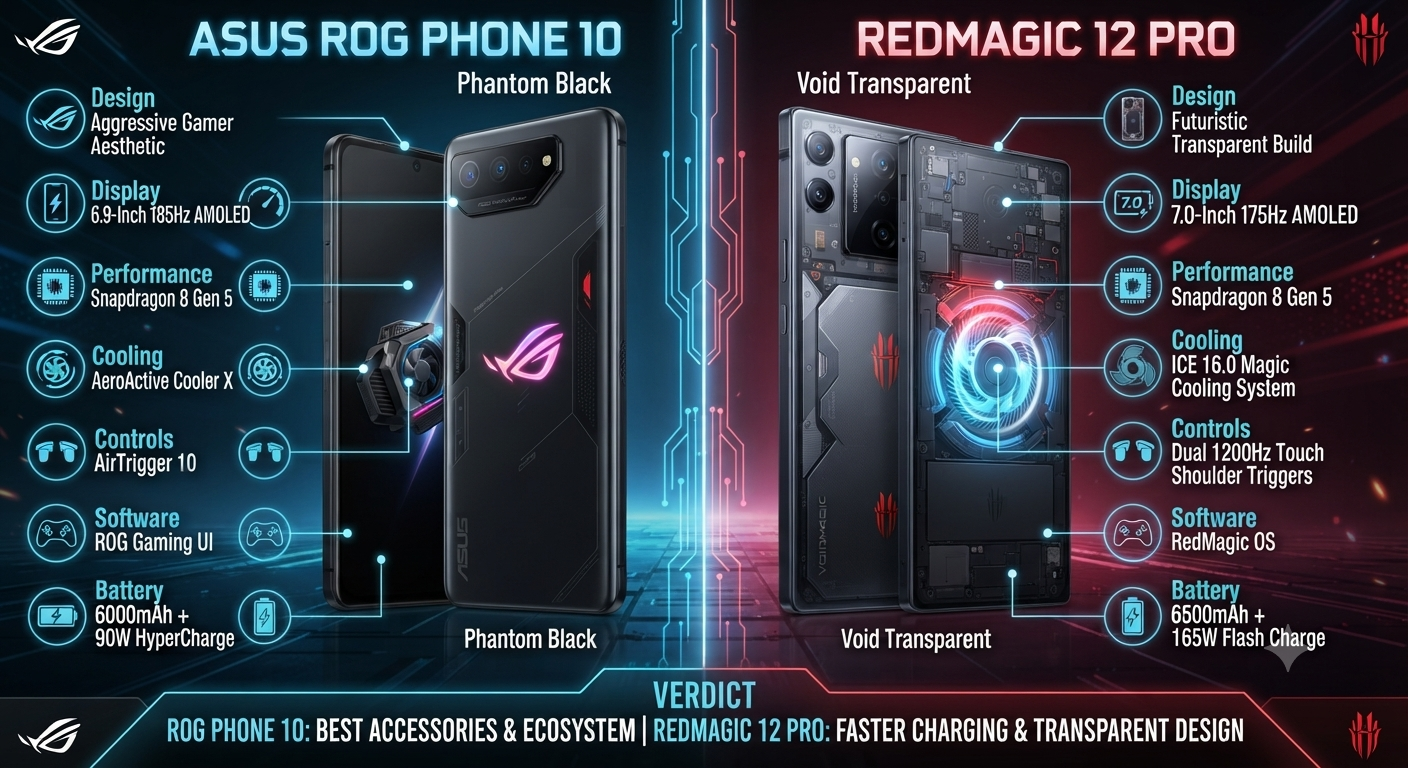
The ASUS ROG Phone 10 continues to refine the "stealth fighter" aesthetic. It’s aggressive yet sophisticated, featuring a robust metal and glass chassis with sharp lines and the iconic, customizable Aura RGB ROG logo on the back. It feels substantial and premium, built to withstand intense gaming sessions without flexing. ASUS has prioritized ergonomics, with subtle curves on the back edges that make it comfortable to hold in landscape orientation for long periods. The overall build exudes a sense of refined quality and a complete, cohesive gaming ecosystem.
Conversely, the RedMagic 12 Pro leans into a more futuristic and transparent design language. Its most distinctive feature is the "Void Transparent" edition, which showcases the internal components, including the high-speed turbofan, illuminated by customizable RGB lights. It’s a showstopper designed to be flaunted. The phone has a flatter, boxier shape that algunos gamers find provides a more secure grip. While perhaps less "premium" to the touch than the ROG Phone 10, the RedMagic 12 Pro’s design is unapologetically bold and tech-centric.
2. Display Technology and Visual Immersion
A gaming phone is only as good as its window into the virtual world. Both contenders deliver top-tier panels, but with different strengths.
The ASUS ROG Phone 10 boasts a stunning 6.9-inch AMOLED display with an ultra-smooth 185Hz refresh rate. This refresh rate, one of the highest on the market, offers unparalleled fluidity in fast-paced shooters and competitive games, making motion blur virtually non-existent. The color accuracy is superb, and the panel supports HDR10+ for vibrant, cinematic visuals in story-driven titles. Its touch sampling rate is also top-tier, ensuring your inputs are registered instantaneously.
The RedMagic 12 Pro counters with an even larger 7.0-inch true full-screen AMOLED display. By utilizing an under-display camera (UDC) technology, RedMagic eliminates the need for a punch-hole cutout, providing an uninterrupted, 100% screen-to-body ratio that is incredibly immersive. The refresh rate is a highly competitive 175Hz. While slightly lower than the ROG’s 185Hz, the lack of any notch or hole is a major advantage for visual purity. The screen also offers incredible peak brightness, making it easy to game outdoors in bright daylight.
3. Performance Hardware and Thermal Management
Under the hood, this is a clash of titans. Both devices are powered by the latest Qualcomm Snapdragon 8 Gen 5 processor, but their performance depends entirely on how they handle the resulting heat.
The ASUS ROG Phone 10 utilizes its comprehensive "GameCool 10" system. This features a large vapor chamber, graphite sheets, and a unique, centered PCB design that keeps heat away from your fingers. Critically, it supports the external AeroActive Cooler X. This clip-on accessory isn't just a fan; it’s an active thermoelectric cooler (Peltier element) that can dramatically lower skin temperatures during marathon sessions, unlocking sustained peak performance that passive cooling simply cannot match. For users invested in the ecosystem, it’s a game-changer.
The RedMagic 12 Pro doubles down on its signature active cooling system, the "ICE 16.0 Magic Cooling System." This features the industry's fastest built-in turbofan, now spinning at incredible speeds with reduced noise. The internal duct system pulls cool air in and pushes hot air out, providing a constant stream of cooling without needing an external attachment. While this built-in solution is incredibly convenient, it can't match the raw cooling power of the AeroActive Cooler X’s thermoelectric plate. However, it ensures the phone is always performing at its peak, anywhere, without extra bulk.
4. Gaming Controls and Software Experience
Performance is meaningless if you can't control the action. Both phones go far beyond standard touchscreen inputs.
The ASUS ROG Phone 10 features the latest generation of its renowned "AirTrigger 10" ultrasonic shoulder sensors. These are pressure-sensitive and support multiple gestures per trigger (tap, slide, press and lift), offering a level of customization that rivals a dedicated controller. The accompanying Armoury Crate software is the gold standard in mobile gaming hubs, allowing for granular control over performance profiles, fan speeds, lighting, and audio settings for every individual game in your library.
The RedMagic 12 Pro offers a powerful alternative with its dedicated dual 1200Hz touch sampling shoulder triggers. These are among the most responsive on the market, providing a tactile click that some users prefer over ultrasonic sensors. The RedMagic OS is heavily optimized for gaming, with a dedicated "RedMagic Studio" space that offers a floating dashboard to tweak settings on the fly. Its "X Gravity" platform also allows you to easily map on-screen controls to external peripherals like keyboards and mice.
5. Battery Life and Charging Velocity
Power anxiety is the gamer’s worst enemy. These phones offer two different solutions to the same problem.
The ASUS ROG Phone 10 sticks with its innovative split-battery design, totaling a massive 6000mAh capacity. This design centers the weight for better balance and reduces heat buildup during charging. It supports 90W HyperCharge, which can fill the battery from empty in under 35 minutes. While incredibly fast, it’s not the fastest on the block.
The RedMagic 12 Pro houses an even larger 6500mAh single-cell battery, offering exceptional longevity for extended gaming sessions. To combat the longer charge time for a bigger battery, it features blistering 165W Flash Charge technology. This can charge the enormous battery from 0% to 100% in a scarcely believable 15-20 minutes, effectively eliminating power anxiety altogether.
Final Verdict: Which Gaming Powerhouse is Right for You?
Concluding our extensive analysis, the ASUS ROG Phone 10 and the RedMagic 12 Pro are both magnificent triumphs of mobile gaming engineering. There is no clear "winner," as the best choice depends entirely on your personal priorities.
- Choose the ASUS ROG Phone 10 if you value a complete, premium ecosystem. With its superior optional thermoelectric cooler (AeroActive Cooler X), unparalleled AirTrigger customization, and refined software, it offers the ultimate, professional-grade mobile gaming experience.
- Choose the RedMagic 12 Pro if your primary demand is raw, unthrottled performance and convenience. With its massive 6500mAh battery, fastest-in-class 165W charging, immersive uninterrupted display, and powerful built-in turbofan, it is an untamed beast designed for dominance.
Which of these futuristic gaming phones represents your ultimate setup? Let us know your pick in the comments below!