





The Science of Morning Routines: What Actually Works?

Forget the "5 AM Club" myths. We dive into the neuroscience of waking up to reveal the essential, evidence-backed steps that optimize your brain chemistry and energy for the day ahead

The Science of Morning Routines: What Actually Works?

We live in an era obsessed with optimization. Walk into any bookstore or scroll through any productivity blog, and you will be bombarded with prescriptive dogma about the "perfect" morning routine. We are told that to be successful, happy, and productive, we must wake up at 5:00 AM, ice-bath our faces, journal for an hour, run five miles, and consume a green smoothie before the sun crests the horizon. This "one-size-fits-all" approach to mornings often leads to more burnout than breakthroughs, leaving many feeling inadequate before their workday even begins.

The truth, validated by neuroscience and chronobiology, is far more nuanced. There is no single magical routine. However, there *is* a science to understanding how our brains and bodies transition from sleep to wakefulness. By leveraging specific biological mechanisms, you can design a flexible morning protocol that optimizes your neurochemistry, manages your stress response, and sets a stable foundation for the day. Forget the myths; here is what actually works based on the science of the human body.

1. The Biology of Waking Up: Hacking Your Brain Chemistry

To understand how to design a routine, you must first understand what happens biologically the moment you open your eyes. The quality of your morning is largely dictated by two primary neurochemical and hormonal shifts:

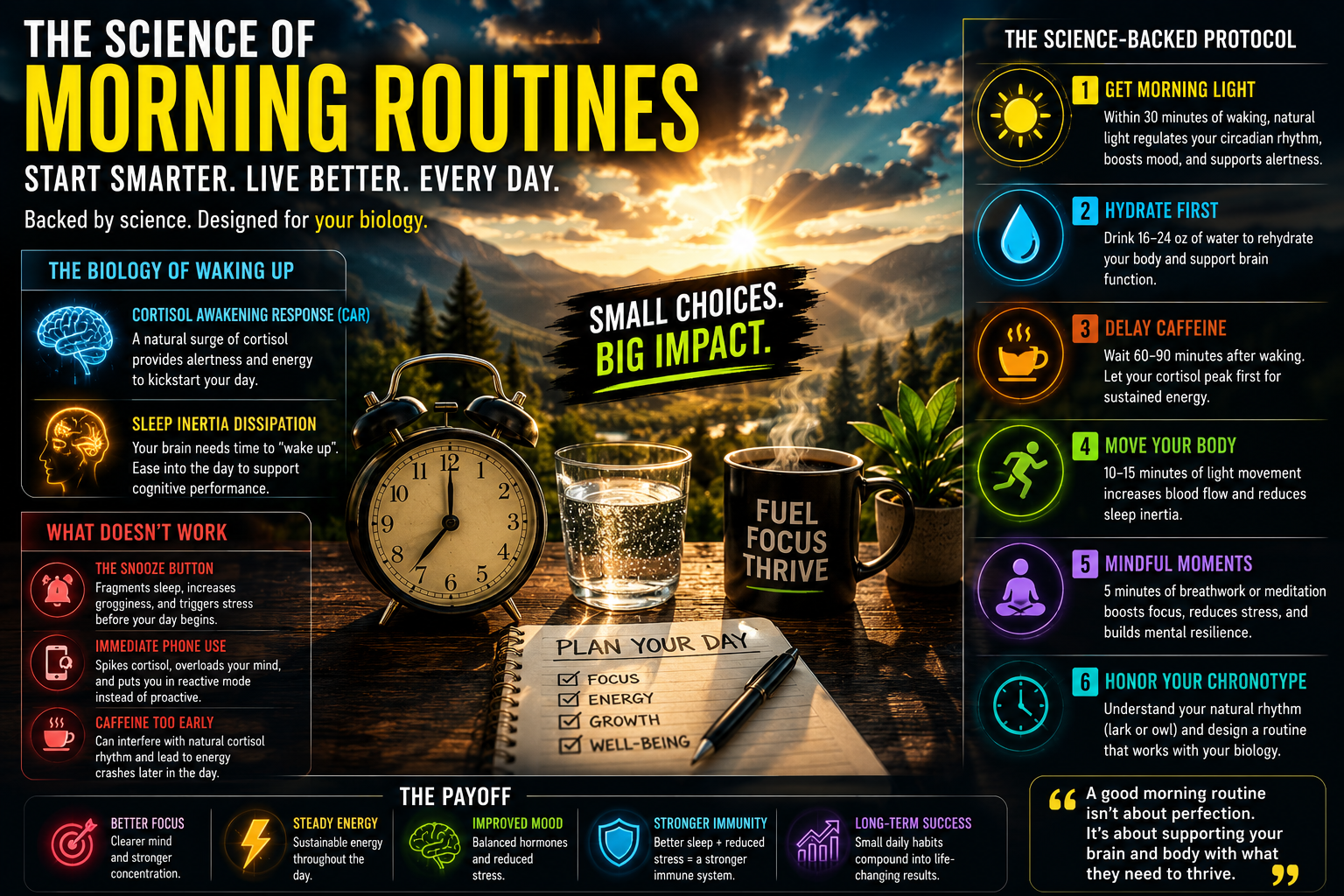
  • The Cortisol Awakening Response (CAR): Upon waking, your adrenal glands release a surge of cortisol. While cortisol is often maligned as the "stress hormone," the CAR is a healthy, natural mechanism. It acts as your body’s internal espresso shot, providing the alertness and energy needed to get out of bed. A robust CAR is associated with better cognitive function and emotional regulation throughout the day.
  • Sleep Inertia Dissipation: Sleep inertia is that groggy, disoriented feeling you experience immediately after waking. It occurs because your prefrontal cortex—the part of the brain responsible for complex decision-making and impulse control—takes time to fully boot up from deep sleep. Your routine needs to facilitate this transition, not fight against it.

2. What Doesn't Work: Common Traps to Avoid

Before adopting new habits, it is crucial to identify the practices that actively undermine your biology.

  • The Snooze Button Cycle: Hitting snooze fragments your final, crucial cycles of REM and slow-wave sleep. Waking up repeatedly from these stages induces severe sleep inertia, leaving you far groggier than if you had just woken up to the first alarm. Furthermore, it initiates fragmented, incomplete stress cycles that start your day on a neurologically anxious footing.
  • Immediate Digital Immersion: Grabbing your phone the second you open your eyes is perhaps the most destructive modern habit. It forces your brain to instantly switch from a restful state into high-alert reactivity. The deluge of emails, news alerts, and social media notifications spikes cortisol prematurely, hijacking your prefrontal cortex and putting you into a defensive, rather than proactive, mental state.

3. The Science-Backed Protocol: Essential Steps for an Effective Morning

If the extreme 5:00 AM routines are unnecessary, and the digital doom-scroll is harmful, what should you actually do? A science-aligned routine focuses on supporting your natural rhythms and gradually ramping up cognitive load. Here are the core components:

A. Strategic Light Exposure: Anchoring Your Circadian Rhythm

This is the single most powerful lever you have for regulating your internal clock. Within the first 30 minutes of waking, expose your eyes to natural daylight (ideally sunlight, even through cloud cover). This signal travels to the suprachiasmatic nucleus (SCN) in your brain, which acts as the master clock for your entire body.

Sunlight exposure triggers the precise timing of melatonin release for the *following* evening and reinforces the daytime release of serotonin and dopamine. It directly boosts the Cortisol Awakening Response in a healthy, regulated manner. If you wake up before sunrise, simulating bright light with specialized SAD lamps is the next best alternative.

B. Hydration First: Reversing Overnight Dehydration

You lose a significant amount of water overnight through respiration and perspiration. Waking up in a state of mild dehydration compromises cognitive performance, mood, and physical energy. Before reaching for coffee, consume 16–24 ounces of water. Rehydrating the body immediately kickstarts physiological processes and provides the fluid necessary for optimal neurological function.

C. Delayed Gratification: Pushing Back Caffeine

While coffee is a powerful stimulant, the science suggests timing matters immensely. Throughout the day, your brain accumulates a chemical called adenosine, which creates sleep pressure—the feeling of being tired. Caffeine works by blocking adenosine receptors.

Upon waking, your brain is already clearing out residual adenosine, and your cortisol is naturally surging. Consuming caffeine in this first hour can interfere with this natural process and may lead to a more significant energy crash later in the afternoon. The optimal window for caffeine is generally 60 to 90 minutes after waking, once your natural cortisol peak begins to subside, allowing the caffeine to genuinely counteract rising adenosine rather than just overlapping with cortisol.

D. Movement and Mindfulness: Priming Body and Mind

A brief period of intentional movement—stretching, light yoga, or a brisk walk—increases blood flow to the brain and body, helping to dissipate sleep inertia and activate neural pathways. This doesn't need to be an intense gym session; 10–15 minutes is sufficient.

Pairing movement with a low-stakes mindfulness practice, such as 5 minutes of breathwork or seated meditation, trains your attention control. This strengthens the prefrontal cortex, helping you resist the urge to reactively check your phone and instead set a deliberate intention for how you want to approach the day's challenges.

4. Personalization: The Importance of Chronotype

The most critical scientific finding in routine research is the importance of individual chronotype. Your chronotype is your body's natural inclination to be asleep or awake at certain times, driven by genetics.

Forcing an evening-inclined person (a "night owl") to adhere to a strict 5:00 AM routine fights directly against their internal biology. They will experience chronic sleep debt and reduced performance compared to when they follow their natural schedule. An effective routine honors your chronotype. While you cannot always perfectly align work schedules with your natural rhythm, understanding whether you are a lark or an owl allows you to structure your morning demands realistically and sustainably.

Conclusion: Consistency Over Intensity

The science of morning routines teaches us that simplicity and consistency far outweigh intensity and complexity. A routine that works is one you can actually sustain without dread.

By focusing on these foundational biological pillars—getting sunlight in your eyes, hydrating immediately, delaying caffeine, and engaging in gentle movement and mindfulness—you provide your brain and body with the signals they need to transition optimally from sleep to waking. The goal is not to win the morning by 8:00 AM; the goal is to fuel yourself sufficiently to win the day.


Quick Summary

Forget the "5 AM Club" myths. We dive into the neuroscience of waking up to reveal the essential, evidence-backed steps that optimize your brain chemistry and energy for the day ahead

Key Takeaways

  • The Cortisol Awakening Response (CAR): Upon waking, your adrenal glands release a surge of cortisol. While cortisol is often maligned as the "stress hormone," the CAR is a healthy, natural mechanism. It acts as your body’s internal espresso shot, providing the alertness and energy needed to get out of bed. A robust CAR is associated with better cognitive function and emotional regulation throughout the day.
  • Sleep Inertia Dissipation: Sleep inertia is that groggy, disoriented feeling you experience immediately after waking. It occurs because your prefrontal cortex—the part of the brain responsible for complex decision-making and impulse control—takes time to fully boot up from deep sleep. Your routine needs to facilitate this transition, not fight against it.
  • The Snooze Button Cycle: Hitting snooze fragments your final, crucial cycles of REM and slow-wave sleep. Waking up repeatedly from these stages induces severe sleep inertia, leaving you far groggier than if you had just woken up to the first alarm. Furthermore, it initiates fragmented, incomplete stress cycles that start your day on a neurologically anxious footing.
  • Immediate Digital Immersion: Grabbing your phone the second you open your eyes is perhaps the most destructive modern habit. It forces your brain to instantly switch from a restful state into high-alert reactivity. The deluge of emails, news alerts, and social media notifications spikes cortisol prematurely, hijacking your prefrontal cortex and putting you into a defensive, rather than proactive, mental state.

Quick Facts

Category: Lifestyle
Published: August 6, 2026
Updated: October 8, 2026
Reading time: 6 min
90 views
Updated Oct 8, 2026 6 min read

Related Articles

View all
The Beauty Reset: Key Trends Sweeping Social Media in 2026 Lifestyle
Article Lifestyle

The Beauty Reset: Key Trends Sweeping Social Media in 2026

Forget the heavy, perfectly filtered aesthetics of the past. In 2026, the beauty narrative on social media has shifted toward "authentic enhancement." From hyper-personalized skincare routines to the rise of minimalist "skin-streaming," beauty enthusiasts are prioritizing long-term health over short-term trends.

Quinn, Kate 9 min 117

Popular

View all

Mixed Content

Lifestyle
Article Lifestyle

The Post-Automation Economy: Architecting Human Skill Premiums in the Age of Autonomy

The rapid proliferation of agentic workflows and large action models is structurally inverting the traditional corporate skill pyramid. While routine analytical processes and information retrieval tasks are being automated into low-cost utility, uncommoditizable human traits—emotional intelligence, strategic ambiguity management, and ethical governance—are commanding an unprecedented value premium. Succeeding in the post-automation enterprise requires re-engineering workforce development to focu

Mutwassim 3 min 72
The Decline of Friction: Inside the FinTech Revolution in Cross-Border Settlement and Digital Identity Lifestyle
Article Lifestyle

The Decline of Friction: Inside the FinTech Revolution in Cross-Border Settlement and Digital Identity

The traditional plumbing of global finance—characterized by multi-day delays, hidden fees, and fragmented identity silo—is undergoing a profound transformation. A new generation of FinTech architectures, combining distributed ledger technology (DLT), synchronized liquidity pools, and decentralized digital passports, is enabling cross-border instant payments with near-zero friction.

Mutwassim 1 min 44
The City as a Switch: Architecting IoT Logistics for the Post-Congestion Urban Era Lifestyle
Article Lifestyle

The City as a Switch: Architecting IoT Logistics for the Post-Congestion Urban Era

The traditional model of urban delivery—reliant on high-emission diesel vans navigating static street grids—is creating unsustainable levels of congestion and pollution in global metros. To reclaim urban space, cities are transitioning to IoT-orchestrated logistics. This data-driven framework utilizes autonomous delivery swarms, automated micro-fulfillment centers, and dynamic digital kerb-side management to route goods with the efficiency of internet packets, transforming static streets into fl

Mutwassim 4 min 71
Beyond the Coffee Shop: How Cross-Border Employment and Sovereign Visas Are Institutionalizing Remote Work Lifestyle
Article Lifestyle

Beyond the Coffee Shop: How Cross-Border Employment and Sovereign Visas Are Institutionalizing Remote Work

Remote work is transitioning from an informal perk into an institutionalized pillar of international commerce. Over 60 nations have launched dedicated digital nomad visa regimes, while multi-jurisdictional compliance platforms and Employer of Record (EOR) frameworks dismantle traditional geographic barriers. As knowledge workers disperse globally, enterprises and municipal governments are formalizing policies around tax residency, permanent establishment risk, and asynchronous operational workfl

Mutwassim 3 min 71
The Death of Syntax: Inside the Shift to Intent-Driven Software Engineering Lifestyle
Article Lifestyle

The Death of Syntax: Inside the Shift to Intent-Driven Software Engineering

The day-to-day discipline of software engineering is undergoing its most radical abstraction leap since the transition from assembly language to high-level compilers. Generative code synthesis and deterministic reasoning engines are automating boilerplate syntax, turning software developers into systems architects. Survival in this new paradigm demands mastering intent formalization, specification design, and continuous verification.

Mutwassim 3 min 71
The Post-Visual Threat: Architecting Zero-Trust Defense Against Weaponized Deepfakes Lifestyle
Article Lifestyle

The Post-Visual Threat: Architecting Zero-Trust Defense Against Weaponized Deepfakes

The rapid weaponization of real-time voice cloning and synthetic video generation has transformed social engineering from opportunistic phishing into targeted executive identity emulation. High-profile incidents involving multi-million-dollar wire transfers authorized via synthetic video calls prove that sight and sound can no longer authenticate authorization. Securing modern enterprises requires an uncompromising zero-trust identity layer capable of neutralizing synthetic deception.

Mutwassim 3 min 139
Beyond the Battery: How Electric Mobility Is Forcing a Overhaul of the Global Power Grid Lifestyle
Article Lifestyle

Beyond the Battery: How Electric Mobility Is Forcing a Overhaul of the Global Power Grid

The global transition toward electric vehicles is no longer constrained primarily by battery chemistry or vehicle range. Instead, the real bottleneck has shifted directly to the electrical grid. As commercial fleets and passenger cars electrify at scale, utilities and city planners are racing to deploy vehicle-to-grid (V2G) bidirectional systems, AI-driven dynamic load balancers, and decentralized microgrid storage to avoid grid failure.

Mutwassim 3 min 58
Cloud 3.0: The Shift Toward Sovereign Data Architectures and Edge Computing Lifestyle
Article Lifestyle

Cloud 3.0: The Shift Toward Sovereign Data Architectures and Edge Computing

The architectural assumption that enterprise compute and storage should reside in a handful of centralized hyperscaler data centers is fracturing. Driven by strict cross-border data sovereignty regulations and the demand for millisecond-latency AI inference, global IT leaders are pivoting to Cloud 3.0—a model centered on distributed, locally governed, and hybrid sovereign architectures.

Mutwassim 3 min 61