




When we think about monumental shifts in human history, our minds naturally gravitate toward colossal achievements. We think of towering skyscrapers, roaring steam engines, transcontinental railways, rockets landing on the Moon, and massive suspension bridges connecting distant shores. We measure progress in scale, weight, and structural dominance.
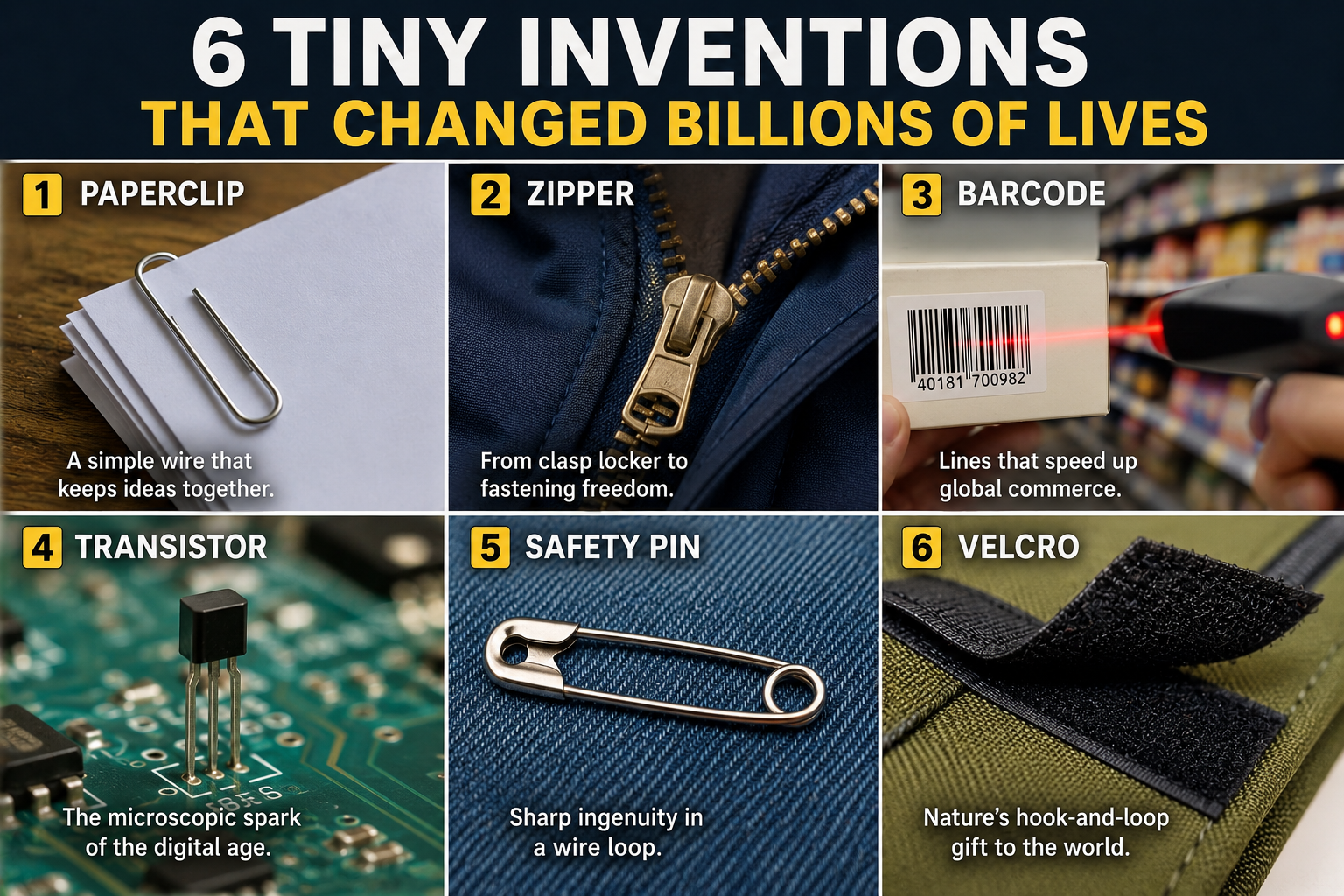
Yet, some of the most profound revolutions in human civilization cannot be seen from space. They sit quietly in our pockets, on our desks, sewn into our clothing, or embedded deep inside our electronics. History teaches us that size has very little to do with impact. Here is a look at the tiny inventions that changed billions of lives and quietly built the modern world.
1. The Paperclip: Simple Wire That Organized Human Thought
Before the late 19th century, keeping sheets of paper together was a clumsy, frustrating endeavor. People used straight pins, which punctured holes through documents, rusted over time, and frequently pricked fingers. Office workers needed a temporary, secure way to bundle papers without damaging them.
While various iterations of wire clips popped up in the late 1800s, the most iconic double-oval design—known as the Gem paperclip—was widely manufactured around 1899. Though it appears to be nothing more than a piece of bent steel wire, it solved a universal administrative bottleneck. During World War II, Norwegian citizens even wore paperclips on their lapels as a silent, unified symbol of resistance against Nazi occupation. It is a masterclass in minimalist design: cheap to produce, infinitely reusable, and entirely indispensable.
2. The Zipper: From "Clasp Locker" to Fastening Freedom
Getting dressed used to be a painfully time-consuming ordeal. High-button shoes, rows of tiny metal corset hooks, and delicate fabric buttons meant that ordinary people spent significant portions of their day fastening and unfastening their garments.
The journey of the zipper took over forty years of trial and error. Originally invented by Whitcomb Judson in 1893 as a "clasp locker" for shoes, it was notoriously unreliable and prone to jamming. It wasn't until Swedish-American electrical engineer Gideon Sundbäck redesigned the mechanism in 1913—increasing the number of fastening elements per inch and adding interlocking teeth—that the modern zipper was born.
Initially adopted by the U.S. Navy for flight suits and money belts during World War I, the zipper eventually revolutionized the fashion industry, replacing buttons on trousers, jackets, luggage, and boots worldwide.
3. The Barcode: Lines That Speed Up Global Commerce
In the mid-20th century, supermarket checkout lines were slow, chaotic nightmares. Cashiers had to manually read price tags and punch individual numbers into cash registers, leading to human error, bloated labor costs, and long customer queues.
The solution was born out of a sandy beach in Miami in 1948, when engineering graduate student Norman Joseph Woodland traced Morse code lines in the sand, expanding them downward to create a series of thick and thin stripes. Patented in 1952, the barcode sat waiting for decades until laser technology caught up with the concept.
On June 26, 1974, a pack of Wrigley's Juicy Fruit chewing gum scanned at a supermarket checkout in Troy, Ohio, becoming the first commercial product ever scanned with a barcode. Today, billions of products are scanned every single day, powering global supply chains, inventory management, and fast retail transactions.
4. The Transistor: The Microscopic Spark of the Digital Age
If you stripped away every single transistor from modern electronics, global civilization would screech to a halt within seconds. Smartphones, computers, medical equipment, traffic lights, and power grids all rely entirely on this microscopic invention.
Before December 1947, electronic devices relied on bulky, fragile, heat-producing vacuum tubes. Researchers John Bardeen, Walter Brattain, and William Shockley at Bell Labs successfully created the first working solid-state transistor using a tiny crystal of germanium. The transistor acted as a microscopic electronic switch and amplifier with no moving parts.
Its creation allowed engineers to miniaturize circuitry, eventually packing billions of transistors onto silicon computer chips no larger than a fingernail. Without the transistor, the internet, artificial intelligence, and the digital revolution would be physically impossible.
5. The Safety Pin: Sharp Ingenuity in a Wire Loop
It sounds dramatic, but before Walter Hunt invented the safety pin in 1849, fastening fabric securely without poking yourself was a daily hazard. Hunt, a notoriously prolific American mechanic, was deep in debt and urgently needed to pay off a $15 loan.
While twisting a piece of brass wire in his hands to pass the time, he accidentally invented the spring-action coiled loop with a protective clasp guard on the end. The design prevented the sharp point from piercing the user's fingers. Though Hunt quickly sold the patent for a mere $400 to pay off his debt, missing out on millions in future royalties, his tiny piece of twisted wire became a universal household staple.
6. Velcro: Nature’s Hook-and-Loop Gift
Inspired by the persistent burdock burrs that clung stubbornly to his hunting clothes and his dog's fur in the Swiss Alps, George de Mestral spent years examining plant hooks under a microscope. By translating nature's tiny botanical grappling hooks into durable nylon strips, he created Velcro.
While often viewed as a simple convenience for children's sneakers, Velcro became a critical engineering material. It secured artificial hearts during early experimental surgeries, kept equipment anchored inside NASA space shuttles, and revolutionized military tactical gear.
Conclusion: Big Lessons from Small Things
These tiny inventions remind us that innovation does not always require massive industrial budgets or complex engineering complexes. Sometimes, a bent piece of wire, a twist of nylon, or a pattern of black-and-white stripes is all it takes to completely rewrite the way humanity lives, works, and connects.
The next time you zip up your jacket, clip together a stack of papers, or scan an item at the grocery store, take a moment to appreciate the microscopic genius hiding in plain sight.