





Introduction
Artificial intelligence is no longer a technology reserved for large corporations with massive budgets. In 2026, AI has become one of the most accessible and valuable business tools available to small businesses. Whether you run an online store, local service company, marketing agency, restaurant, consultancy, or startup, AI can help you save time, reduce costs, improve customer experiences, and ultimately increase profits.
The biggest misconception about AI is that businesses need to completely transform themselves into technology companies. In reality, successful businesses are not replacing people with AI—they are using AI to make people more productive. The goal is to become an AI-enabled business, where intelligent tools handle repetitive tasks while employees focus on creativity, customer relationships, strategic planning, and business growth.
Small businesses often face limited budgets, smaller teams, and increasing competition. Every hour spent on manual administrative work is an hour that cannot be invested in serving customers or generating revenue. AI changes this equation by automating routine processes, improving marketing performance, providing valuable business insights, and allowing companies to scale without dramatically increasing operating costs.
Today’s AI tools are easier to use than ever before. Most require no programming knowledge and integrate seamlessly with popular business platforms such as Google Workspace, Microsoft 365, Shopify, Canva, QuickBooks, Slack, and customer relationship management systems.
This article explores how artificial intelligence is transforming small businesses in 2026 and provides practical strategies that entrepreneurs can implement immediately to improve efficiency, profitability, and long-term growth.
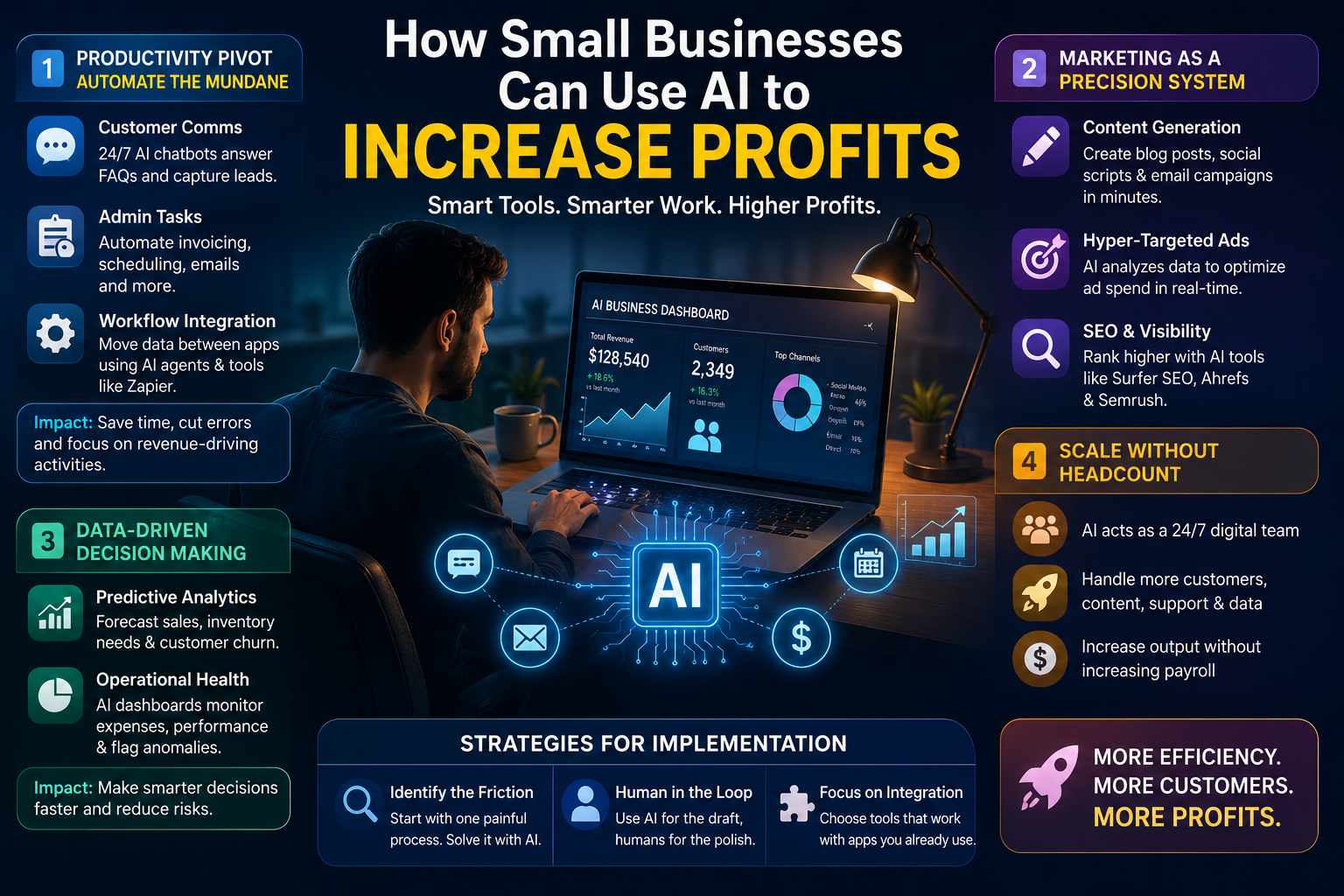
1. The Productivity Revolution: Automating Everyday Business Tasks
One of the biggest challenges facing small business owners is administrative overload. Managing emails, invoices, appointments, customer inquiries, scheduling, documentation, and data entry consumes valuable time every day.
Artificial intelligence is solving this problem by automating repetitive tasks that previously required constant manual attention.
Instead of answering the same customer questions repeatedly, AI-powered chatbots provide instant responses twenty-four hours a day. They answer frequently asked questions, collect customer information, recommend products, schedule appointments, and even qualify potential leads before a human representative becomes involved.
This ensures that businesses never miss opportunities simply because employees are unavailable outside normal working hours.
Administrative automation has also improved significantly.
AI now organizes email inboxes by priority, drafts professional replies, categorizes incoming messages, summarizes lengthy conversations, schedules meetings automatically, and reminds employees about important deadlines.
Accounting software powered by AI can generate invoices, process receipts, categorize expenses, monitor cash flow, and prepare financial reports with minimal human input.
Businesses using workflow automation platforms can connect multiple applications together.
For example, when a customer submits an online form, AI can automatically create a CRM contact, send a welcome email, notify the sales team, schedule a follow-up task, and update internal databases—all without manual intervention.
Removing repetitive “copy-and-paste” work allows employees to spend more time solving customer problems, improving products, and developing new business opportunities.
Productivity improvements often translate directly into increased profitability because businesses accomplish more without increasing staffing costs.
2. AI-Powered Marketing: Smarter Campaigns, Better Results
Marketing has become one of the areas where artificial intelligence delivers the fastest return on investment.
Traditional marketing often relied on trial and error. Businesses launched campaigns, waited for results, analyzed performance, and then made adjustments.
AI has transformed this process into a continuous system of optimization driven by real-time data.
Content creation has become dramatically faster.
AI writing assistants help businesses create blog articles, product descriptions, newsletters, advertising copy, social media captions, email campaigns, landing pages, and promotional materials within minutes.
Rather than replacing human creativity, AI provides high-quality first drafts that marketers refine according to brand voice and business objectives.
This allows small teams to publish content more consistently without sacrificing quality.
Visual content creation has also accelerated.
Modern AI design tools generate social media graphics, advertisements, presentations, videos, product mockups, and promotional materials without requiring advanced graphic design expertise.
Businesses maintain professional branding while reducing production costs.
Advertising has become increasingly precise.
Artificial intelligence analyzes customer behavior, purchasing patterns, demographics, browsing activity, and engagement history to identify audiences most likely to convert.
Advertising budgets are automatically optimized by shifting spending toward high-performing campaigns while reducing investment in underperforming advertisements.
Email marketing benefits from AI personalization.
Instead of sending identical messages to every customer, AI creates personalized recommendations based on browsing history, previous purchases, interests, and customer behavior.
Personalized marketing consistently produces higher engagement, increased conversions, and stronger customer loyalty.
Small businesses no longer compete simply through larger marketing budgets.
Instead, they compete through smarter use of data and automation.
3. Search Engine Optimization Made Simpler with AI
Ranking on search engines remains one of the most effective ways to attract new customers.
However, SEO has traditionally required extensive keyword research, competitor analysis, content planning, and technical optimization.
Artificial intelligence has dramatically simplified these tasks.
AI-powered SEO platforms analyze competitor websites, identify valuable keyword opportunities, recommend content improvements, monitor ranking performance, and detect technical issues affecting website visibility.
Instead of guessing what customers are searching for, businesses receive data-driven recommendations based on current search behavior.
AI also helps optimize content structure.
It suggests better headlines, improved readability, semantic keywords, internal linking opportunities, and frequently asked questions that increase search visibility.
Content optimization becomes significantly faster while maintaining high quality.
Businesses consistently publishing AI-assisted, well-optimized content improve organic traffic, reduce dependence on paid advertising, and generate long-term customer acquisition at lower costs.
SEO has become less about technical complexity and more about delivering valuable content supported by intelligent optimization.
4. Making Better Business Decisions Through Data
Modern businesses generate enormous amounts of information every day.
Sales reports, customer interactions, website traffic, inventory levels, advertising performance, financial transactions, and operational metrics all produce valuable insights.
The challenge has always been turning this raw information into meaningful business decisions.
Artificial intelligence solves this challenge through advanced analytics.
Instead of manually reviewing spreadsheets, business owners receive clear dashboards highlighting trends, opportunities, and potential risks.
Predictive analytics represents one of AI’s most powerful capabilities.
Rather than simply reporting past performance, AI forecasts future outcomes.
Businesses can predict inventory requirements, estimate seasonal demand, identify declining customer engagement, forecast revenue, anticipate supply chain challenges, and recognize operational bottlenecks before they become major problems.
Customer retention also improves through predictive analysis.
AI identifies customers likely to stop purchasing based on behavioral patterns.
Businesses can then intervene with personalized offers, improved customer support, or loyalty incentives before losing valuable relationships.
Financial monitoring has become increasingly intelligent.
AI-powered financial assistants monitor expenses, identify unusual spending patterns, forecast cash flow, calculate profitability, and recommend budgeting improvements.
Business owners gain greater financial visibility without needing advanced accounting expertise.
Data-driven decision-making reduces uncertainty while improving strategic planning across every department.
5. Scaling Your Business Without Hiring More Employees
One of the greatest advantages of artificial intelligence is its ability to help businesses grow without proportionally increasing payroll expenses.
Traditionally, higher sales required additional customer support representatives, administrative staff, marketing specialists, and operations personnel.
AI changes this model.
Digital assistants now perform many routine responsibilities around the clock.
Customer inquiries receive immediate responses.
Appointments schedule automatically.
Invoices generate instantly.
Marketing campaigns launch continuously.
Reports update in real time.
Documents organize themselves.
Content is produced faster.
Lead follow-ups happen automatically.
This allows businesses to handle significantly larger workloads using the same number of employees.
Rather than replacing workers, AI enhances their productivity.
Employees spend less time on repetitive administration and more time building customer relationships, improving products, solving complex challenges, and creating strategic value.
Lean startups can now operate with efficiency levels previously achievable only by much larger organizations.
Scaling becomes more sustainable because operating costs increase much more slowly than revenue.
For growing businesses, this creates stronger profit margins and healthier long-term financial performance.
6. Practical Strategies for Implementing AI Successfully
Many businesses make the mistake of attempting complete digital transformation overnight.
Successful AI adoption follows a much simpler approach.
Begin by identifying your biggest operational bottleneck.
Ask yourself which daily activity consumes the most time while contributing the least value.
Perhaps employees spend hours answering repetitive emails.
Maybe appointment scheduling creates unnecessary delays.
Possibly manual invoice processing slows financial operations.
Select one problem and solve it first.
Once that process becomes automated successfully, identify the next improvement opportunity.
Gradual implementation reduces disruption while allowing employees to adapt comfortably.
Employee training is equally important.
AI tools are most effective when staff understand their capabilities and limitations.
Providing practical training increases confidence, encourages adoption, and maximizes return on investment.
Businesses should also establish clear goals before implementing AI.
Examples include reducing customer response times, increasing marketing productivity, lowering operational costs, improving customer satisfaction, or generating additional sales.
Measuring progress against these objectives helps determine whether AI investments produce meaningful business value.
7. Keeping Humans in the Loop
Although AI has become remarkably capable, human expertise remains essential.
Artificial intelligence excels at generating ideas, organizing information, recognizing patterns, and automating repetitive work.
However, it cannot fully replace human creativity, emotional intelligence, ethical judgment, leadership, or relationship-building.
Successful businesses use AI as an assistant rather than a decision-maker.
Marketing copy generated by AI should be reviewed for accuracy and brand consistency.
Financial recommendations require human oversight.
Customer conversations sometimes need empathy beyond automated responses.
Legal documents should always receive professional review.
Human expertise provides the creativity, context, and strategic thinking that AI cannot replicate.
This partnership between intelligent software and experienced professionals consistently produces the strongest business outcomes.
8. Choosing AI Tools That Integrate with Your Existing Business
The most valuable AI solutions are often those that integrate seamlessly into software businesses already use.
Instead of creating disconnected systems, integrated AI improves existing workflows.
Google Workspace users benefit from AI-assisted document creation, meeting summaries, and email drafting.
Microsoft 365 incorporates AI throughout Word, Excel, Outlook, and Teams.
Canva simplifies visual content production.
QuickBooks automates accounting processes.
CRM platforms increasingly include intelligent customer insights.
Workflow automation connects applications together so information flows automatically between departments.
Businesses should prioritize compatibility over novelty.
Choosing tools that fit naturally into current operations minimizes learning curves while maximizing productivity improvements.
The goal is creating one connected digital ecosystem rather than managing dozens of unrelated applications.
The Future of AI for Small Businesses
Artificial intelligence will continue evolving rapidly throughout the remainder of the decade.
Future systems will become more personalized, proactive, and capable of completing increasingly complex business tasks.
AI agents will coordinate projects across departments.
Customer support will become even more conversational.
Financial forecasting will become increasingly accurate.
Marketing personalization will reach unprecedented levels.
Business owners will receive strategic recommendations before problems arise rather than after they occur.
Companies embracing AI today will be better positioned to adapt as these capabilities continue expanding.
The businesses that delay adoption risk falling behind competitors that operate more efficiently and serve customers more effectively.
Final Thoughts
Artificial intelligence has become one of the most important competitive advantages available to small businesses in 2026.
The objective is not to replace employees or transform into a technology company. Instead, it is to empower teams with intelligent tools that automate repetitive work, improve marketing performance, strengthen customer relationships, and support better decision-making.
By automating administrative tasks, optimizing marketing campaigns, improving SEO, analyzing business data, scaling operations without excessive hiring, and integrating AI into existing workflows, small businesses can achieve remarkable productivity gains while increasing profitability.
The most successful entrepreneurs understand that AI is not a replacement for human talent—it is a force multiplier.
Businesses that combine intelligent automation with human creativity, leadership, and customer service will be best positioned for sustainable growth in the years ahead.
The future belongs to businesses that embrace AI strategically, implement it thoughtfully, and use it to free people to focus on what humans do best: innovate, build relationships, and create lasting value.