





The Voice Revolution: How Real-Time AI Conversations and Specialized Models Are Reshaping the Future of Artificial Intelligence
Introduction
Artificial intelligence has evolved at an extraordinary pace over the past decade, moving from simple automation tools to sophisticated systems capable of understanding language, generating creative content, solving complex problems, and assisting people across countless industries. Yet despite these remarkable advances, one aspect of human-computer interaction has remained noticeably imperfect: natural conversation.
Traditional voice assistants have made digital interactions more convenient, but they still struggle to replicate the fluid rhythm of human dialogue. Conversations often involve noticeable pauses, rigid turn-taking, delayed responses, and an inability to handle interruptions naturally. These limitations remind users that they are speaking to a machine rather than engaging in a genuine conversation.
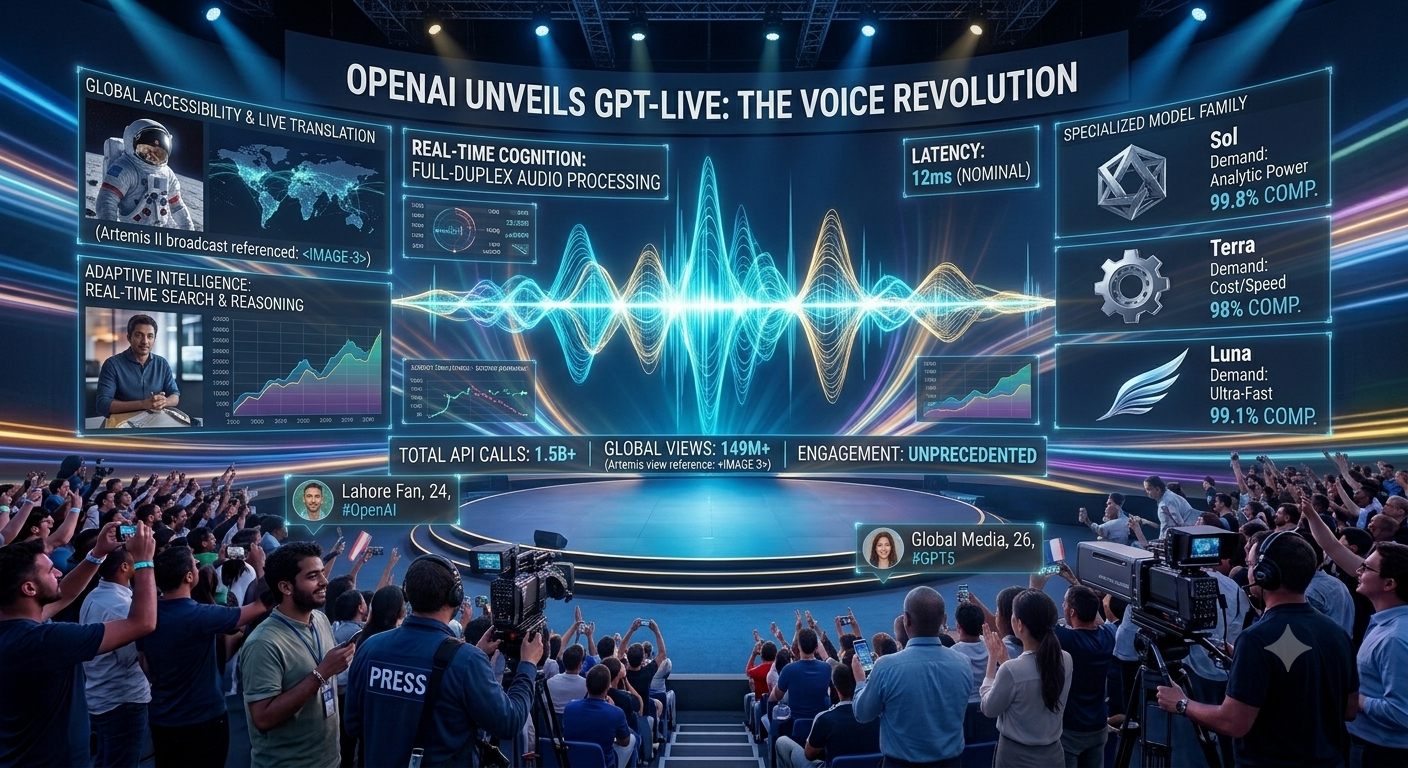
A new generation of voice technology seeks to change that experience entirely. The introduction of GPT-Live represents a significant step toward AI systems that can communicate in a manner much closer to human interaction. Built on a full-duplex voice architecture, the platform is designed to listen, speak, and process information simultaneously instead of treating conversation as a sequence of isolated commands.
At the same time, OpenAI is introducing a broader architectural shift that extends beyond voice technology. Rather than relying exclusively on a single general-purpose model capable of handling every task, the company is moving toward a family of specialized AI models designed for different workloads and performance requirements. This approach reflects an important realization within the AI industry: different problems require different computational strategies, and optimizing models for specific purposes can improve efficiency, reduce costs, and enhance user experiences.
Together, these developments point toward a future where conversations with AI become more natural, responsive, and context-aware while the underlying technology becomes increasingly specialized and efficient. This transformation has implications not only for individual users but also for businesses, developers, educators, researchers, healthcare providers, and organizations that rely on artificial intelligence to power their products and services.
Understanding the Evolution of Voice AI
From Command-Based Systems to Conversational Intelligence
Voice-controlled technology has existed for many years, gradually improving as speech recognition algorithms became more accurate. Early voice assistants primarily functioned as command interpreters. Users had to phrase requests carefully, speak one instruction at a time, and wait for the system to process each request before continuing.
While these systems introduced convenience, they lacked the spontaneity of real conversation. Human dialogue rarely follows a strict pattern where one person speaks, pauses completely, waits for a response, and only then continues. Instead, conversations naturally involve interruptions, clarifications, overlapping speech, changes in tone, and evolving context.
Modern artificial intelligence has significantly improved language understanding, enabling AI systems to generate more coherent and contextually appropriate responses. However, even advanced voice assistants have traditionally relied on half-duplex communication models, where listening and speaking occur separately rather than simultaneously.
This architectural limitation has been one of the biggest barriers preventing AI conversations from feeling genuinely natural.
Introducing GPT-Live
A New Era of Real-Time Communication
GPT-Live represents an effort to close the gap between machine communication and natural human conversation. Instead of treating each spoken sentence as a separate request requiring complete processing before responding, the platform continuously processes incoming audio while simultaneously generating responses.
This capability creates a far smoother conversational experience that more closely resembles interactions between people.
Rather than waiting for complete silence before speaking, GPT-Live can understand evolving conversations as they happen. It can recognize when users interrupt, modify requests midway through a sentence, or change topics naturally.
The result is a conversation that feels less mechanical and considerably more fluid.
Although this represents a technical advancement, its importance extends beyond engineering. More natural conversations reduce friction, making AI more accessible to users who may not be comfortable issuing rigid voice commands or navigating complicated interfaces.
Understanding Full-Duplex Voice Architecture
What Does Full-Duplex Mean?
Traditional communication systems often rely on half-duplex communication, where only one participant speaks at a time.
Walkie-talkies provide a familiar example. One person speaks while the other listens. Communication switches back and forth rather than occurring simultaneously.
Human conversations operate very differently.
People often:
- Briefly interrupt each other
- Respond with acknowledgments while listening
- Correct themselves mid-sentence
- Change topics naturally
- Finish each other's thoughts
- React emotionally before a sentence is complete
Full-duplex architecture enables AI systems to participate in conversations that better reflect these natural communication patterns.
Instead of alternating between listening and speaking, GPT-Live continuously performs multiple processes simultaneously:
- Receiving audio input
- Understanding speech
- Tracking conversational context
- Generating responses
- Speaking naturally
- Updating reasoning in real time
This parallel processing dramatically reduces conversational latency while making interactions feel significantly more realistic.
Real-Time Audio Processing
Eliminating Artificial Delays
One of the most noticeable characteristics of traditional voice assistants is the delay between user input and system response.
Several separate processes typically occur:
- Record speech.
- Convert speech into text.
- Analyze the request.
- Generate a response.
- Convert text back into speech.
- Deliver the audio.
Although modern systems complete these steps quickly, users often perceive small delays that interrupt conversational flow.
GPT-Live approaches this differently by continuously processing incoming audio streams rather than waiting for complete sentences.
This enables the AI to begin understanding intent almost immediately, reducing waiting times and allowing more responsive interactions.
As a result, conversations become smoother, with fewer awkward pauses that remind users they are communicating with software.
Natural Interruptions and Dynamic Conversations
Responding Like a Human Speaker
Interruptions are a normal part of conversation.
People frequently:
- Clarify themselves.
- Add information before finishing a sentence.
- Correct previous statements.
- Change their minds.
- Ask follow-up questions immediately.
Traditional voice assistants often become confused when interrupted, requiring users to restart commands entirely.
GPT-Live is designed to handle interruptions gracefully.
Instead of treating interruptions as errors, it can adapt to evolving conversations, modifying its reasoning based on new information while maintaining conversational continuity.
This flexibility creates a more intuitive experience, reducing the need for users to carefully structure every request.
Adaptive Tone and Conversational Context
Human communication depends on far more than words alone.
Tone, pacing, emphasis, and context all contribute to meaning.
An effective conversational AI must therefore do more than simply produce grammatically correct sentences. It should also recognize conversational dynamics and adjust its delivery appropriately.
GPT-Live introduces the ability to adapt its speaking style during conversations.
Rather than maintaining a single rigid speaking pattern, the system can modify pacing, emphasis, and conversational tone depending on the context of the discussion.
While maintaining consistency and clarity, this adaptability contributes to interactions that feel more comfortable and engaging across different situations.
Live Translation in Real Time
Breaking Language Barriers
Language differences remain one of the largest obstacles to global communication.
Real-time translation has improved dramatically through advances in AI, but many systems still introduce delays or require users to alternate between speaking and waiting.
GPT-Live incorporates live translation capabilities directly into conversations.
Instead of functioning as a separate translation tool, the technology allows multilingual communication to become part of the conversation itself.
This capability has broad applications across:
- International business meetings
- Travel
- Customer support
- Education
- Healthcare communication
- Cross-border collaboration
- Global research projects
Reducing language barriers can help individuals and organizations communicate more efficiently while preserving conversational flow.
Instant Web Search Integration
Modern conversations often involve questions that require up-to-date information.
Whether discussing current events, product availability, technical documentation, or newly published research, access to recent information significantly expands an AI assistant's usefulness.
GPT-Live integrates instant web search capabilities into voice interactions, allowing conversations to incorporate current information when appropriate.
Rather than requiring users to leave the conversation to perform separate searches, relevant information can be incorporated into the ongoing dialogue, making interactions more seamless and productive.
The Shift Toward Specialized AI Models
Moving Beyond One General-Purpose System
Voice technology is only one aspect of OpenAI's evolving strategy.
Another major development is the transition from relying solely on a single large general-purpose model to introducing a family of specialized models designed for different computational needs.
This reflects a broader trend within artificial intelligence.
Although large universal models are highly capable, they are not always the most efficient solution for every task.
Different workloads have different requirements.
Some tasks demand extensive reasoning.
Others require immediate responses.
Still others prioritize lower operational costs or efficient deployment on resource-constrained devices.
Rather than optimizing one model for every possible scenario, specialized models allow developers to choose the most appropriate tool for each application.
The GPT-5.6 Family
A Tiered Model Architecture
The GPT-5.6 family introduces three distinct models, each designed with a different balance of reasoning capability, computational efficiency, and responsiveness.
Sol
Sol serves as the flagship model within the family.
It is intended for highly demanding analytical workloads involving complex reasoning, mathematics, structured problem-solving, and tasks requiring deeper computational resources.
Applications may include advanced research assistance, scientific analysis, software engineering support, financial modeling, and complex decision-support systems.
Terra
Terra focuses on balancing capability with efficiency.
Many organizations require strong reasoning performance without incurring the highest computational costs.
Terra is designed to provide that balance, making it suitable for enterprise applications, productivity software, business automation, customer service systems, and a wide variety of commercial workloads.
For many developers, this balance between performance and cost may represent the most practical option for production environments.
Luna
Luna emphasizes speed and lightweight deployment.
Not every interaction requires deep reasoning.
Simple questions, everyday conversations, quick searches, reminders, and routine assistance benefit more from fast responses than maximum computational power.
Luna is designed to deliver those instantaneous interactions while supporting efficient operation, including scenarios where local-device performance is especially valuable.
Why Specialized Models Matter
The introduction of specialized models represents more than a naming convention. It reflects a broader philosophy of optimizing artificial intelligence for specific purposes rather than assuming one model can deliver the best experience in every situation.
For developers, this approach offers greater flexibility when designing applications. A customer support chatbot, for example, may prioritize speed and low operating costs, while a scientific research platform may require extensive reasoning capabilities. By selecting the most appropriate model for each workload, organizations can better align performance with their technical and financial requirements.
This modular strategy also supports scalability. As AI adoption grows across industries, demand will continue to increase for systems that can deliver high performance without unnecessary computational overhead. Specialized models make it easier to allocate resources efficiently, ensuring that complex tasks receive the processing power they need while routine interactions remain fast and cost-effective.
Infrastructure for the Next Generation of AI
Behind every conversational AI system lies a sophisticated infrastructure responsible for processing requests, managing computational resources, and delivering responses with minimal delay.
As AI applications become more widespread, infrastructure must evolve to support millions of simultaneous interactions across different devices and use cases. Specialized models contribute to this evolution by enabling more efficient resource allocation. Lightweight models can handle routine requests, while more powerful models are reserved for tasks that genuinely require advanced reasoning.
This layered infrastructure has the potential to improve scalability, reduce latency, and optimize operational costs for organizations deploying AI at large scale. It also opens the door to broader deployment across cloud services, enterprise platforms, and devices with varying hardware capabilities.
Implications for Developers and Businesses
Developers stand to benefit from greater control over how AI is integrated into their products. Rather than relying on a single model for every feature, they can design workflows that route different tasks to models best suited for the job. This flexibility can improve application performance, enhance user experiences, and support more efficient use of computing resources.
For businesses, more responsive voice interfaces and specialized back-end models may streamline customer support, internal collaboration, training, multilingual communication, and workflow automation. Organizations can tailor AI deployments to their operational needs, balancing speed, accuracy, and cost according to the demands of each application.
Challenges and Considerations
Despite these advances, the transition to increasingly conversational AI introduces important considerations. Maintaining privacy, protecting user data, ensuring reliable performance, and preventing misuse remain critical responsibilities. Systems capable of processing continuous audio streams must be designed with robust security measures and transparent controls so users understand when and how their data is handled.
Specialized model ecosystems also require thoughtful orchestration. Determining which model should handle a given task, maintaining consistency across different models, and managing updates over time are engineering challenges that developers and platform providers will continue to address.
The Future of Human–AI Interaction
The convergence of real-time voice communication and specialized AI models suggests a future in which interacting with computers feels less like issuing commands and more like collaborating with an intelligent assistant. As conversational systems become faster, more context-aware, and better adapted to different workloads, AI may increasingly fade into the background, serving as a seamless layer within everyday activities rather than a separate tool that demands constant attention.
Advances in voice technology could make AI more accessible to people of all ages and technical backgrounds, while specialized model architectures may enable more efficient deployment across industries ranging from education and healthcare to finance, engineering, manufacturing, and creative work. The combination of natural interaction and optimized infrastructure has the potential to reshape how individuals and organizations use artificial intelligence in their daily lives.
Conclusion
The introduction of GPT-Live and the move toward a family of specialized AI models represent complementary steps in the ongoing evolution of artificial intelligence. On one hand, real-time voice interaction seeks to make conversations with AI more natural by reducing delays, supporting interruptions, adapting conversational tone, and integrating capabilities such as live translation and web search. On the other, specialized models recognize that no single system is ideally suited to every computational challenge, offering tailored solutions for workloads that prioritize deep reasoning, balanced performance, or rapid responsiveness.
Together, these developments illustrate a broader direction for the AI industry: systems that are not only more capable but also more adaptable, efficient, and aligned with the diverse ways people interact with technology. As research and engineering continue to advance, the combination of conversational interfaces and purpose-built models is likely to play an increasingly important role in shaping the next generation of intelligent applications, making AI more integrated, responsive, and practical across both personal and professional environments.