





Introduction
The FIFA World Cup 2026 Final delivered a defining football moment as Spain finally broke the deadlock against Argentina after a tense tactical battle. Throughout the match, Spain controlled possession, dictated the tempo, and patiently searched for weaknesses in Argentina’s disciplined defensive structure. While Argentina defended courageously and remained dangerous on the counterattack, Spain never abandoned its football philosophy. Instead, it continued building attacks with precision and confidence until the breakthrough finally arrived. The decisive goal not only gave Spain the advantage but also highlighted why tactical discipline, intelligent movement, and patience remain some of the most effective weapons in modern football. It was a goal that reflected months of preparation and an entire tournament built around controlled possession, teamwork, and technical excellence.
The Breakthrough Moment
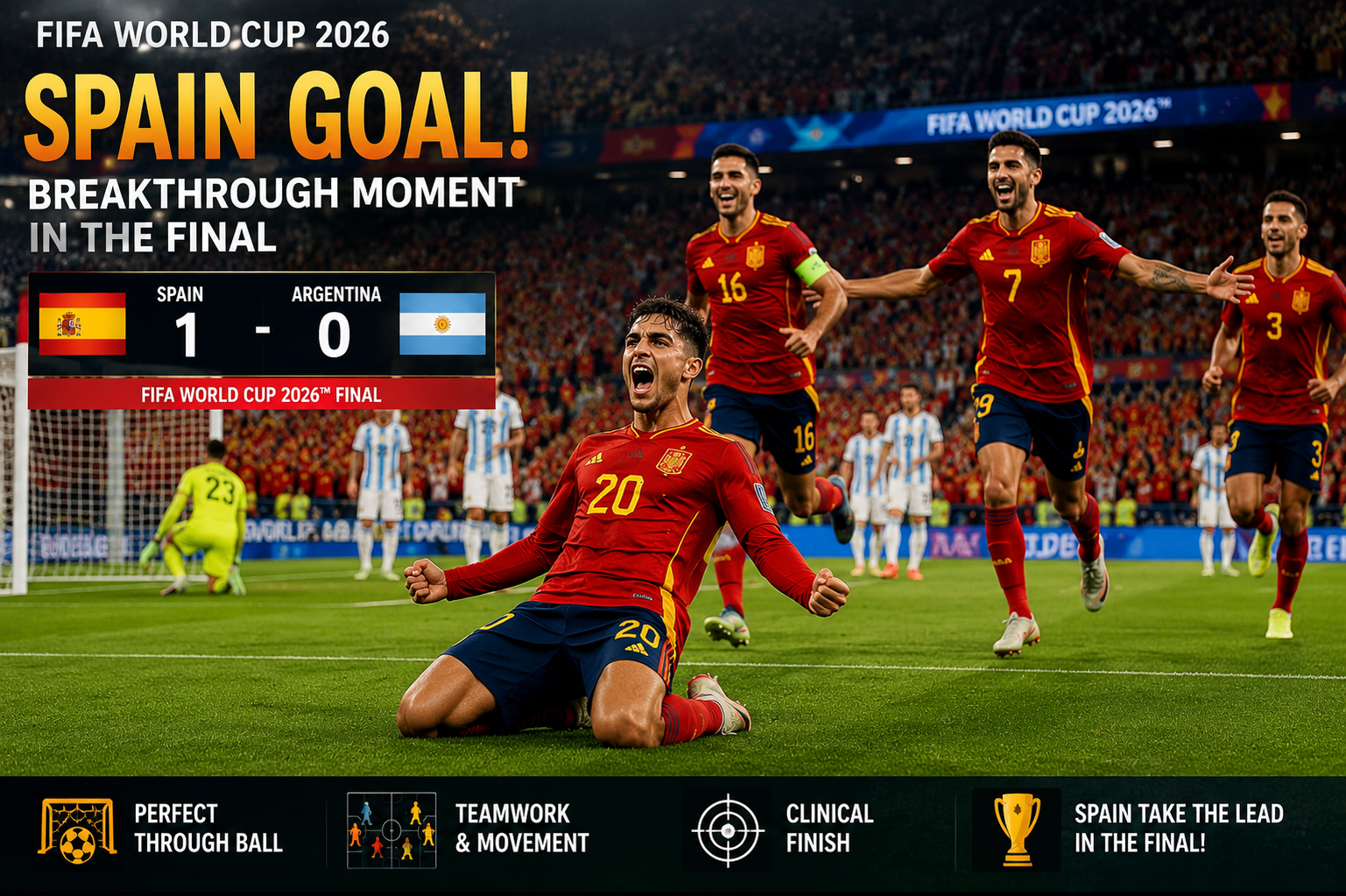
The goal that tilted the balance of the FIFA World Cup 2026 Final perfectly represented Spain’s identity throughout the tournament. Rather than relying on individual brilliance or hopeful long passes, Spain trusted its established system and remained patient even after several earlier opportunities failed to produce a goal.
The attack began deep inside Spain’s own half, where defenders calmly circulated possession before moving the ball into midfield. Short, accurate passes gradually pulled Argentina’s compact defensive shape from side to side, forcing players to leave their original positions. Spain continued recycling possession instead of rushing forward, waiting for the ideal opportunity to attack.
As Argentina’s midfield shifted toward one side of the pitch, a small gap appeared between the defensive and midfield lines. Spain immediately recognized the opening and delivered a perfectly weighted through ball that split Argentina’s defense. Timing was everything. The Spanish forward delayed the run until the last possible moment, avoiding the offside trap before accelerating into the open space.
Receiving the pass in full stride, the attacker showed remarkable composure despite enormous pressure. Instead of rushing the finish, the forward calmly rounded the advancing goalkeeper before placing the ball into the empty net. The stadium erupted with celebration as Spanish players embraced one another, knowing that the breakthrough had finally arrived after more than an hour of relentless pressure.
The goal immediately changed the atmosphere of the final, rewarding Spain’s patience while placing Argentina under enormous pressure during the closing stages.
Creating the Overload
One of Spain’s biggest tactical strengths throughout the tournament has been its ability to create numerical superiority in different areas of the pitch. This strategy once again proved decisive in the final.
Throughout the first half, Spain repeatedly attacked through both flanks. The wide players remained close to the touchline, stretching Argentina’s defensive line and forcing the full-backs to defend larger areas. Meanwhile, the midfield constantly rotated positions, creating additional passing options and making it difficult for Argentina to track runners.
By continuously switching play from one side of the pitch to the other, Spain gradually tired Argentina’s midfield and defensive units. Every change of direction forced defenders to adjust their positioning, creating small gaps that became increasingly difficult to close.
Eventually, this constant movement created the opening Spain had been waiting for. As Argentina shifted toward the ball, the opposite side briefly became exposed. Spain immediately exploited the space through quick passing and intelligent movement, leading directly to the decisive goal.
This attacking pattern demonstrated why Spain remains one of the world’s best possession-based teams. Rather than forcing opportunities, they patiently manipulate defensive structures until spaces naturally appear.
Defensive Discipline
Although Spain will be remembered for scoring the winning goal, their defensive organization played an equally important role in the victory.
Immediately after losing possession, Spain activated an aggressive counter-press designed to recover the ball within seconds. Instead of retreating into a defensive shape, nearby players immediately surrounded the ball carrier, limiting passing options and forcing mistakes.
This approach prevented Argentina from launching dangerous counter-attacks throughout much of the match. Every successful recovery allowed Spain to begin another attacking sequence while maintaining complete territorial control.
Spain also maintained an organized defensive line, ensuring that the distance between defenders and midfielders remained compact. This reduced the space available for Argentina’s forwards and forced them into difficult attacking situations.
The team’s defensive discipline meant that even while committing large numbers forward, they rarely became vulnerable at the back. Every player understood their responsibilities, making Spain extremely difficult to break down despite adopting an attacking approach.
The “De la Fuente” Philosophy
Spain’s success in the final reflected the football philosophy developed by head coach Luis de la Fuente throughout the tournament.
His approach emphasizes controlled possession rather than possession for its own sake. Every pass has a purpose. Every movement is designed to create better positioning, numerical advantages, and improved passing angles.
Players are encouraged to remain calm under pressure, recycle possession whenever necessary, and avoid unnecessary risks. Rather than forcing attacks through crowded central areas, Spain patiently moves opponents out of position before accelerating into the available space.
This philosophy requires exceptional technical quality and complete trust between teammates. Throughout the tournament, Spain demonstrated outstanding confidence in its system regardless of the scoreline.
The winning goal perfectly illustrated this tactical identity. It was not created by luck or individual improvisation but by dozens of intelligent passes that gradually exhausted Argentina’s defensive organization.
Instead of abandoning their principles after earlier chances were missed, Spain continued executing the same strategy until it finally produced the breakthrough.
Argentina’s Defensive Resistance
Argentina deserves enormous credit for producing one of the tournament’s strongest defensive performances.
Despite facing constant pressure, the defending champions remained disciplined for long periods, protecting central areas while forcing Spain toward wider positions. Every defender displayed outstanding concentration, communication, and tactical awareness.
The midfield also contributed significantly by tracking runners, closing passing lanes, and supporting the back line whenever Spain attempted to attack through the middle.
Even after facing continuous waves of Spanish attacks, Argentina refused to panic. Their compact defensive shape frustrated Spain and prevented numerous dangerous opportunities.
However, defending against sustained pressure for such a long period eventually became physically and mentally exhausting. Small positional errors gradually appeared as fatigue increased, allowing Spain to exploit the decisive opening.
Although Argentina ultimately conceded, their defensive resilience remained one of the defining features of the final.
Post-Match Impact
Spain’s winning goal represented much more than a single successful attack. It became the ultimate validation of the team’s football philosophy throughout the FIFA World Cup 2026.
During earlier stages of the tournament, some critics argued that Spain’s possession-heavy style lacked urgency and directness. Others believed the team should rely more frequently on long passes and quick transitions instead of patiently building attacks.
The final provided the perfect answer to those criticisms.
Spain proved that patience, technical quality, and tactical intelligence remain capable of defeating even the strongest defensive opponents. Rather than becoming frustrated, the players trusted their preparation and continued following the manager’s instructions until the decisive opportunity arrived.
The victory also demonstrated the importance of teamwork over individual brilliance. Every player contributed to the build-up, movement, pressing, and defensive organization that ultimately produced the winning goal.
For Argentina, the defeat highlighted the incredibly fine margins that define World Cup finals. One brief lapse in concentration after more than an hour of disciplined defending proved enough to decide football’s biggest prize.
Final Thoughts
Spain’s breakthrough goal in the FIFA World Cup 2026 Final will be remembered as one of the tournament’s defining moments. It perfectly captured everything that made Spain successful throughout the competition: patience, precision, tactical discipline, and complete belief in its football philosophy.
Rather than relying on moments of luck, Spain earned the decisive goal through intelligent movement, relentless pressure, and outstanding teamwork. Every pass, every run, and every tactical adjustment contributed to a move that ultimately delivered football’s greatest prize.
The final served as a reminder that modern football is not simply about individual talent but also about preparation, strategy, and collective understanding. Spain demonstrated that when a team remains committed to its principles under pressure, success often follows.
As football fans look back on the FIFA World Cup 2026, Spain’s decisive goal will stand as a symbol of tactical excellence and a fitting conclusion to one of the most memorable tournaments in World Cup history.